The Other Kitchens
Finding Other Ways to Work, Learn, and Stay in Cooking
There was a period in Amsterdam when I began questioning not whether I wanted to cook, but where I wanted to cook. That distinction took me some time to understand.
I had been working in a Michelin-starred kitchen that, from the outside, represented exactly the kind of place a young cook might want on a curriculum. The standards were high, the food was serious, and I was certainly learning. But I was not happy there. I did not look forward to going to work, and I often had the feeling that whatever I was doing was somehow not enough. The expectation was always somewhere ahead of me, but I could not quite understand what that expectation was.
That experience felt particularly strange because I had come from another Michelin-starred kitchen where the atmosphere had been completely different. There, the pressure was also real, but the kitchen felt like a team. There was a chef leading us, of course, but responsibility seemed to circulate through everyone. We depended on one another, and there was a sense that each person had to bring something extra because the whole service depended on it. Nobody needed to constantly tell us that.
The second kitchen felt more like a staff. There were tasks, standards, pressure, and the persistent feeling that we were not reaching some invisible level. But if you do not understand clearly what that level is, it becomes very difficult to improve toward it. After some time, I started feeling not only frustrated with myself, but disconnected from the restaurant, the group, and eventually even the food. That was an important realization. Sometimes a good restaurant is simply not your restaurant.
Not Every Good Kitchen Is a Good Fit
There can be a tendency in cooking to believe that if an opportunity is prestigious, demanding, or technically strong, we should automatically feel fortunate to be there. If we are unhappy, perhaps we assume that the problem is us. We are not strong enough, disciplined enough, committed enough, or willing enough to suffer. But fit matters.
That does not mean every uncomfortable moment is a sign that we should leave. Kitchens are difficult places. We will be challenged, corrected, exhausted, and occasionally frustrated wherever we work. But there is a difference between being challenged inside an environment where we are growing and being slowly depleted by one in which we never quite find our place.
I think we have to be able to ask ourselves some simple questions from time to time. How do I feel when I go to work? Am I learning? Do I understand what is expected from me? Do I trust the people around me? Do I feel they have my back, and do they know I have theirs? Is the food still interesting to me? Can I imagine becoming better by staying here?
Those questions are not about making ourselves victims of a difficult environment. They are about paying attention before dissatisfaction becomes something more serious. One person cannot fit everywhere, and once we accept that, leaving one kind of kitchen does not have to mean leaving cooking.
Trying Other Kitchens
After I left that restaurant, I began looking around more deliberately. At that time in Amsterdam, it was still quite common to walk into a restaurant and ask whether you could come for a trial shift. A chef might tell you to come that afternoon, the next day, or later in the week. You would work a shift, help the kitchen, get paid an agreed amount, and both sides would have a chance to see whether there was a match.
I did quite a few of those. Some kitchens were larger, some smaller, some more formal, some much more relaxed. The experience itself became useful because I started noticing how differently kitchens could operate. The food might be serious in two places, but the rhythms, expectations, hierarchy, personalities, and sense of teamwork could be completely different. Eventually, through one of those connections, I found a job in a hotel kitchen, and that opened another world.
Working in a hotel immediately changed the rhythm of the job because there was no single service defining the kitchen. We had the hotel restaurant, room service, breakfast, events, staff meals, and all the other demands that appear inside a property where food has to function throughout the day. I moved between roles. Some days I was responsible for breakfast. Other days I was working restaurant service. Sometimes I prepared staff meals. When the chef was away, I could become the person responsible for the kitchen for several days, and then return to a sous-chef role when the chef came back.
The hotel also worked with many interns, which meant teaching became part of the job. Suddenly, I was not only responsible for producing food but for explaining things to someone else, checking their work, helping them understand a technique, and making sure they could eventually operate with more independence. The work was constantly moving, and that suited me at the time because it expanded what I thought kitchen work could be.
I was still cooking professionally, but the work was no longer defined by one line, one menu, and one dinner service. I was learning about organization, training, events, breakfast production, staff food, room service, and responsibility from several different angles. It made the profession feel larger.
Kitchens That Barely Looked Like Kitchens
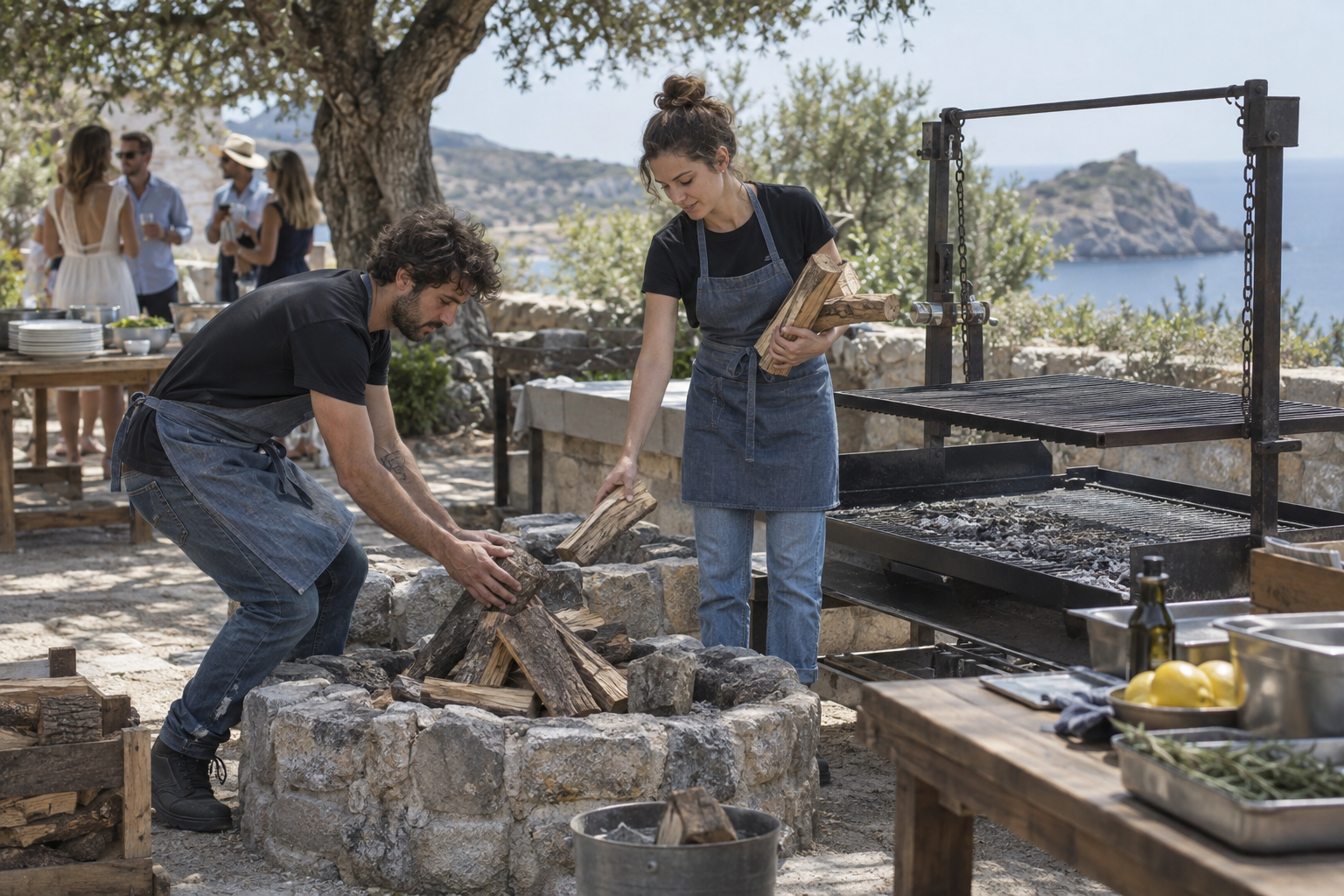
Later, I worked in catering, and the idea of the kitchen expanded again. Sometimes the food was prepared in a production kitchen and sent out. Other times, we arrived somewhere with equipment and effectively constructed a temporary kitchen for the event. It might be a wedding, a private home, an outdoor location, or somewhere that had never been designed for professional cooking.
Everything had to be anticipated differently. You could not simply walk back into the refrigerator because you had forgotten something. Equipment had to travel. Food had to survive transport. Timing had to account for distance. The service might happen in a garden, a tent, a house, or in the middle of nowhere.
The cooking itself was only one part of the operation. That kind of work teaches another form of discipline because you begin thinking much more seriously about logistics, contingency, transport, holding, equipment, and what absolutely needs to happen before you leave the production kitchen. It also changes the rhythm of life. Catering is not restaurant service. The hours move differently, the peaks are different, and the pressure arrives in another form. Again, it was still cooking. It was simply another kitchen.
Teaching, Private Dinners, and Development Work
At another point, I began doing cooking demonstrations for students. I would develop a menu, prepare it in front of people, explain what I was doing, and turn the process of cooking into something visible enough that someone else could learn from it.
That demanded a completely different kind of attention. Knowing how to do something and knowing how to explain it are not the same skill. Teaching forced me to articulate decisions that, inside a restaurant kitchen, might have remained instinctive. Why am I doing this first? What should they be looking for here? How do I know this is ready? What happens if we change this step? That kind of work made me understand my own cooking differently.
Private dinners created another relationship again. I would cook in people's homes for groups of perhaps eight or ten guests, build a menu around their preferences, and have enough freedom to surprise them within the parameters they had given me. I could help shape the beverage choices, prepare the meal, serve it, and go out to the table to explain what I had made.
The distance between the cook and the guest almost disappeared. In a restaurant, we often experience the guest indirectly. In a private dinner, the relationship becomes immediate. You see how people respond. You hear the conversation. You know why the menu was created and for whom.
Years later, cooking led me toward recipe development and product work, and the questions changed again. The goal was not necessarily to make something beautiful for service that evening. A preparation had to become reproducible. It had to be tested, adjusted, documented, and perhaps adapted to a product, production method, packaging requirement, or commercial context. That brought me closer to culinary R&D and formulation. The kitchen became a place to investigate rather than simply produce.
This is one of the reasons I resist the idea that there is one professional path for cooks. The same basic knowledge of ingredients, technique, seasoning, organization, and sensory judgment can move into very different environments. What changes is what the environment asks us to do with those skills.
The Other Kitchens Are Not Escape Routes
There is an important qualification here. I am describing these transitions very quickly, but real life does not happen that cleanly. There were periods of hesitation, uncertainty, other kinds of work, financial considerations, and questions about whether leaving something too early would create another problem later. We have responsibilities. Rent has to be paid. Families depend on us. Sometimes the better professional choice cannot happen immediately.
There is also a point in a career when moving constantly can begin working against us. Early on, spending shorter periods in several kitchens can make sense because we are learning, gathering references, and trying to understand what kind of cook we want to become. Later, if every position on a CV lasts only a few months, an employer may reasonably wonder whether it is worth investing time in training us.
That is why searching for a better fit is not the same as jumping from job to job whenever something becomes difficult. The movement has to be thoughtful. Sometimes the mature decision is to leave. Sometimes it is to stay long enough to learn what the situation still has to teach us. Sometimes we have to acknowledge that a very good opportunity is simply not the opportunity we need.
Geography also changes what is possible. A cook in a large city may have hotels, restaurants, caterers, institutions, private clubs, schools, food companies, event kitchens, corporate dining, product development, teaching, and private-chef work all within reach. Someone living in a smaller or isolated community may have only a handful of professional kitchens nearby.
A job can also look good on paper and become unsustainable because it requires two hours of commuting every day. Another may pay well but demand a rhythm that is physically impossible to maintain for very long. A position may offer prestige but very little room for the kind of development we actually want.
These are not secondary considerations. Our professional life happens inside our actual life.
The Body Is Part of the Career
This becomes particularly important in cooking because the body is one of our primary tools. We stand for long periods. We lift. We bend. We repeat movements. We work with heat, slippery floors, knives, heavy pots, awkward storage, and schedules that can make recovery difficult. Over years, small problems can become large ones if we continuously ignore them.
There is a dangerous kind of pride around pushing through pain. A knee hurts, a shoulder begins failing, a wrist never quite recovers, but service keeps moving and we tell ourselves we will deal with it later. Sometimes later comes after the damage has already become much harder to reverse. Burnout is not only emotional exhaustion. It can also appear physically.
A cook who loves being in kitchens can eventually reach a point where their body no longer permits the work they still want to do. That is why noticing the signs matters. Taking a break, getting something treated, changing the type of kitchen, reducing a particular physical demand, or moving temporarily into another role may protect the possibility of continuing to cook for much longer.
The objective should not be proving how much the body can endure. The objective is being able to keep using it.
There Are More Kitchens Than We Usually Imagine
When cooks begin feeling exhausted by restaurant life, the conversation often becomes too absolute: stay in restaurants or leave cooking. But there is a lot of space between those two choices.
There are hotel kitchens, catering companies, event kitchens, private-chef work, institutional kitchens, schools, corporate dining, recipe development, food brands, test kitchens, cookbook production, culinary media, demonstration work, teaching, consulting, product development, and research kitchens. They are not all easier. They simply ask different things.
A hotel may demand versatility. Catering may demand logistics. A private chef needs adaptability and client management. Teaching requires communication. Product development requires documentation and repeatability. Institutional cooking may require scale, nutrition, and systems. A test kitchen may involve far less service and far more repetition. The important thing is that the skills we develop in one kitchen are often more transferable than we initially imagine.
Looking back, the most useful discovery was not that one kind of kitchen was better than another. It was that I had options. Leaving a restaurant where I did not feel well did not mean that I had failed as a cook. Working in a hotel did not make the work less serious. Catering did not make me less of a chef. Teaching, private dinners, and recipe development each revealed different parts of the same profession. They also revealed different parts of me.
Some environments made me more interested in leadership. Others made me interested in teaching. Some made me pay attention to logistics. Others brought me closer to guests. Development work made me more aware of research, documentation, testing, and repeatability. That accumulation eventually became part of my culinary practice.
Perhaps that is the real value of looking at the other kitchens. We do not only discover other places to work. We discover other ways of being a cook.
The Other Kitchens
Read Next: Kitchen Myth: Why Culinary Excellence Does Not Require Chaos
Read Next: Kitchen Burnout: Strategic Adaptation in the Professional Kitchen