Kitchen Burnout: Strategic Adaptation in the Professional Kitchen
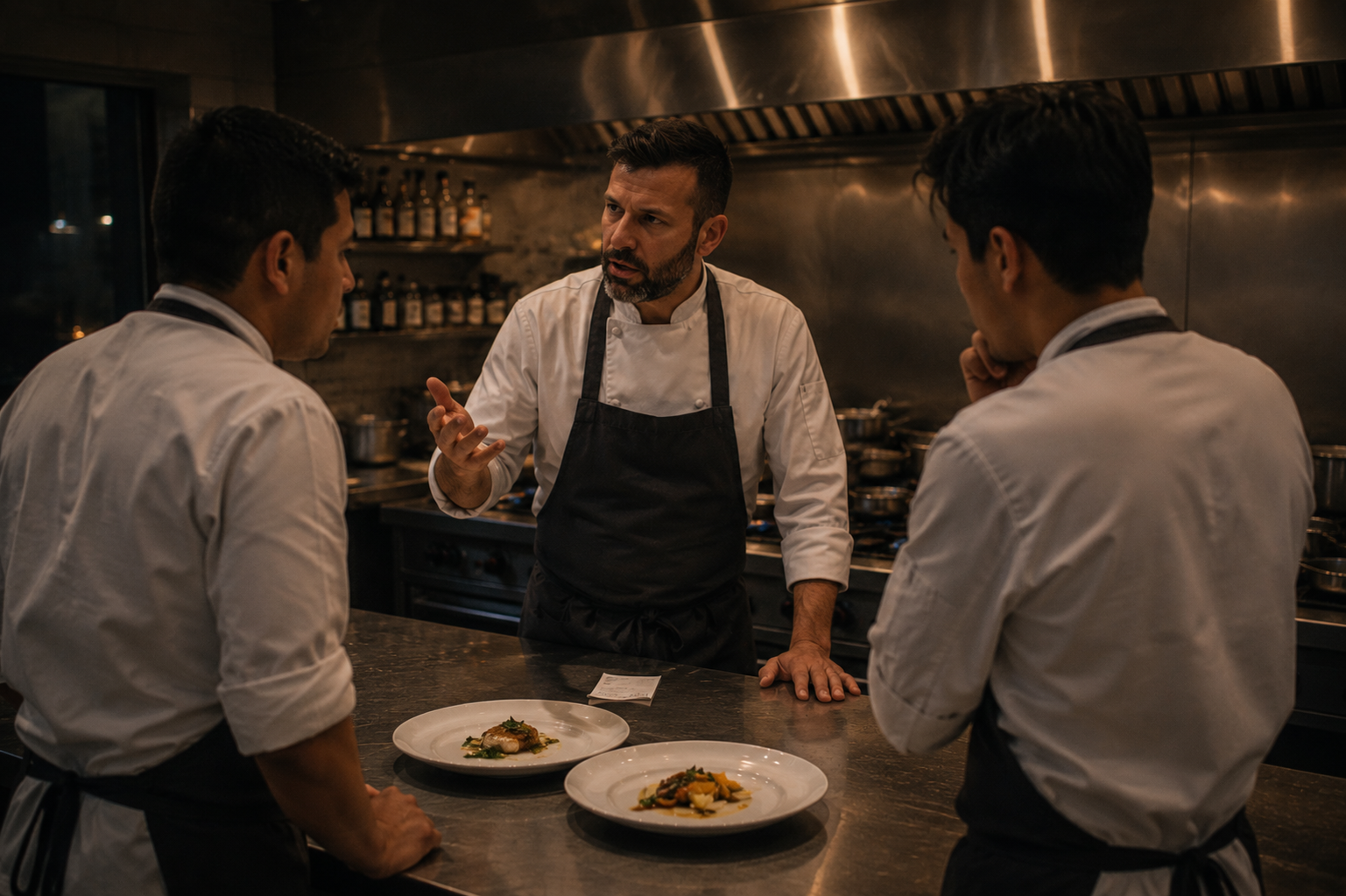
Burnout in the kitchen does not always arrive as a dramatic collapse. Sometimes it arrives quietly. You wake up tired before the day has started. You feel your back before you feel your appetite. Your hands ache. Your knees complain when you go down the stairs. You finish late, sleep badly, wake too soon, and tell yourself this is just what the work requires.
Then, little by little, something else begins to change. The thing you once loved starts to feel heavy. The sound of the printer, the heat of the line, the smell of the fryer, the pressure before service, the repetition of prep, the endless cleaning, the late nights, the early mornings, the extra shifts, the physical pain you keep ignoring. All of it begins to gather in the body. And because kitchens are places where endurance is often admired, many cooks keep going. They keep going because rent has to be paid. Because people depend on them. Because quitting is not a simple option. Because the schedule is already written. Because the team is short. Because someone called in sick. Because they do not want to look weak. Because, at some point, pushing through became part of the identity.
This is one of the difficult truths of professional cooking: the work can give you purpose, pride, skill, and belonging, but it can also consume more than you realized you were giving. Not every kitchen is like this. Not every cook burns out. There are cooks who find good rhythms, good teams, good hours, good positions, and they build long, satisfying careers in the kitchen. They love the work. They know what it asks of them, and they have found a way to meet it without losing themselves completely. But many cooks do not notice the imbalance until they are deep inside it. That is why burnout is worth naming. Not as a complaint. Not as a weakness. Not as a fashionable word. But as a professional reality.
A cook works through the body. This is obvious, but often forgotten. The body stands, lifts, bends, cuts, carries, tastes, remembers, repeats. It works in heat, noise, pressure, speed, humidity, and repetition. It absorbs the rhythm of the kitchen long after service is finished. And the body keeps score. Ignoring it does not make the cost disappear. A sore shoulder becomes a constant shoulder. A tired back becomes a bad back. A bad sleep pattern becomes a life pattern. Small injuries become part of the uniform. Pain becomes normal. Exhaustion becomes personality. Irritability becomes part of the character. Then one day, a cook realizes they no longer recognize their own relationship to the work.
They still know how to cook. They may still be good at it. They may still execute the station, run the prep list, finish the plates, hold the team together. But something has gone quiet. The curiosity is gone. The pleasure is gone. The sense of direction is gone. And this is where the question becomes serious: Is the kitchen destroying you, or is this particular kitchen no longer the right place for you? Those are not the same question. There is a difference between the profession and the environment. There is a difference between cooking and the conditions under which you are asked to cook. A person can love cooking and still be damaged by a specific schedule, a specific leadership style, a specific business model, a specific culture of pressure.
This distinction matters because many cooks, when they burn out, begin to think they are finished with cooking altogether. Sometimes they are not. Sometimes they are finished with that version of cooking. A possible antidote to kitchen burnout begins here: with the ability to look honestly at the conditions of your work. Not romantically. Not dramatically. Honestly. What is this job doing to my body? What is this schedule doing to my life? What is this environment doing to my character? What is this position giving me, and what is it taking away? Is the exchange still fair? These are not easy questions, because cooks carry responsibilities. You cannot always walk away because you are tired. You may have rent, children, debts, family obligations, immigration questions, contracts, business loans, employees, or simply no financial cushion.
Telling a burned-out cook to “just rest” or “just leave” can be insulting when personally you do not have that option. So the antidote cannot be fantasy. It has to be strategic. Sometimes the first move is not quitting. It is observing. You begin to read your own situation with the same seriousness you would bring to a station that is failing. Where is the pressure coming from? Is it the hours? The leadership? The commute? The physical demand? The lack of money? The lack of respect? The lack of growth? The fact that you no longer believe in the food? The fact that you are carrying responsibility without authority? In kitchens problems rarely get solved by emotion alone. They get solved by identifying where the system is breaking.
The same is true for the cook. If the work is breaking you, you have to understand where. This is where skill becomes more than pride. It becomes mobility. The more capable you are, the more options you have. A cook with a wide range of skills can move between environments. Restaurants, hotels, catering, banquets, schools, private households, test kitchens, cafés, production kitchens, bakeries, recipe development, food media, consulting, product work, institutional kitchens. Not every environment asks the same thing from the body. Not every kitchen has the same rhythm. Not every serious cook has to live forever on the most punishing version of the line.
Maybe you need mornings instead of nights. Maybe you need a kitchen with less aggression. Maybe you need a hotel structure instead of an independent restaurant. Maybe you need catering, where the intensity is different. Maybe you need production, where repetition is high but service pressure is lower. Maybe you need to learn pastry, butchery, fermentation, costing, management, recipe testing, or another skill that gives you access to a different kind of position. This is not giving up. This is career intelligence.
Another danger in the cooking profession is that ambition can become confused with suffering. A cook begins in one demanding kitchen, then wants the next more prestigious one, then the next, then the next. The résumé becomes a ladder of difficulty. The names become proof. The pressure becomes identity. For some cooks, that path makes sense. They know what they are trying to learn, what they are willing to pay, and what they expect in return. But not everyone stops to ask that question. What is this path actually giving me? A famous kitchen may give discipline, technique, contacts, and intensity. It may also give exhaustion, low pay, pain, and a distorted idea of what professional seriousness requires. A prestigious restaurant can teach you a great deal, but prestige does not automatically protect your life.
At some point, every cook has to ask what kind of career they are actually building. Not the one that looks impressive from the outside, but the one they can live inside.This is especially difficult for chefs and owners. When it is your business, burnout has another weight. You cannot simply say the kitchen is badly run and leave. You are the one carrying the debt, the payroll, the suppliers, the staff, the guests, the reputation, the broken equipment, the taxes, the reviews, the menu, the decisions. The restaurant may be your dream, but it may also become the machine that consumes you. In that situation, the antidote is rarely one grand solution. It is perspective, then sequence. You step back as much as you can, even if only mentally at first, and ask: what is the first problem that can be reduced? Not solved forever. Reduced.
Is the menu too large? Is prep badly organized? Is one station always collapsing? Is purchasing chaotic? Is the team undertrained? Is the owner doing work that should be delegated? Is the schedule destroying everyone? Is the restaurant trying to be too many things at once? A burned-out chef often sees one giant problem called “the restaurant.” But inside that problem are smaller systems. Menu. Labor. Prep. Service flow. Storage. Leadership. Training. Communication. Costing. Hours. You cannot fix everything at once. But you can begin somewhere. That beginning matters because burnout often comes from the feeling that nothing can change. The smallest intelligent change can restore a sense of agency. And agency is part of the antidote.
The deeper antidote, though, is balance. Not balance as a soft word. Not balance as an aesthetic lifestyle idea. Balance as a hard professional requirement. A cook has a body. A cook has a life. A cook has limits. Those limits are not enemies of the work. They are the conditions that allow the work to continue. If you want to stay in the kitchen for years, you cannot treat yourself as disposable equipment. You have to learn what kind of kitchen you can survive in. More than that, what kind of kitchen allows you to remain alive to do the work.
Because there is a difference between surviving cooking and practicing it with dignity. Sometimes that means changing jobs. Sometimes it means learning new skills. Sometimes it means leaving a toxic environment. Sometimes it means taking a less prestigious position with better hours. Sometimes it means stepping down from a title that is costing too much. Sometimes it means accepting that the path you imagined at twenty no longer fits the person you are becoming at thirty-five, forty, or fifty. That is not failure. That is adaptation. The cook who adapts may last. And lasting matters.
It is worth remembering why you entered the kitchen in the first place. Maybe it was the pleasure of feeding people. Maybe it was the intensity of service. Maybe it was the beauty of ingredients. Maybe it was craft, discipline, community, movement, fire, flavor, the feeling of doing something real with your hands. Burnout does not always erase that origin. Sometimes it buries it. The work becomes so heavy that you forget there was once a spark beneath it. Not a romantic spark. A real one. The first time a dish worked. The first time someone trusted you with a station. The first time you felt useful in service. The first time you understood that cooking could be a life.
A possible antidote to burnout is not pretending the kitchen is easy. It is choosing, with as much clarity as possible, the conditions under which you can continue. This requires honesty. It requires skill. It requires planning. It may require saving money, studying, applying elsewhere, asking for help, changing cities, changing schedules, changing ambitions, or rebuilding your relationship to the profession. It may also require admitting that pain is not proof of devotion. The kitchen will always ask something from you. Time. Energy. Attention. Strength. Discipline. Care. But it should not ask for everything. A good career in cooking is not only about how much you can endure. It is about learning where your endurance should be spent.
A Possible Antidote to Kitchen Burnout