Staff or Team? Why Restaurant Culture Needs a Clear Operating Structure
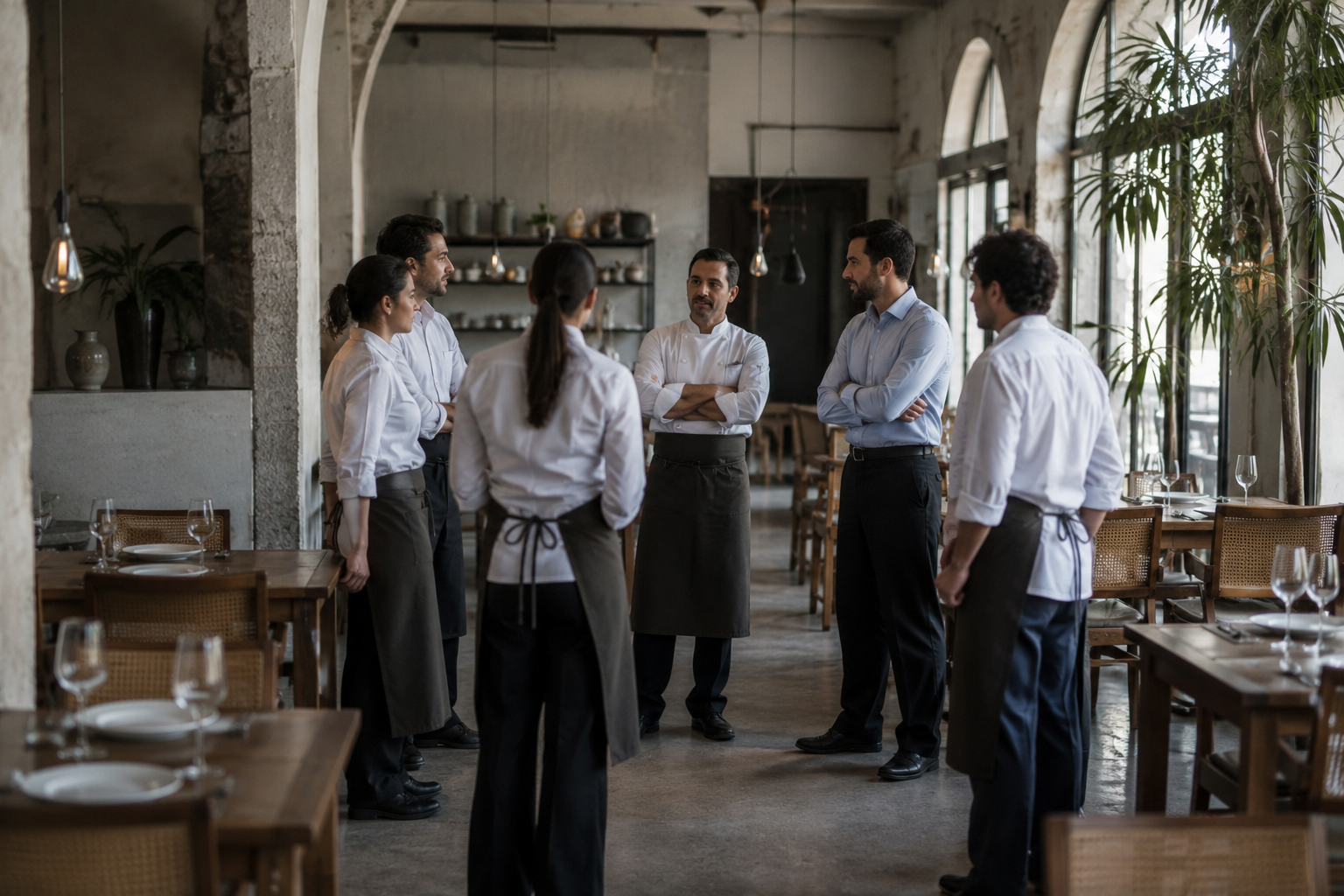
Restaurants have a lot of people working for them. Cooks, servers, dishwashers, bartenders, hosts, managers, porters, pastry cooks, stewards, sommeliers, banquet staff, prep cooks, and supervisors may all be moving through the same operation, but the presence of people does not automatically make a team. Sometimes a restaurant has a staff. Sometimes it has a team. Sometimes it has an unclear mixture of both, and that is where many problems begin.
Hospitality uses the language of teamwork constantly. We say, “We are a team,” “We work together,” or “Everyone gives their best,” but the actual structure may operate very differently. People may be hired for fixed tasks, decisions may come entirely from the top, schedules may define the full extent of commitment, and initiative beyond the assigned role may even be discouraged. None of that is necessarily wrong. It may simply mean the restaurant operates as a staff.
The problem appears when ownership wants the predictability of a staff and the emotional commitment of a team at the same time. The business tells people they are employees but expects them to behave like partners. Or it calls everyone a team while giving no real participation, no shared responsibility, no development, and no structure for trust. The language says one thing, while the operation demands another. That is when frustration begins.
Staff and Team Are Different Agreements
The distinction between staff and team is not a question of which model is morally better. Both can work well. Both can fail badly. The important thing is whether the restaurant understands what it is asking from people and whether the structure supports that expectation. A staff structure can be extremely effective because roles are clearly defined. A cook is responsible for a station, a server for a section, a dishwasher for the dish area, a supervisor for the floor, and a manager for the decisions above that level. The chain of command is visible, people know where their responsibility begins and ends, and the operation moves through defined tasks, rules, procedures, and authority.
Many people prefer this kind of environment. They do not want the job to become their identity or their workplace to become an emotional community. They want to arrive, perform the assigned work well, be paid correctly, understand who is in charge, and leave at the end of the shift with their personal life intact. A person can be an excellent employee without wanting to belong to a mission-driven team culture, and a well-run staff structure respects that. The problem is not having a staff. The problem is pretending that the staff structure is a team.
A team is also a structure, but the agreement is different. People are expected to see beyond the narrow limits of the assigned task. They notice when another station is falling behind, recognize when the operation is beginning to drift, communicate early, and take some responsibility for the collective result. This usually requires more explanation, more feedback, more trust, more training, and more opportunity for people to understand why the work is being done in a certain way.
In that environment, a difficult service may become something the group carries together rather than simply a difficult shift everyone survives individually. People may help one another without being instructed every time, contribute ideas, or take pride not only in their own station but in what the restaurant achieved as a whole. That can be powerful. It can also be abused. “We are a team” cannot become a way to extract unpaid labor, guilt people into staying beyond their limits, or hide poor planning behind emotional loyalty. A team still needs fair pay, clear schedules, rest, boundaries, and defined responsibility. Belonging does not remove the employment relationship.
Authority Exists in Both Models
This is why the distinction matters. A staff structure says, in effect, “Here is your role, here is the agreement, and here is what we expect.” A team structure says, “Here is your role, but we also expect you to see and contribute to the larger work.” Both are legitimate, but they ask something different from the people inside them. The idea of a team can sometimes make people uncomfortable with hierarchy, as though a collaborative culture should somehow eliminate authority. But restaurants cannot function without decisions, responsibility, and someone carrying the consequences of those decisions.
Someone signs the lease. Someone pays payroll. Someone decides the menu. Someone answers to ownership, investors, regulations, guests, and financial results. Even in the most collaborative kitchen, authority exists. The difference is not whether there is hierarchy. The difference is how that hierarchy communicates.
In a staff structure, authority tends to move through position, rule, and instruction. The owner decides, the manager communicates, the supervisor implements, and the staff follows. This can be extremely useful when speed, control, safety, scale, or consistency matter. Hotels, banquet operations, large restaurants, and corporate environments often depend on clear channels precisely because too much ambiguity would make the operation unmanageable.
A team structure may involve more participation before decisions are made. The service team may explain what guests are saying, the kitchen may discuss whether a new dish is executable, the bartender may describe the effect of a drink program on the floor, and the dishwasher may identify a station problem management has not seen. Leadership still decides, but it recognizes that knowledge is distributed throughout the restaurant. The person closest to the work often sees something the person at the top does not. A good team structure creates ways for that information to move upward without pretending that every decision requires a vote. Endless discussion without decision is not teamwork. It is a drift.
This is also where the same words can mean different things depending on the culture. “Oui, Chef!” in a rigid staff structure may simply mean, “I heard the instruction and I will execute it.” In a more team-oriented kitchen, the phrase may carry the same discipline during service, while the cook is still expected to ask questions, contribute ideas, or raise problems during prep or development. Both approaches can work. The difficulty begins when no one knows when one mode ends and the other begins.
A chef may expect complete obedience during service but creative participation during development. That is reasonable if the boundaries are clear. During service, follow the call. During prep, raise concerns early. During development, bring ideas. During an emergency, use judgment within the protocol. Without that clarity, people begin to guess. One cook remains silent when they should speak. Another speaks when the chef expects immediate execution. One is judged passive and the other disrespectful, even though the deeper problem is that the operating culture was never explained.
Accountability Changes With the Structure
In a staff environment, accountability is often role-based. Did you complete your prep? Did you arrive on time? Did you follow the procedure? Did you clean the station? Did you report the problem to the person above you? In a team environment, those individual responsibilities remain, but the collective result matters more explicitly. Did we communicate early enough? Did we support the station that was falling behind? Did we protect the guest experience? Did we learn from what happened?
That wider accountability can create a strong sense of shared ownership, but it can also become vague very quickly. When everyone is responsible, sometimes no one is responsible. “We failed as a team” can sound generous while avoiding the harder question of who did not complete the work, who lacked training, or which leader failed to assign responsibility. A strong team culture can hold both truths at once. The group may have missed the mark together, while specific people still need to understand what belongs to them.
The same distinction appears when extra effort is required. Restaurants face pressure. Someone calls in sick, a banquet runs late, a group arrives at the last minute, or service becomes heavier than expected. In a staff structure, the conversation can remain primarily operational. We need two more hours. You will be paid. Who is available? What does the schedule allow? In a team culture, the same situation may carry more emotional weight because people feel connected to the group. They look at the people who would remain, consider their own plans, and sometimes choose to stay because they do not want to leave the others in difficulty.
That can be generous and deeply human. It can also become coercive if the culture treats staying as proof of loyalty and leaving as betrayal. A healthy team appreciates extra effort without assuming it. A person who cannot stay should not suddenly become an outsider. The emotional power of team culture has to be handled carefully because it can inspire people, but it can also pressure them in ways that are less visible than a direct order.
The danger in a badly run staff structure is often tyranny. A weak boss hides behind authority, people stop sharing information, and eventually employees do only what is necessary to avoid punishment. A cook sees that a popular garnish may run out but prepares only the amount written on the list because the culture has taught them that their job is to execute, not to think beyond the instruction. When the garnish runs out, management asks why no one said anything. The answer is in the structure.
The danger in a badly run team culture is the opposite: vagueness. People are told to use common sense, feel the rhythm, help wherever needed, and somehow absorb the culture without proper training. New employees are expected to understand unwritten rules, and when they do not, they are treated as a poor fit. Common sense is not a training program. A team still needs orientation, protocols, roles, correction, and clarity. Without those things, team language can become a way of protecting those who already understand the inner circle while making everyone else feel inadequate. That is not teamwork. It is poor management disguised as intimacy.
People and Leaders Need the Right Fit
Different people thrive in different operating cultures. Some enjoy shared purpose, communication, initiative, and the feeling that they are contributing to something larger than their own position. They want to bring ideas, solve problems, and understand where the restaurant is heading. Others prefer defined tasks, predictable authority, and clear limits. They may be excellent workers precisely because they do not want the job to absorb their identity. They do the work well, respect the structure, and leave when the shift is over. Both can be valuable. Both can suffer in the wrong place.
A highly team-oriented person inside a rigid staff structure may feel restricted, ignored, or bored. A person who prefers staff clarity may feel anxious or manipulated inside a culture where expectations are constantly shifting and participation is treated as moral commitment. This is why hiring should reflect the structure of the business. A restaurant that needs disciplined execution should look for people who work well within clear roles and procedures. A restaurant that depends on distributed initiative should look for people who communicate, notice the whole operation, and can carry responsibility beyond a narrow task.
The same is true for leadership. A chef who wants a highly collaborative kitchen may not fit an owner who expects a strict hierarchy. A manager who depends entirely on top-down authority may fail in a restaurant where the staff expects dialogue and participation. Neither person is necessarily wrong. They may simply belong to different operating cultures. Misalignment at leadership level spreads quickly. The owner expects one kind of employee, the chef hires another, the floor operates like a staff, the kitchen like a team, the bar becomes an island, and the dish station is treated as labor while still being asked to demonstrate team spirit.
Now the restaurant contains several cultures at once. Conflict becomes predictable. This is why the CEO or owner has to be honest about the model being built. A new restaurant should not leave culture to accident. Is the business organized around formal roles, clear schedules, procedures, and replaceable positions? Or is it being built as a more collective culinary project where development, shared responsibility, and identity matter? Both paths require skill. A strong staff structure requires fair management, clear roles, procedures, supervisors, and consistency. A strong team structure requires leadership, communication, delegation, conflict management, development, and accountability. Personality is not enough. Culture needs design.
Hybrid Structures Can Work, but the Switching Has to Be Clear
Most restaurants are not purely one thing. The kitchen may operate as a team during one kind of work and as a staff during another. A banquet may require strict roles and clear command, while a small evening service allows more fluidity. A hotel may depend on formal hierarchy at the institutional level while building strong team culture inside individual departments. Hybrid structures are often necessary. The problem is not being hybrid. The problem is switching without explaining when or why.
People are told to take initiative, then punished for stepping outside their role. Or they are told to follow the procedure, then criticized for not acting creatively when conditions changed. This is where the operating culture needs its own grammar. During service, the chef’s call is final. During weekly development, everyone can bring ideas. During emergencies, supervisors can authorize specific decisions. During prep, each person owns a list but is expected to alert the chef when volume changes.
Now people know which behavior belongs to which moment. The same restaurant can ask for discipline and participation without contradiction, but only when those expectations are visible. Leadership becomes especially important here because most restaurant leaders need to do some of both. There are moments when a decision has to be made quickly and the group must follow. There are other moments when the leader should listen, develop people, invite participation, and create shared responsibility.
The important question is not whether the person has authority. It is how that authority is used. A good leader in a team structure develops judgment in others. People begin to notice, communicate, and take responsibility. A good boss in a staff structure creates fairness, consistency, and order. People know exactly what is expected and do not have to interpret the emotional state of the person in charge. Both require real skill. Both can create good workplaces. Both can become damaging when badly run.
Clarity Protects Everyone
The worst operating culture is the one that lies about itself. A restaurant calls itself a family while treating people as replaceable. It says initiative is valued but punishes anyone who questions a poor decision. It says everyone is part of the team while only leadership receives recognition or benefit. It says the job is simple and structured but expects employees to solve problems beyond their authority. That is where resentment grows.
People can accept many different working models when the agreement is honest. Some may deliberately choose a formal staff structure because they want stability. Others may choose a demanding team culture because they want growth, responsibility, and belonging. But they need to know what they are entering. Clarity is a form of respect. For the owner, clarity protects the business. For the manager, it protects authority. For the employee, it protects expectation. People should know how decisions are made, what kind of initiative is expected, where responsibility begins and ends, and what commitment actually means.
Without that, every pressure point becomes personal. One person thinks they are helping while another thinks they are interfering. One leaves at the end of the shift while another feels abandoned. One waits for instructions while another sees a lack of initiative. Often, the conflict is not about character. It is about unclear structure.
This is also the first task of a manager who enters an existing restaurant where the culture is already confused. The owner speaks like a boss but expects team loyalty. The chef runs the kitchen collaboratively while the floor operates through strict roles. Some employees take initiative while others do only what they are assigned, and no one agrees on what commitment means. The manager has to diagnose before trying to fix it. How does the restaurant actually operate? Where are roles clear? Where are they vague? Where is initiative needed? Where is initiative causing conflict? Where is leadership asking for team behavior without offering team-level participation?
Only then can the business decide whether to formalize the structure, build a stronger team culture, or define the places where each mode belongs. The undefined middle has to be named. Staff or team? The point is not to decide that team is good and staff is bad. The point is alignment. A banquet operation may need a disciplined staff structure to execute large-scale repetition. A small creative restaurant may need a team that thinks together. A hotel may require both depending on the department and the moment. A family restaurant may begin as a team and later need more formal staff systems as it grows.
What matters is that the restaurant leadership knows. If you want a staff, build a good staff. Define roles, pay properly, train well, make decisions clearly, and respect people’s time. Do not demand emotional ownership that was never part of the agreement. If you want a team, build a real team. Share purpose, train people, invite responsibility, listen, create protocols, develop leadership, and respect boundaries. Do not hide poor planning behind the language of loyalty. The restaurant world needs both staff and teams. What it does not need is confusion pretending to be culture.
Staff or Team? Why Restaurant Culture Needs a Clear Operating Structure