The Scissors
The Instrument of Cutting Beyond the Board
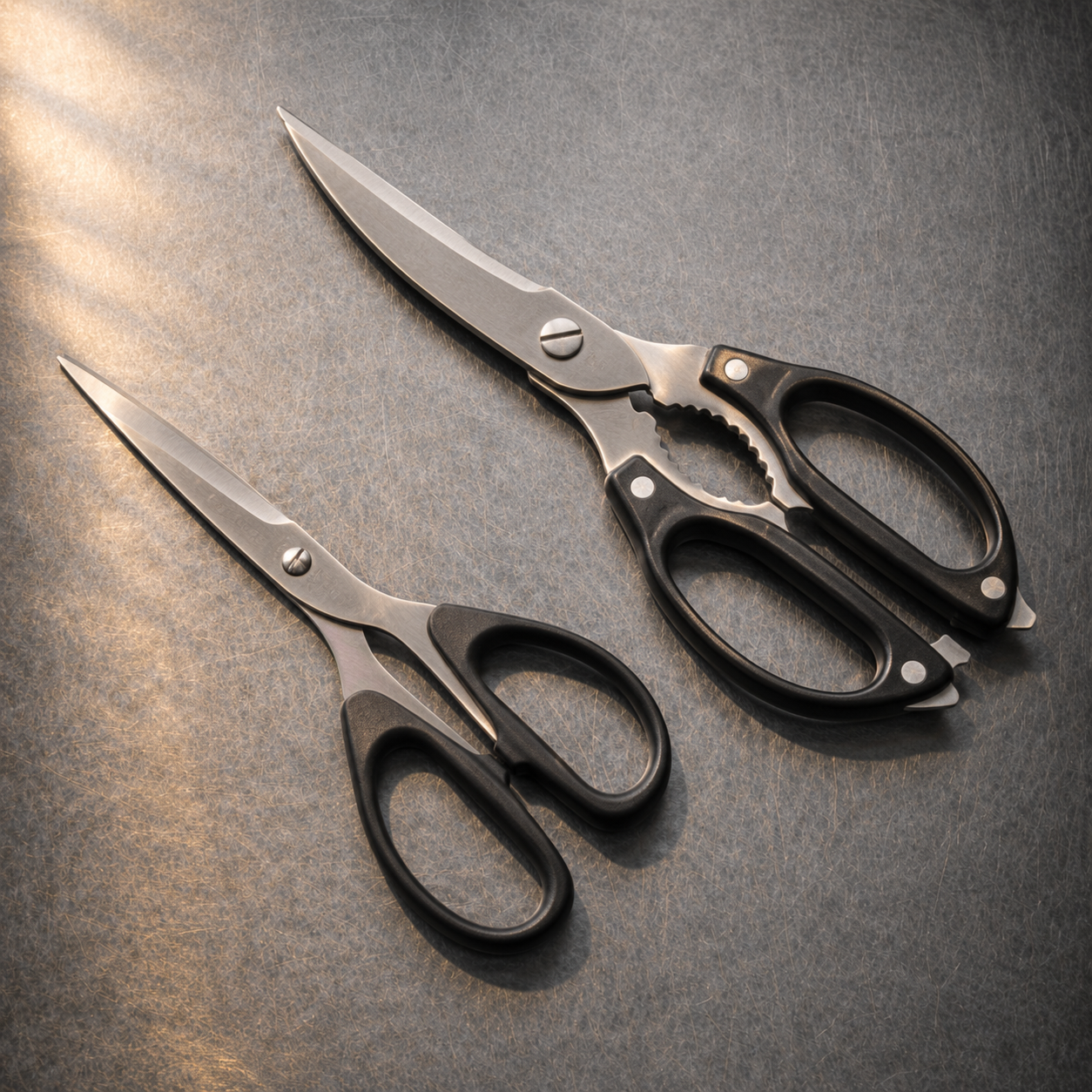
Scissors are often treated as a secondary tool in the kitchen. They are grabbed quickly to open a bag, cut a piece of packaging, trim a herb, or break down a small piece of poultry. Because they seem ordinary, they are often used carelessly, passed from one task to another without much thought.
But in a professional kitchen, scissors deserve more attention. They cut in a different way from a knife. A knife works against a board. Scissors cut by bringing two blades together around the material. This makes them useful in situations where the ingredient is suspended, irregular, delicate, wet, or difficult to stabilize on a flat surface. Scissors are not just for convenience. Used correctly, they become instruments of control, access, and precision.
Function
The function of kitchen scissors depends on the task they are assigned to.
They may be used to:
• open bags and packaging
• cut parchment, plastic, or kitchen materials
• trim herbs
• cut fins, bones, or small fish parts
• clean poultry
• portion delicate items
• finish garnishes during plating
This range of use is exactly why scissors must be assigned carefully. A pair of scissors used for opening cardboard or storage packaging should not later be used to trim herbs, cut fish, or finish a plate.
Geometry
The geometry of scissors determines their strength, precision, and safety.
Utility Scissors
Utility scissors are used for opening bags, boxes, plastic wrap, labels, or other non-food materials.
They should be durable, accessible, and clearly separated from food-use scissors.
Kitchen Shears
Kitchen shears are built for food handling.
They are usually stronger than standard scissors and may be used for trimming poultry, cutting small bones, portioning fish, or handling tougher ingredients.
Many kitchen shears are designed to come apart for easier cleaning.
Precision Scissors
Precision scissors have finer blades and sharper tips.
They are useful for cutting delicate garnishes, herbs, edible flowers, fine vegetable shapes, or small decorative preparations.
They require careful storage because a damaged tip compromises their purpose.
Short vs. Long Blades
Shorter blades offer control and strength for tighter work.
Longer blades provide cleaner, continuous cuts but require more space and control.
The wrong blade length can make a task slower, less precise, or more dangerous.
Materials
Kitchen scissors must be built from materials that tolerate moisture, fat, repeated washing, and food contact.
Stainless Steel Blades
Stainless steel is the standard material for professional kitchen scissors because it resists corrosion and cleans well.
For food-use scissors, rust resistance is essential.
High-Carbon Stainless Steel
Some scissors use harder steels that hold an edge longer.
These may cut more cleanly, but they still require proper maintenance and careful storage.
Handles
Handles matter as much as blades.
They should be nonporous, easy to clean, and comfortable to grip. In professional kitchens, handles may come into contact with wet hands, oily hands, or raw product, so materials that absorb moisture or residue are inappropriate.
Rubberized or textured handles can improve grip, but they must also be cleanable.
Ergonomics
Scissors are hand-driven instruments, so comfort and control are essential.
Grip
The handle must fit the hand comfortably.
If scissors are used repeatedly during prep, poor ergonomics can cause fatigue and reduce precision.
Tension
The pivot point must hold proper tension.
If the blades are too loose, they chew or crush rather than cut. If too tight, they become tiring to use.
Slip Resistance
In kitchens, hands are often wet, greasy, or covered with product.
Scissors used for food preparation should provide a secure grip even under imperfect working conditions.
Cleaning Access
Scissors with detachable blades are often easier to clean thoroughly.
This is especially important when they are used for raw poultry, fish, or fatty preparations.
Choosing the Tool
The correct scissors depend on the task.
For storage and receiving areas, keep utility scissors dedicated to packaging and non-food materials.
For fish or poultry work, use kitchen shears designed for strength, cleaning, and food contact.
For herbs, garnishes, and plating, use sharp precision scissors kept clean and protected.
Important considerations include:
• blade strength
• blade length
• sharpness
• handle comfort
• food-safe materials
• ease of cleaning
• dedicated storage location
The best scissors are not the most expensive ones. They are the ones designed for the work they are expected to perform.
Hygiene and Organization
Scissors require strict organization because they easily move between tasks.
This is where problems begin.
A pair of scissors used to open boxes should not be used to cut herbs. Scissors used for raw fish or poultry should not be used for plating. Scissors used near the receiving area should not migrate to the garnish station.
Good practice requires:
• assigning scissors by task
• storing them near the station where they are used
• cleaning them after each use
• separating food-use scissors from utility scissors
• replacing or sharpening scissors when they no longer cut cleanly
• protecting precision scissors from damage
Scissors should not be anonymous tools floating around the kitchen. They should belong somewhere and be assigned sections.
Common Misconceptions
One common misconception is that scissors are interchangeable. They are not.
Utility scissors, poultry shears, fish scissors, herb scissors, and plating scissors are built for different tasks and should not be used as substitutes for one another.
Another misconception is that scissors do not need sharpening. Like knives, scissors lose their edge. Dull scissors crush, tear, and increase the risk of accidents because the cook applies more force than necessary.
A final mistake is treating scissors as harmless because they are familiar. In a busy kitchen, wet hands, dull blades, and poor task assignment can make scissors dangerous.
Closing Reflection
Scissors cut where the knife is not always practical. They allow the cook to trim, open, snip, and shape with direct hand control. They can be rough utility tools at the receiving station or delicate finishing instruments at the pass.
But their versatility also makes them risky if they are not organized. A good kitchen does not simply have scissors. It has the right scissors in the right place, assigned to the right task. Used with discipline, scissors become instruments of access and precision, helping the cook cut beyond the limits of the board.