The Chef’s Knife
The Central Instrument of the Kitchen
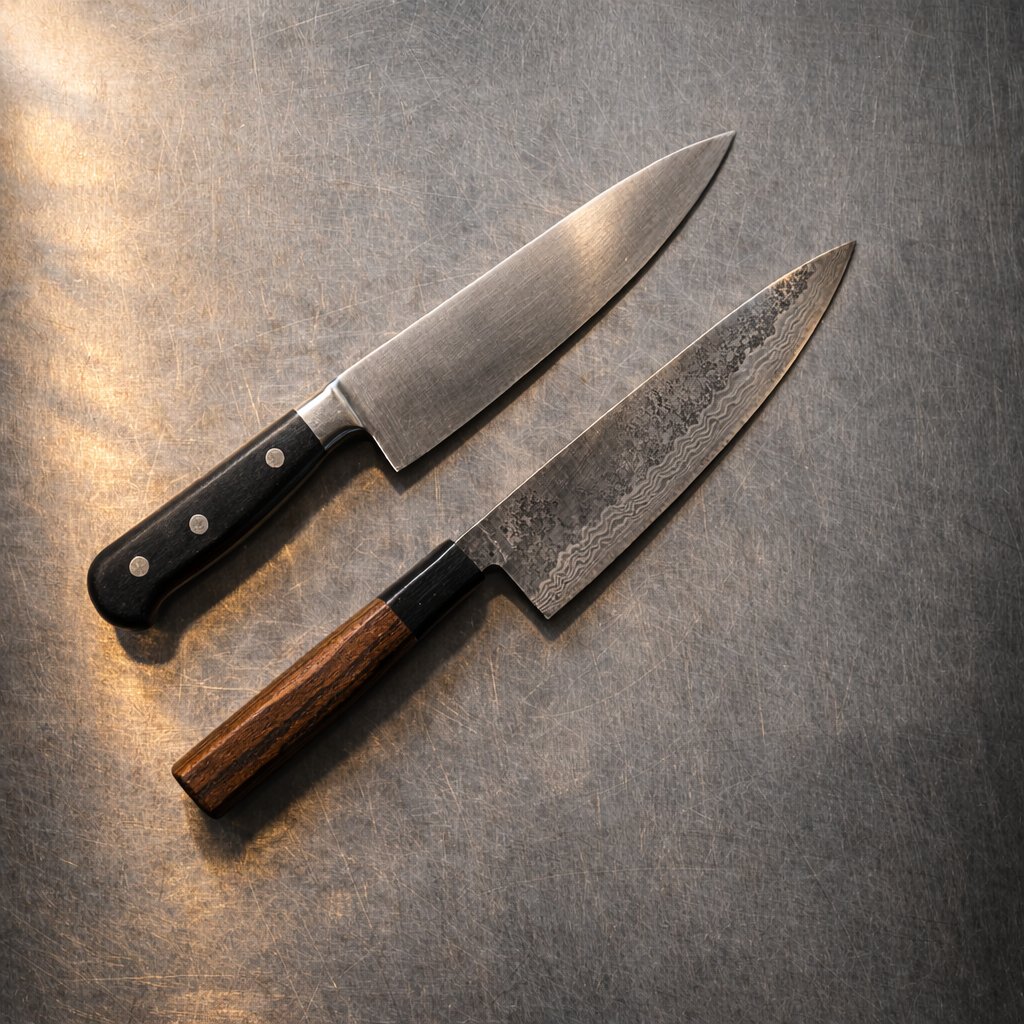
If a kitchen had to be reduced to a single knife, it would almost always be the chef’s knife. It is the central instrument of the kitchen, the knife that accompanies the cook through nearly every stage of preparation. From slicing onions to portioning fish, from chopping herbs to breaking down vegetables, it is designed to perform a wide range of tasks with efficiency and rhythm.
Where the paring knife brings the cook close to the ingredient, the chef’s knife works at the scale of preparation. It moves across the board with the shoulder and forearm, allowing the cook to transform ingredients quickly and consistently. For many cooks, it becomes the knife they rarely set down. In professional kitchens, it is not unusual to see a chef complete nearly an entire day of prep with nothing more than this single knife.
Function
The chef’s knife is designed to be a multipurpose cutting instrument. Its long edge and balanced geometry allow it to perform a wide range of tasks:
• chopping vegetables
• slicing meats and fish
• mincing herbs and aromatics
• crushing garlic
• portioning larger ingredients
Because of its versatility, many cooks rely on the chef’s knife for the majority of their work. While specialized knives exist for specific tasks, the chef’s knife often serves as the primary working blade in both professional and home kitchens.
Geometry
One of the most interesting aspects of the chef’s knife is that its shape varies across culinary traditions. Each profile reflects a different philosophy of cutting.
The French Profile
The classic French chef’s knife typically features a relatively straight edge with a gentle curve toward the tip. The blade is often thinner and lighter, enabling precise slicing and push-cutting techniques. This style favors controlled, linear movements rather than heavy rocking.
The German Profile
German-style chef’s knives are usually thicker and heavier, with a more pronounced curve along the blade. This geometry encourages a rocking motion on the board, which is particularly effective for chopping herbs and vegetables. The blade spine is often thicker, giving the knife a slightly more robust feel.
The Japanese Gyuto
The Gyuto is the Japanese interpretation of the Western chef’s knife. These knives are typically thinner, harder, and capable of taking extremely sharp edges. They are designed for precise slicing and controlled cuts rather than heavy chopping. Because of their harder steel, they require careful handling and maintenance.
The Chinese Cleaver
In Chinese cuisine, the wide rectangular cleaver often serves the role of the chef’s knife. Despite its appearance, it is not necessarily used for heavy bone chopping. Instead, it functions as a versatile, all-purpose knife for slicing vegetables, cutting meat, and transferring ingredients from the board to the pan. Its broad blade provides both cutting surface and utility.
Materials
The performance of a chef’s knife is heavily influenced by the steel used to make it.
Softer Steels
Softer steels are easier to sharpen and more forgiving during heavy work.
Advantages include:
• easier sharpening
• greater durability during tough tasks
• resistance to chipping
The trade-off is that the edge loses sharpness more quickly.
Harder Steels
Harder steels allow extremely fine cutting edges and retain sharpness longer.
Advantages include:
• longer edge retention
• sharper cutting performance
• cleaner slicing
However, harder steels are more brittle and require more skill when sharpening.
Ergonomics
Because the chef’s knife is used extensively, its balance and handling characteristics are crucial.
Blade Length
Chef’s knives typically range between 20 and 26 cm (8–10 inches). Longer knives allow longer slicing strokes and greater efficiency, but they require sufficient workspace. In smaller kitchens or tight workstations, slightly shorter knives may offer better maneuverability.
Balance
A well-balanced chef’s knife should feel stable in the hand, neither blade-heavy nor handle-heavy.
Proper balance allows the knife to move naturally through ingredients without excessive effort.
Handle Comfort
The handle should fit comfortably in the cook’s grip and allow secure control during repetitive movements. Different cooks prefer different handle shapes, which is why personal preference plays a significant role when selecting a chef’s knife.
Choosing the Tool
Selecting a chef’s knife involves both technical considerations and personal feel. Important factors include:
Size
Choose a blade length that matches your workspace and cutting style.
Steel type
Consider whether you prefer a knife that holds its edge longer or one that is easier to sharpen.
Comfort
Perhaps most importantly, the knife should feel natural in your hand. A knife may have excellent reviews or craftsmanship, but if it does not suit your grip or cutting style, it will never feel truly comfortable. In many cases, finding the right chef’s knife involves a degree of experimentation.
Common Misconceptions
One misconception is that the chef’s knife should be used for every cutting task. While it is extremely versatile, certain tasks are better suited to specialized knives, such as filleting fish or peeling delicate fruits. Another misunderstanding involves which part of the blade should perform different tasks. The heel of the blade provides power for heavier cuts, while the center of the blade handles most slicing work. The tip is reserved for delicate tasks and fine detail. Understanding how to use the different parts of the blade improves both efficiency and safety.
Closing Reflection
Over time, the chef’s knife becomes more than a tool. It becomes the instrument through which a cook develops rhythm and familiarity with ingredients. The weight of the blade, the movement across the board, the sound of vegetables being cut — all become part of the daily choreography of cooking. For this reason, many cooks develop a strong attachment to their chef’s knife. It is the instrument that accompanies them through almost every preparation.