The Mold
The Instrument of Shape, Portion, and Presentation
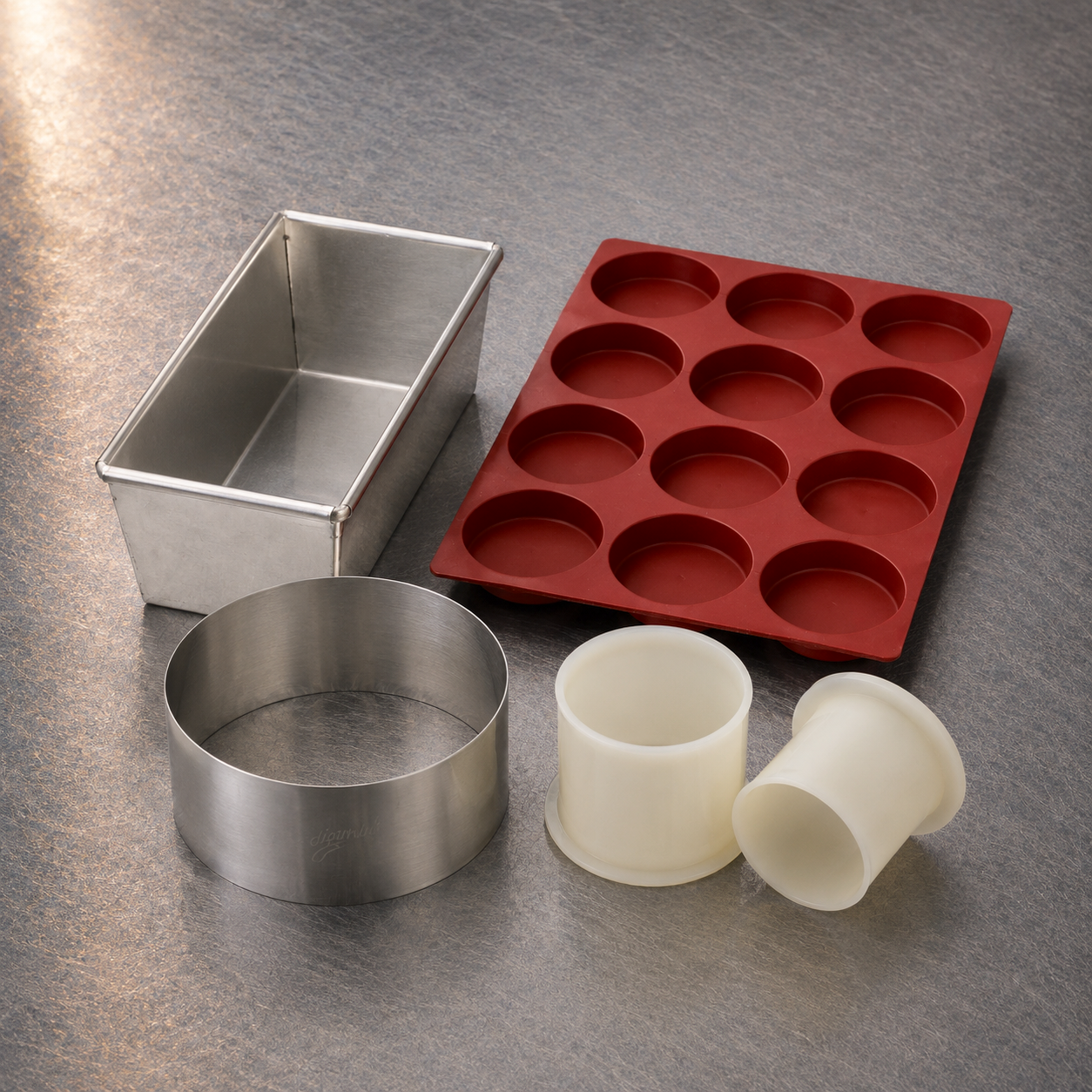
A mold is one of the kitchen’s quiet instruments of structure. It does not cut, stir, heat, or blend. Instead, it gives shape. It holds a preparation in place while it cooks, freezes, sets, cools, or waits to be presented. In this sense, the mold is not only a container. It is a temporary architectural structure.
A cake rises inside a mold. A terrine sets inside a mold. A gel takes its final form inside a mold. A plated rice preparation, tartare, mousse, or purée can be arranged inside a ring to create a precise visual structure. Molds allow the cook to control form, portion, and presentation. But like all instruments, they must be matched to the task. The question is not: Which mold is best? The question is: What does this preparation need the mold to do?
Function
The mold serves several functions in the kitchen.
It can be used to:
• shape preparations
• standardize portions
• bake cakes, breads, or pastries
• freeze mousses, purées, inserts, or semifreddos
• set gels, aspics, custards, or terrines
• arrange ingredients during plating
• control presentation and size
The mold is especially useful when the final dish requires consistency. If every portion must be the same size, height, or shape, the mold provides structure and repeatability. This makes it valuable not only for presentation, but also for costing and production planning. A mold helps the cook produce the same form again and again.
Geometry
The geometry of a mold determines how the preparation forms, releases, and presents.
Ring Molds
Ring molds are commonly used for plating.
They allow cooks to build layered or compact preparations directly on the plate: tartares, rice preparations, salads, purées, vegetables, or composed cold dishes.
They are also useful for cutting doughs or shaping small baked items.
Baking Molds
Baking molds are designed to hold batters, doughs, custards, or cakes during cooking.
Their geometry affects heat transfer, rise, crust formation, and release.
A deep mold behaves differently from a shallow mold. A metal mold behaves differently from silicone.
Silicone Molds
Silicone molds are flexible and useful for freezing, baking, setting, and unmolding delicate preparations.
Their flexibility allows cooks to release items without forcing them out with sharp tools.
Plastic and Polycarbonate Molds
Plastic molds are often useful for cold preparations, chocolate work, jellified preparations, or repeated shaping.
Polycarbonate molds, especially in chocolate work, can create clean surfaces and defined shapes when handled correctly.
Terrine and Loaf Molds
Long rectangular molds are used for terrines, pâtés, breads, cakes, and layered preparations.
They are useful when the cook wants to slice a preparation into consistent portions.
Materials
Mold materials determine how they respond to heat, cold, pressure, and unmolding.
Silicone
Silicone is flexible and useful for baking, freezing, and unmolding delicate items.
However, not all silicone is the same. Some molds are designed for high heat, while others are better suited to cold or room-temperature preparations.
Silicone can be damaged easily by knives, forks, or sharp tools.
Metal
Metal molds transfer heat efficiently.
They are useful for baking, cooking, setting structured preparations, and producing clean edges. Stainless steel rings and aluminum molds are common in professional kitchens.
Metal is durable, but it can also conduct heat quickly, so handling requires care.
Plastic
Plastic molds are useful for cold preparations, shaping, storage, and light production.
They are not always appropriate for heat, freezing, or temperature shock. Some plastics can deform, crack, or absorb odors depending on use.
Polycarbonate
Polycarbonate molds are especially common in chocolate work.
They can produce glossy finishes and precise shapes, but they require careful cleaning and handling.
Ceramic
Ceramic molds hold heat gently and can be useful for baked custards, gratins, and certain traditional preparations.
They are less flexible and can break if mishandled.
Temperature and Material Limits
Temperature is one of the most important considerations when working with molds.
Some molds are designed for ovens.
Some are designed for freezers.
Some are designed only for cold or room-temperature use.
A mold used beyond its intended temperature range can deform, crack, weaken, release odors, or become unsafe for food contact. This is especially important when moving between extremes: freezer to oven, oven to cold surface, or hot preparation into a plastic mold. A mold must be selected not only for shape, but for the temperature environment it will enter.
Ergonomics
Molds must be easy to fill, move, stack, unmold, and clean.
Stability
Flexible molds often require support.
A silicone mold filled with liquid mousse, gel, or custard may be difficult to move without a tray underneath. The tray becomes the mold’s partner, giving structure to a flexible tool.
Stackability
Some molds are designed to stack efficiently, which is useful in professional kitchens where space is limited.
Stackability matters especially for production, refrigeration, freezing, and storage.
Unmolding
A good mold releases the preparation cleanly.
Some preparations require flexible molds. Others benefit from parchment paper, acetate, plastic wrap, or light greasing.
The unmolding process should be considered before the preparation is made, not after it has set.
Choosing the Tool
Choosing a mold depends on the preparation.
For baking, the mold must tolerate heat and provide proper heat transfer.
For freezing, it must remain flexible and stable at low temperatures.
For gels and cold preparations, it must release cleanly and hold shape without deforming.
For plating, it must create the desired portion size and visual structure.
Important considerations include:
• material
• temperature range
• flexibility
• size and portion yield
• ease of unmolding
• cleaning requirements
• compatibility with trays, parchment, acetate, or plastic wrap
Expensive high-temperature molds are not always necessary. A simple mold may be perfectly appropriate for cold gels, refrigerated preparations, or plating.
The best mold is the one suited to the process.
Care and Maintenance
Molds are often damaged by misuse.
One of the most common mistakes is using sharp tools to unmold preparations. Knives, forks, and metal tips can cut silicone, scratch plastic, or damage polycarbonate surfaces.
Once a mold is cut, warped, or deeply scratched, it becomes harder to clean and may release fragments into food.
Good practice requires:
• avoiding sharp tools inside molds
• washing molds according to material
• drying them completely before storage
• storing flexible molds flat when possible
• using trays for support
• separating molds by use and temperature rating
• discarding damaged molds
A mold should hold shape, release cleanly, and remain food safe.
Common Misconceptions
One common misconception is that molds are only for pastry. In reality, molds are used across savory cooking, pastry, plating, freezing, gelification, terrines, custards, sauces, inserts, and portion control.
Another misconception is that silicone molds are indestructible. They are flexible, but they are not immune to cutting, tearing, burning, or deformation. A final misunderstanding is that one mold can work for every temperature. Mold materials have limits, and those limits must be respected.
Closing Reflection
The mold gives form to ingredients that would otherwise spread, collapse, or remain irregular. It allows the cook to create structure, repetition, and visual clarity. It can shape a cake, set a gel, hold a terrine, freeze a mousse, or organize a plate. But the mold is never neutral. Its material, geometry, temperature tolerance, and release behavior all influence the final preparation. Used well, the mold becomes an instrument of culinary architecture: a temporary structure that helps a preparation become itself.