The Immersion Circulator
The Instrument of Controlled Temperature
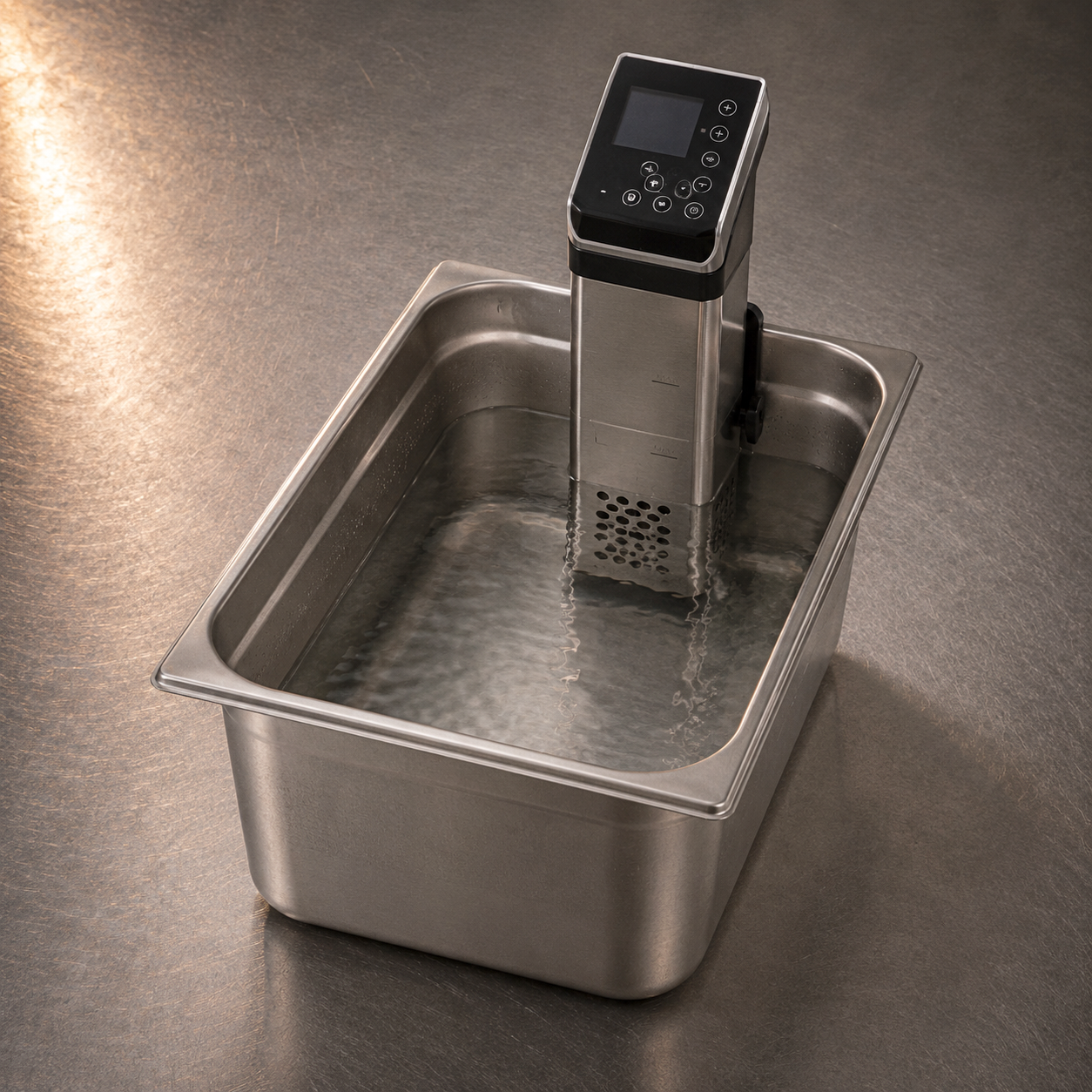
The immersion circulator changes the cook’s relationship to heat. A pan gives direct surface heat. A pot surrounds ingredients with liquid. A braiser traps heat and moisture. The immersion circulator introduces something more exact: a controlled water bath held at a specific temperature for an extended period of time.
This precision allows ingredients to cook slowly, evenly, and predictably. In sous vide cooking, food is sealed in bags and placed into the bath, where temperature, not guesswork, determines the result. But the immersion circulator is not only for cooking. It can also hold preparations warm, reheat sealed portions gently, or maintain service-ready components at a controlled temperature. It is an instrument of patience and thermal discipline.
Function
The immersion circulator heats water and moves it continuously. This circulation prevents hot and cold zones from forming in the bath, allowing the water to remain consistent throughout the container.
Typical uses include:
• cooking proteins sous vide
• holding sealed portions warm before service
• reheating sauces or preparations in bags
• maintaining precise temperatures for long cooking periods
• controlling delicate preparations that require stable heat
The central value of the immersion circulator is not speed. Its value is temperature stability. It allows the cook to decide not only how hot something should become, but how long it should remain at that temperature.
Geometry
The immersion circulator is only one part of the system.
It requires a water bath.
The Circulator
The circulator contains the heating element, temperature sensor, pump, and control interface.
The heating element brings the water to temperature. The pump moves the water. The sensor monitors the bath and adjusts heat as needed.
The Bath
The bath may be a large pot, a commercial sous vide container, or a purpose-built insulated vessel.
The container must be appropriate for heat. Not every plastic container is suitable. A container exposed to warm or hot water for long periods must be food-safe, heat-resistant, and stable.
Using the wrong container can create deformation, odor, instability, or contamination risk.
Water Volume
The size of the bath matters.
A small circulator may work well for a few portions, but it may struggle to heat and maintain a large volume of water. Large baths, frozen bags, or high-volume service use may require a more powerful circulator or multiple units.
The circulator must match the workload.
Materials
Immersion circulators combine metal, plastic, electronic components, and heating systems.
The heating element and lower working parts are commonly stainless steel or metal components designed for water contact.
The body may include heat-resistant plastic and digital controls.
The bath container is equally important. It should tolerate long exposure to heat without warping, cracking, or transferring unwanted odors into the kitchen environment.
Food-safe and heat-resistant containers are essential.
Ergonomics
An immersion circulator should be easy to set up, read, and operate.
Controls
In professional kitchens, simplicity matters.
A circulator used for holding food at one temperature during service should not require complicated programming. Clear buttons, readable temperature displays, and reliable settings help prevent errors.
Stability
The circulator must attach securely to the bath.
If the unit shifts, tilts, or sits too high or too low in the water, it may not circulate properly.
Accessibility
The bath should be positioned where cooks can safely add and remove bags without spilling hot water or blocking workflow.
This matters especially during service, when bags may be added, removed, opened, and plated quickly.
Choosing the Tool
Choosing an immersion circulator depends on scale and purpose.
For small preparations, a compact circulator may be enough.
For professional kitchens, larger or more powerful units may be necessary, especially when the bath holds many bags or large volumes of water.
Important considerations include:
• heating power
• circulation strength
• maximum water volume
• temperature accuracy
• ease of use
• clamp stability
• cleaning access
• container compatibility
If cold or frozen bags are added repeatedly, the circulator must have enough power to recover temperature efficiently.
A weak circulator in an oversized bath will struggle to maintain control.
Temperature Management
The immersion circulator is valuable because it holds a precise temperature, but that precision depends on how the system is used.
Adding cold bags lowers the temperature of the bath.
Adding too many bags at once slows circulation.
Crowding the container can prevent water from moving evenly around each portion.
For consistent results, the cook must consider:
• bath volume
• quantity of bags
• starting temperature of the food
• spacing between portions
• recovery time after adding cold product
• duration of cooking or holding
The water bath is a controlled environment, but it still needs management.
Common Misconceptions
One common misconception is that sous vide cooking is automatic. It is not. The immersion circulator controls water temperature, but the cook still controls preparation, bagging, timing, seasoning, thickness, cooling, holding, and finishing.
Another misconception is that any container can become a sous vide bath. The container must be safe for heat, stable, and appropriate for the duration of use. A final misconception is that one small circulator can handle every situation. Water volume, product volume, and temperature recovery all determine whether the circulator is appropriate for the task.
Hygiene and Organization
Immersion circulator systems require clean water, clean bags, and clean handling.
The circulator itself should be cleaned regularly, especially around the heating element and pump area. Mineral deposits can accumulate over time depending on water quality.
Good practice includes:
• keeping the water bath clean
• descaling the unit when needed
• using food-safe bags
• labeling bags clearly
• organizing cooking times and temperatures
• cooling cooked products properly when stored
• avoiding overloading the bath
Because sous vide often involves long cooking or holding times, organization matters. Temperature control without proper labeling and timing can quickly become confusing.
Closing Reflection
The immersion circulator is an instrument of controlled heat. It does not cook through intensity, but through precision. It allows the cook to hold an ingredient at a defined temperature long enough for transformation to occur evenly and predictably. This makes it especially valuable for sous vide cooking, but also for holding, reheating, and managing service with consistency.
Used well, the immersion circulator gives the kitchen something difficult to achieve by instinct alone: stable heat over time. It turns temperature into a controlled environment.