Field Notes From the Bar: What Chefs Can Learn From Mixology
One of the clearest lessons I remember from Le Cordon Bleu came from a bottle of wine. We were preparing boeuf bourguignon, and the chef had opened a very good bottle to use in the dish. Someone asked what seemed like a reasonable question: why waste such a good wine if it was only going to be cooked? The chef stopped and corrected the premise immediately. You do not cook with wine you would not want to drink. If the wine is part of the preparation, then its quality matters, and if the same wine is served with the dish, the relationship becomes even more complete.
At the time, that idea stayed with me because it revealed something larger than the recipe itself. The wine was not simply an ingredient. It belonged to the logic of the dish, to the culture around it, and to the experience of eating it. In French cooking, that relationship between food and wine is not an accessory added at the end. It is often embedded in the dish itself, in the region, and in the habits surrounding the meal.
That is one of the reasons I think chefs should spend more time paying attention to what happens at the bar. Not because every chef needs to become a bartender or a professional mixologist. The point is not to add another profession to the job. It is to understand that the bar and the kitchen are often working with many of the same questions: flavor, aroma, balance, extraction, temperature, dilution, texture, presentation, memory, and sequence. When those two areas operate without speaking to each other, the restaurant loses possibilities.
Pairing Can Begin Before the Dish Is Finished
We often think about pairing as something that happens after the dish has already been created. The chef develops the food, and then the sommelier, bartender, or beverage director finds something that goes with it. That approach can work perfectly well, but it also leaves a lot of creative territory unexplored because the relationship between food and beverage can begin much earlier.
The dish itself may already contain wine, beer, coffee, tea, spirits, fortified wine, bitters, or another ingredient that belongs equally to the bar. A sauce may be deglazed with one wine while another is being proposed at the table. A dessert may use Cointreau or Grand Marnier while the bar is already working with the same orange profile in a cocktail. The kitchen may be using coffee to build bitterness and body into a sauce while the bartender has developed a syrup or extraction from the same coffee.
Once we begin looking at the restaurant this way, the kitchen and the bar stop appearing like completely separate departments. They become two areas working with the same pantry of sensory possibilities. That does not mean every dish needs a matching cocktail or that every drink has to repeat an ingredient from the plate. Pairing can work through contrast, relief, freshness, bitterness, acidity, temperature, aroma, or texture. But those decisions become more deliberate when the people creating both sides of the experience are actually communicating.
The chef does not necessarily need to know which bottle should accompany every plate. What matters is recognizing that beverage can be considered while the food is still being developed, not only after the culinary decisions have already been closed.
The Bar Has Its Own MIXOLOGICAL Grammar
One of the reasons chefs can learn so much from mixology is that a serious mixologist works with ingredients in ways that are very familiar to cooks, but often with different priorities. Infusions, extractions, syrups, bitters, tinctures, macerations, reductions, clarifications, smoke, fermentation, citrus oils, herbs, spices, coffee, tea, and fruit are all part of the territory. The techniques may be adapted to liquids, spirits, and the speed of bar service, but the underlying questions are culinary.
What happens if this ingredient is extracted cold rather than hot? How long should something infuse before bitterness begins to dominate? Which part of the citrus carries the aroma we want? How does dilution alter flavor perception? What happens when sweetness arrives first and acidity later, or when bitterness remains in the aftertaste? These are not foreign questions to a chef. They are simply being asked from another station.
This is where going to the bar with curiosity becomes particularly valuable. A mixologist may have developed an extraction or syrup that the kitchen would never have thought to make in the same way, and that preparation might inspire a dessert, glaze, sauce, finishing element, or entirely different direction. The exchange can move in reverse as well. A kitchen reduction may inspire a cocktail. A preserved fruit from pastry may become useful at the bar. Herb stems that are not attractive enough for plating may still contain exactly the aroma a bartender wants to capture.
Once that dialogue begins, the restaurant starts seeing its ingredients more completely. Instead of the kitchen maintaining one vocabulary and the bar another, the two begin recognizing where their languages overlap.
Flavor Does Not Stop at the Edge of the Plate
There is another reason chefs benefit from understanding beverages: the guest experiences the meal as a whole. The palate does not reset simply because one item arrived from the bar and another from the kitchen. A cocktail with strong sweetness, bitterness, acidity, smoke, or alcohol changes what comes after it. A wine can amplify or suppress certain qualities in a dish. Beer can bring bitterness, carbonation, malt, fruit, or roasted flavors into the experience. Tea, coffee, and non-alcoholic drinks can create equally important relationships.
The chef does not need to become an expert in every beverage category to understand that these relationships matter. Even a basic conversation with the bar can be illuminating. What kind of drinks is the restaurant known for? Is the program spirit-forward? Does it lean toward acidity and freshness? Is there a strong whisky selection? Are non-alcoholic drinks an important part of the offer? What wines are guests ordering most often?
Those answers can matter to the menu. If the bar has a serious whisky program, there may be dishes that naturally support that profile. If the beverage offer is dominated by bright, aromatic, acidic drinks, the kitchen may want to avoid creating unnecessary clashes. If the restaurant is known for beer, then malt, bitterness, smoke, fermentation, and carbonation become part of the sensory landscape in which the food is being served.
This does not mean designing the kitchen around the bar. It means designing the whole experience with enough awareness that the two do not accidentally work against one another.
Pairing Becomes Real Through Service
There is also a practical reason for this collaboration: the server eventually has to communicate it. A pairing is only useful if someone at the table can explain why the combination might be enjoyable.
“Try this cocktail with that dish” becomes a much stronger recommendation when the server knows what connects them. Perhaps the drink brings acidity that cuts through richness. Perhaps the wine shares an herbal note used in the sauce. Maybe the bitterness of a beer balances sweetness in the food. Perhaps a non-alcoholic drink has been designed specifically to refresh the palate between bites.
When the kitchen and the bar have discussed these relationships, front of house has something real to say. The recommendation becomes more credible and can increase sales naturally because it is tied to the guest experience rather than merely to upselling.
The customer notices that coherence. A dish arrives with a drink that genuinely makes sense beside it, and the restaurant suddenly feels more considered. The guest may not be able to explain exactly why the combination works, but they feel that the meal has been thought through as one experience rather than assembled from unrelated departments.
That is part of hospitality as much as it is part of flavor.
The Chef Does Not Need to Become the Mixologist
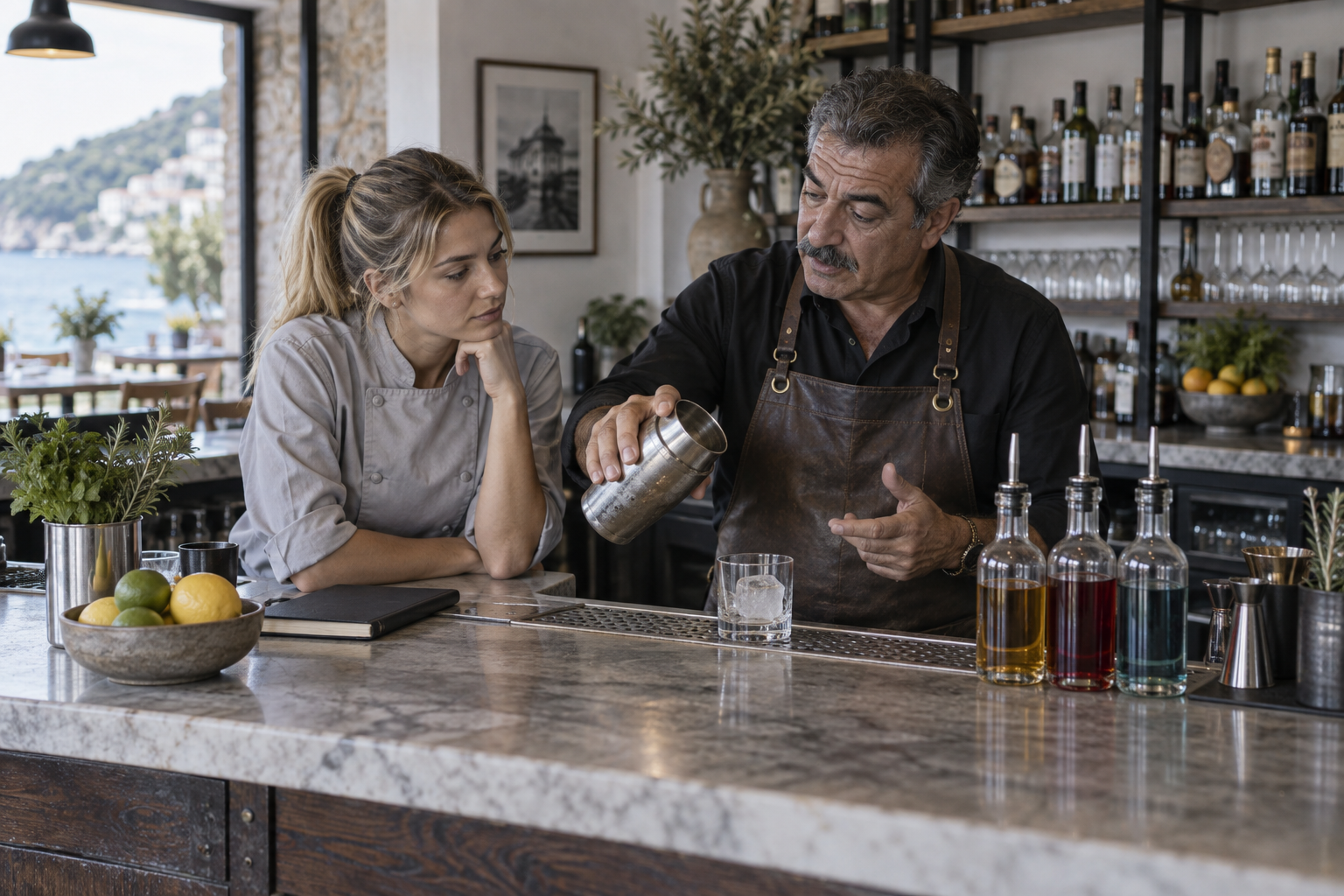
This distinction is important because the useful relationship is not created by the chef walking behind the bar and pretending to be the person who already works there. A professional mixologist has their own craft, speed, technical knowledge, service discipline, and experience. The chef does not need to replace that expertise. The more useful position is closer to apprenticeship through curiosity.
Go to the bar and ask what is being made. Ask why a particular infusion is being used, what a bitter contributes, why one spirit was chosen over another, how dilution changes the drink, what guests are responding to, and which combinations have failed. Those conversations can expand the chef's reference field without requiring mastery of the entire profession.
It is similar to visiting a baker, cheesemaker, farmer, butcher, or coffee roaster. We do not need to become them. We need to understand enough of their world that it changes how we think about our own.
This is also where the distinction between bartender and mixologist matters. Many bartenders are excellent at the operational side of the bar: organization, speed, service, tickets, and consistency. A mixologist may do all of that while also developing new drinks, building infusions, testing combinations, and proposing new sensory experiences. For the chef interested in creative exchange, that second role is particularly valuable because the bar is also operating as a place of development.
Field Notes Mean Going to Look
This is why I think of this subject as field notes rather than as a lesson in mixology. The useful action is to go and observe. Sit at a good bar and watch how drinks are built. Visit a place that works seriously with tea. Pay attention to a coffee program that treats brewing as a culinary process. Go to a speakeasy and ask what is in the glass. Look at the vessel, the temperature, the aroma before the first sip, the dilution as the drink sits, and the way flavor changes over time.
Then take notes.
The point is not necessarily to return to the kitchen with a recipe. Perhaps what we noticed was an extraction technique, a new way of handling citrus, a relationship between bitterness and sweetness, or a presentation detail we had never considered. A field note may simply add another reference to the archive, and that reference may become useful several months later when another culinary problem appears.
This is exactly how culinary grammar expands. We move outside our immediate station, pay attention to how another discipline works with ingredients, and bring the observation back into our own practice.
Outside the Restaurant, the Relationship Becomes Even Clearer
The same thinking becomes especially useful when a chef is working in catering, private dinners, or events. Food does not arrive in isolation. Someone is choosing wine, beer, cocktails, spirits, or non-alcoholic drinks whether the chef participates in that conversation or not.
Knowing enough to ask what will be served can improve the menu immediately. If a client has selected several IPAs for a barbecue, that information matters. The bitterness, citrus, or malt profile can influence how we think about the food, and perhaps one of the beers can even enter a marinade or sauce if it makes culinary sense. If the event includes a bartender, the chef may not need to design a finished cocktail, but can suggest a direction: something fresh and acidic rather than sweet, perhaps, because the menu already carries enough richness.
That kind of participation makes the chef more useful because they are thinking about the meal as an experience rather than only about what leaves the kitchen. It also allows the chef to anticipate how food and beverage will interact before the guest has to discover the relationship by accident.
The Best Collaborations Expand Both Sides
There is something particularly satisfying when a chef and a mixologist begin working together rather than simply operating beside one another. The bartender brings a new syrup to the kitchen and the chef sees another application. The kitchen has a preserved ingredient the bar had never considered. A dish in development inspires a new drink, and when the drink comes back to the table it changes the way the chef thinks about the seasoning of the dish.
That is where collaboration becomes creative rather than merely logistical. Both people remain inside their own expertise, but each one's work begins expanding the other's field of possibility. The kitchen learns another way to organize flavor and aroma, while the bar gains access to ingredients, preparations, and culinary references it may not have encountered otherwise.
That is why I think the chef should go to the bar. Not to take it over, and not because becoming a mixologist is another requirement of being a chef. The value lies in going there with enough curiosity to understand what is happening only a few meters away.
The bar is another working laboratory of flavor, aroma, extraction, texture, balance, temperature, presentation, and experience. For a chef interested in developing a broader culinary language, it would be a shame not to look.
Field Notes From the Bar
Read Next: The Menu as Object
Read Next: Plating Is Part of the Dish