Flavor — Taste, Balance, Development, and Culinary Meaning
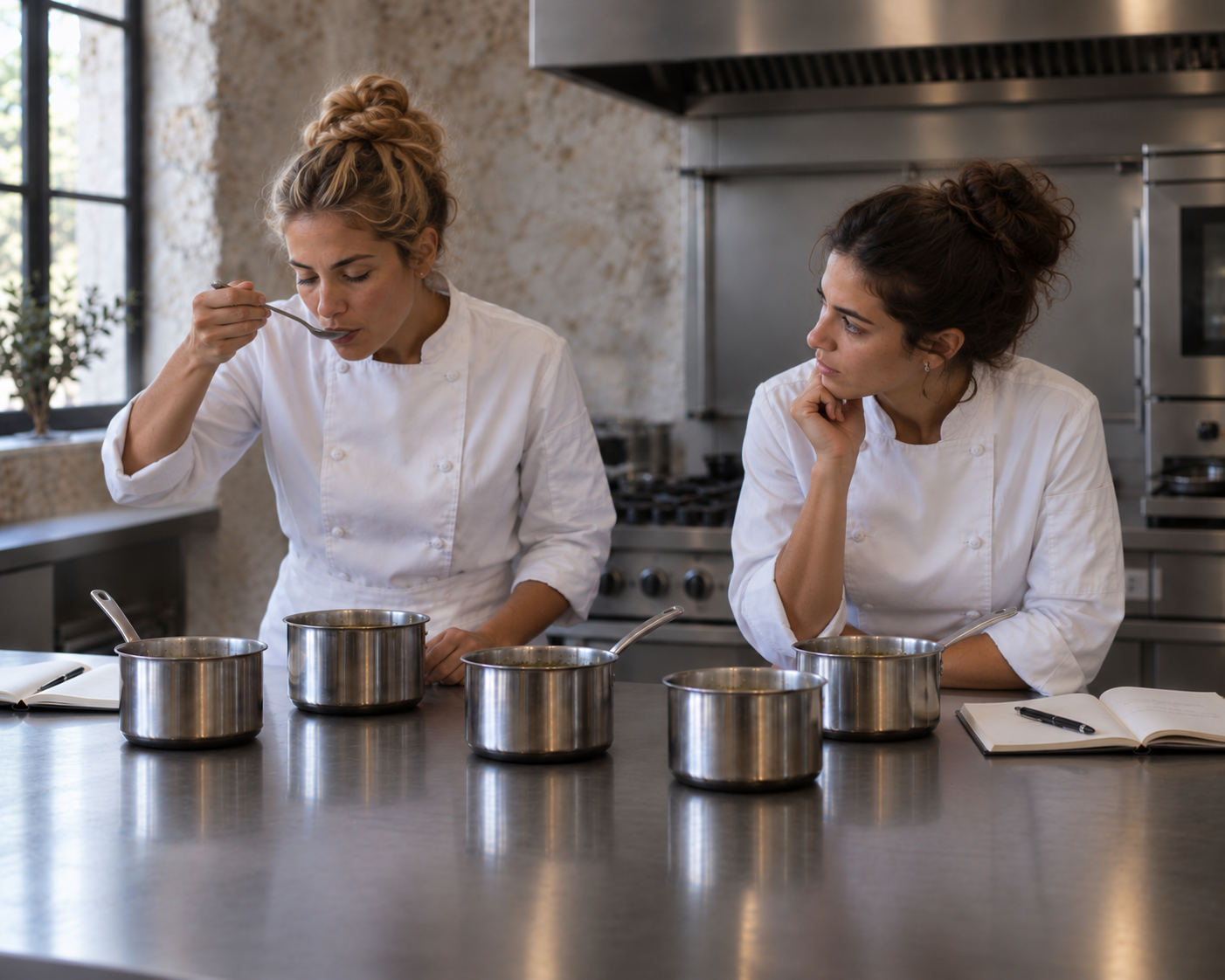
Flavor begins when anticipation becomes contact. Aroma may reach us first. Appearance may prepare us. Texture may make a promise before the first bite. But flavor begins when the preparation enters the mouth and the eater starts to understand what the food is doing.
That first contact can confirm the aroma, complicate it, or contradict it. A sauce that smells sweet may taste sharply acidic. A pale broth may carry unexpected depth. A chile paste may smell smoky but reveal dried fruit, bitterness, garlic, and heat as it moves through the mouth. A preparation with a powerful aroma may become surprisingly delicate once tasted.
It includes taste, but it is larger than taste. It depends on aroma, temperature, texture, physical sensation, intensity, balance, development, aftertaste, memory, culture, and expectation. The Sensory Vocabulary Reference defines taste as the basic sensations of sweet, sour, salty, bitter, and umami, while flavor is the combined experience of taste, aroma, temperature, texture, and physical sensation. This distinction matters.
When a cook says, “the flavor is wrong,” the problem may not be flavor in the narrow sense. It may be insufficient salt, harsh acidity, muted aroma, excessive sweetness, a texture that releases flavor too slowly, fat that coats the palate, chile heat that accumulates, or an aftertaste that lingers in the wrong direction. Flavor is not a static impression. It arrives, develops, changes, remains, and asks to be understood.
What Flavor Is — More Than Taste
Taste is one part of flavor.
The tongue registers basic tastes: sweet, sour, salty, bitter, and umami. These are essential. They give structure and orientation. Sweetness can soften acidity. Acidity can interrupt richness. Salt can make other flavors more perceptible. Bitterness can create contrast. Umami can give depth and persistence.
But flavor is the larger experience built around those tastes. A strawberry does not taste like strawberry only because it is sweet and sour. Much of its recognizable identity comes from aroma. Coffee is not understood only through bitterness. Mushroom is not only umami. Citrus is not only acidity. Butter is not only fat. A grilled piece of fish is not only salt and protein.
Flavor is the full encounter. It includes the way aroma travels from the mouth toward the nose during chewing. It includes whether the food is hot, warm, room temperature, chilled, or frozen. It includes whether the texture is crisp, creamy, fibrous, juicy, sticky, dense, or airy. It includes whether the finish is clean, smoky, bitter, sweet, salty, spicy, metallic, or persistent.
This is why the same ingredients can produce different flavor experiences depending on form. A tomato water, a tomato sauce, a roasted tomato, a fermented tomato, a dried tomato powder, and a tomato oil may all carry tomato, but they do not deliver the same flavor. The material form changes the experience.
Why Flavor Matters — Intention Made Perceptible
Flavor is where culinary intention becomes perceptible.
A cook may intend freshness, depth, comfort, brightness, intensity, restraint, elegance, rusticity, appetite, or surprise. But intention only matters if it is experienced. Flavor is one of the main ways the eater receives that intention.
This is why flavor cannot be reduced to whether something tastes “good.”
During formulation, a more useful question is: what is happening?
Does the acidity arrive before the fruit?
Does sweetness round the tomato or dominate it?
Does umami build slowly?
Does salt support the vegetable or obscure it?
Does bitterness create maturity or harshness?
Does smoke invite another bite or tire the palate?
Does the flavor remain clean after swallowing?
Does the preparation become more interesting or more exhausting as it is eaten?
The Sensory Perception Guide argues that the purpose of sensory evaluation is not to prove that a preparation is good, but to understand what it is doing and what the next experiment needs to investigate.
That is the role of flavor in Culinary Grammar.
It gives the cook information.
Flavor Develops Over Time
Flavor has movement.
It is not one frozen moment. A preparation may begin acidic, become savory, reveal spice through the middle, and finish with bitterness. Another may begin sweet, deepen into roasted aroma, and leave a fatty coating after swallowing. Another may taste balanced at first, but become too salty after several bites.
The Sensory Perception Guide separates flavor development into three useful moments: first contact, development, and finish. First contact is what appears when the preparation enters the mouth. Development is what happens while chewing, dissolving, or moving through the mouth. Finish is what remains as the food is swallowed.
This sequence gives cooks a practical way to observe.
First contact
What appears immediately?
This may be salt, acid, sweetness, heat, aroma, fat, temperature, or texture. First contact often determines whether the eater wants to continue. It can awaken appetite or create resistance.
Development
What happens as the preparation moves through the mouth?
Does umami deepen? Does sweetness grow? Does chile heat build? Does bitterness emerge? Does fat begin to coat? Does aroma become clearer retronasally? Does texture release flavor gradually?
Finish
What remains after swallowing?
A clean finish may invite another bite. A lingering bitterness may create elegance or discomfort. A smoky finish may add depth or dominate the next taste. A fatty coating may carry aroma or create heaviness.
A useful flavor note might read:
“Immediate acidity followed by ripe tomato and roasted garlic. Umami develops through the middle, while a light bitterness appears at the finish.”
That kind of note gives the cook direction.
The Basic Tastes — Structure Beneath Flavor
Flavor is larger than taste, but taste gives it structure.
The five basic tastes should be understood not as isolated boxes, but as forces that interact within a preparation. Their intensity, timing, source, and relationship determine how the flavor behaves.
Sweetness — Roundness, Softness, and Hidden Support
Sweetness is often associated with desserts, ripe fruit, sugar, honey, and syrups, but it also appears in vegetables, dairy, grains, caramelized preparations, and concentrated plant sugars. In savory cooking, sweetness can soften acidity, bitterness, salinity, or chile heat. It can make a preparation feel rounder and more approachable.
Sweetness can be direct or hidden.
A spoonful of sugar in tomato sauce.
The natural sweetness of roasted carrots.
The slow sweetness of onions cooked in fat.
The dark sweetness of molasses.
The floral sweetness of honey.
The caramel depth of palm sugar.
The concentrated sweetness of dried fruit.
Sweetness can balance, but it can also obscure. Too much can make a dish heavy, cloying, or flat. A savory dish may need sweetness without needing to taste sweet.
The cook should ask:
Is the sweetness immediate or gradual?
Does it come from the ingredient or an added sweetener?
Does it balance another taste or cover it?
Does it feel fresh, ripe, caramelized, concentrated, or artificial?
Does it remain after swallowing?
Does it belong in the intended application?
Sweetness is not dessert by default.
It is a structural force.
Sourness and Acidity — Brightness, Tension, and Definition
Sourness is the taste of acidity.
It may come from citrus, vinegar, fermented foods, cultured dairy, wine, fruit, tomatoes, tamarind, or naturally acidic ingredients. Acidity brings brightness, freshness, tension, salivation, and definition. It interrupts richness and prevents a preparation from feeling flat or heavy.
But not all acidity behaves the same way.
Lemon juice, wine vinegar, tamarind, yogurt, fermented brine, rice vinegar, preserved lemon, and sour orange may all taste sour, but each brings different aroma, texture, cultural direction, and persistence.
Acidity may feel bright, sharp, fresh, juicy, lactic, fermented, fruity, clean, harsh, or lingering.
The cook should ask whether acidity lifts the formula or sits apart from it.
A dish can have strong acidity and still feel integrated. Another can have mild acidity but feel disconnected. “Too acidic” is less useful than: “The acidity arrives sharply before the other flavors and remains dominant through the finish.”
That observation tells us what to test next.
Maybe the dish needs sweetness.
Maybe it needs fat.
Maybe it needs dilution.
Maybe it needs a different acid.
Maybe the acid should be added earlier or later.
Acidity gives flavor direction, but only when it belongs to the structure.
Saltiness — Definition, Distribution, and Clarity
Saltiness does more than make food taste salty.
Salt can make other flavors more perceptible, reduce certain bitter impressions, support sweetness, and give definition to a preparation that feels muted. Too little salt can make a formula indistinct. Too much can dominate the palate, suppress subtlety, and make repeated tasting difficult.
The source of salinity matters.
Salt crystals, brine, soy sauce, miso, cured ingredients, seaweed, cheese, preserved fish, olives, capers, and fermented sauces do not contribute salt alone. They carry minerals, fermentation, smoke, bitterness, umami, marine depth, fat, or age.
This is why seasoning is not only quantity.
It is source and distribution.
The cook should ask:
How quickly does saltiness appear?
Is it evenly distributed?
Does it support the main ingredient or become the main impression?
Is it clean, mineral, fermented, smoky, marine, or bitter?
Does it become stronger as the preparation reduces or cools?
Does it encourage another bite or create fatigue?
Salt is one of the most powerful flavor tools because it makes other things visible.
But when it becomes dominant, it turns visibility into glare.
Bitterness — Contrast, Maturity, and Risk
Bitterness is often treated as a defect.
That is too limited. Bitterness can give freshness, contrast, maturity, appetite, and length. Leafy greens, cacao, coffee, citrus peel, olives, beer, herbs, spices, charred surfaces, and many vegetables contain bitterness. In the right proportion, bitterness keeps richness from becoming heavy and sweetness from becoming childish.
The question is not only whether bitterness is present.
The question is what kind of bitterness it is.
Fresh and vegetal bitterness is not the same as burnt bitterness. Citrus peel bitterness is not the same as coffee bitterness. Olive bitterness is not the same as medicinal bitterness. Charred bitterness can be beautiful or acrid depending on control.
The Sensory Perception Guide notes that bitterness may feel fresh and vegetal, dry, aromatic, medicinal, roasted, burnt, mineral, clean, harsh, or persistent. It also emphasizes that cultural experience strongly influences how bitterness is accepted.
A controlled bitterness can give a dish adulthood.
An uncontrolled bitterness can make it difficult to eat.
The cook must taste for purpose.
Umami — Depth, Savory Length, and Completion
Umami is the savory taste associated with glutamates and certain nucleotides. It appears in tomatoes, mushrooms, seaweed, aged cheese, fermented soy products, cured meats, broths, fish, shellfish, and many slowly cooked or aged ingredients.
Umami often creates depth, fullness, salivation, and persistence. It can make a preparation feel more complete without necessarily making it heavier.
Some umami-rich ingredients reinforce one another.
Mushrooms and aged cheese.
Seaweed and fish.
Tomato and cured meat.
Miso and butter.
Anchovy and garlic.
Soy sauce and roasted vegetables.
Dried mushrooms and broth.
But umami should not become a vague synonym for delicious.
A dish can have strong umami and still be too salty, muddy, heavy, flat, or unpleasant. Umami needs balance just like sweetness, acidity, saltiness, and bitterness.
The cook should ask:
Does the savory character appear immediately or build gradually?
Does it deepen the principal ingredient or conceal it?
Does it increase salivation?
Is it accompanied by saltiness, fermentation, meatiness, earthiness, or aged aromas?
Does it remain pleasant or become tiring?
Umami is depth, but depth still needs clarity.
Taste Interactions — The Work of Balance
Basic tastes rarely appear alone.
Their relationships create much of a formula’s structure. Sweetness can soften acidity or bitterness. Salt can reduce some bitter impressions and make flavors clearer. Acidity can interrupt richness and give definition to sweetness. Bitterness can create contrast. Umami can add depth and persistence.
But these interactions are not automatic rules.
Adding sugar does not always fix acidity. Adding salt does not always improve a muted sauce. Adding acid does not always make a rich dish lighter. Each adjustment changes the whole system.
The Sensory Perception Guide recommends controlled comparison: if a sauce seems too acidic, divide it into small samples and adjust one with sweetness, another with fat, another with dilution, and another with additional aromatics. Taste them beside the original.
This is Culinary Grammar in practice.
Do not adjust blindly.
Test the relationship.
Balance is not a single gesture. It is a series of decisions.
Balance Is Not Equality
A balanced dish does not need equal amounts of sweet, sour, salty, bitter, and umami.
Balance means the elements support the intended result.
A lemon preparation should remain acidic. A bitter condiment may need bitterness at the center. A fermented sauce may need pungency. A chile oil may need heat. A rich broth may need umami as its dominant structure. A sweet-sour pickle may need tension, not softness.
The Sensory Perception Guide states that harmony does not require the absence of tension; acidity against richness, bitterness against sweetness, or smoke against freshness can create movement and interest. The question is whether the contrast feels deliberate and whether the preparation continues to invite another taste.
This is important for creative cooking.
Many weak formulas are weakened in the name of balance. The cook removes the edge, softens the bitterness, lowers the acid, reduces the spice, and ends up with something polite but unclear.
Balance does not mean everything becomes quiet.
Balance means every force has a reason.
Intensity and Proportion
Flavor must be evaluated through intensity.
The same taste can be absent, trace, light, clear, strong, or dominant. A trace bitterness at the finish is different from dominant bitterness at first contact. Clear acidity is different from harsh acidity. Strong umami is different from muddy intensity.
The Sensory Vocabulary Reference uses the same practical intensity scale across sensory observation: absent, trace, light, clear, strong, and dominant.
Proportion also matters.
A condiment may taste too strong by the spoonful but perfect in a small amount. A sauce may seem balanced alone but disappear when served with rice. A spice paste may feel aggressive until diluted through coconut milk, broth, fat, vegetables, or meat. A vinaigrette may taste too sharp alone but correct on bitter greens.
A formula should be tasted in its intended use.
How much will be eaten?
With what?
At what temperature?
Across how many bites?
As a main element or a supporting element?
Flavor is judged through application, not abstraction.
Texture Carries Flavor
Flavor does not travel without a body.
A broth spreads immediately. A dense paste stays concentrated. A powder releases differently from an emulsion. A crisp crust breaks and releases aroma suddenly. A fatty sauce coats the tongue and prolongs flavor. A chewy ingredient extends contact through mastication. A foam may release aroma quickly but disappear before delivering enough taste.
The Sensory Perception Guide is direct on this point: flavor does not arrive independently of the material carrying it, and the same seasoning may perform differently in a broth, butter, powder, emulsion, crust, or fermented paste.
This is why flavor cannot be developed only by changing ingredients.
Sometimes the problem is form.
A salsa may need to be coarser so flavors appear in sequence. A sauce may need to be smoother so flavors integrate. A powder may need fat to carry aroma. A vinaigrette may need emulsification so acid and oil reach the palate together. A crispy element may need protection from moisture so its first break remains intact.
Texture controls release.
Flavor depends on that release.
Temperature Changes Flavor
Temperature alters aroma, texture, taste intensity, fat behavior, and mouthfeel.
Cold can suppress aroma and sweetness. Warmth can release aroma and make fat more fluid. Excessive heat can make evaluation difficult because physical heat dominates attention. A formula may change as it cools: saltiness becomes clearer, fats thicken or solidify, sauces tighten, and aromas become quieter.
The Sensory Perception Guide emphasizes that formulas should be tasted at their intended serving temperature, and when relevant, evaluated at more than one temperature.
This matters constantly.
A dressing balanced at room temperature may feel too sharp when chilled. A soup tasted boiling hot may seem less salty than it becomes when slightly cooler. A coconut sauce may feel rich when warm and heavy when cold. A tomato sauce may taste bright when hot but flat after refrigeration. A broth may need steam to carry its aroma.
Temperature is part of flavor structure.
Not an afterthought.
Physical Sensation Inside Flavor
Some experiences we call flavor are not basic tastes or aromas.
Chile heat, mustard pungency, ginger sharpness, horseradish irritation, Sichuan pepper tingling, mint cooling, carbonation, and astringency are physical sensations. They influence flavor even though they belong partly to touch, temperature, irritation, and movement in the mouth.
The Sensory Perception Guide notes that chile heat may suppress delicate aromas, astringency can leave the mouth dry, and cooling can create freshness even when the temperature has not changed.
These sensations can define a dish.
A chile sauce may not be understood without heat. A mustard dressing may need pungency. A sparkling drink depends on effervescence. A tea may need astringency. A mint preparation may depend on cooling.
But physical sensation can also dominate.
Chile heat can build until flavor disappears. Astringency can make the mouth feel rough. Carbonation can fatigue the palate. Excessive pungency can prevent the eater from noticing aroma.
The cook should ask:
Is this sensation supporting flavor or controlling it?
Does it build across repeated bites?
How long does recovery take?
Is the intended portion comfortable?
Is the sensation culturally expected, surprising, or excessive?
Flavor is not only what is tasted.
It is what the body experiences.
Aftertaste — What Flavor Leaves Behind
Flavor continues after swallowing.
Aftertaste may include remaining tastes, retronasal aromas, physical sensations, coating, dryness, bitterness, sweetness, umami, smoke, spice, fermentation, or metallic notes. What remains can confirm the preparation or reveal a problem that was not obvious at first.
The Sensory Vocabulary Reference defines aftertaste as the tastes, aromas, and physical sensations that remain after swallowing, and identifies related terms such as finish, brief, persistent, lingering, clean finish, changing finish, accumulating, recovery, and residue.
A long finish is not automatically better.
Some preparations need persistence. A fermented condiment, aged cheese, smoked broth, or bitter digestif may be designed to remain. Other preparations need a clean finish. A delicate fish, fresh salad, light broth, or chilled fruit dish may suffer if the aftertaste is heavy or coating.
The cook should observe:
What remains?
How long does it remain?
Does it change?
Does it invite another bite?
Does it interfere with the next component?
Does it accumulate across the intended portion?
A flavor is not finished when it is swallowed.
The finish is part of the formula.
Flavor, Appetite, and the Second Bite
A formula must survive beyond first impression.
Some flavors are exciting for one taste and tiring by the third. Others begin quietly and become more compelling as the eater continues. A dish intended for a full portion must be tested differently from a condiment, amuse-bouche, snack, sauce, or tasting spoon.
The Sensory Perception Guide recommends asking whether the formula invites another bite, becomes more interesting or more tiring, accumulates on the palate, suits the intended portion, and works as part of a complete dish.
This is essential.
Intensity is not the same as desire.
A sauce can be strong and still invite another taste. A dish can be subtle and still hold attention. A preparation can be technically balanced but emotionally flat. A condiment can be unpleasant alone but excellent in context.
Flavor should be judged by function.
What is the portion?
What is the role?
What comes before it?
What follows it?
Does the palate want to continue?
The second bite tells the truth that the first bite often hides.
Flavor and Memory
Flavor can move quickly into memory.
A broth may recall a family kitchen. Smoke may suggest food cooked outdoors. Dried chile and maize may evoke a market, a celebration, a childhood meal, or a place. Vinegar may recall pickles. Butter may recall pastry. Seaweed may recall the ocean. Cinnamon may recall dessert in one culture and savory cooking in another.
The Sensory Perception Guide notes that flavor can produce immediate associations, sometimes specific and sometimes atmospheric: domestic, festive, rural, ceremonial, institutional, old-fashioned, or seasonal. It also recommends recording the association without assuming it is universal.
This matters for Culinary Collector.
Memory is valuable, but it must be handled carefully.
Instead of writing:
“This flavor is nostalgic.”
A better note is:
“The combination of smoke, maize, and dried chile reminds me of food cooked outdoors.”
The second statement gives context. It identifies the person, the trigger, and the association.
Flavor can carry place, but it does not carry the same place for everyone.
Cultural Familiarity and Flavor
Flavor is learned through exposure.
What tastes balanced, intense, comforting, strange, fresh, bitter, sour, sweet, fermented, smoky, salty, or spicy depends partly on cultural background, household practice, region, age, memory, and repeated experience.
Someone accustomed to fermented foods may perceive depth where another person perceives excessive pungency. Someone familiar with high-acid condiments may expect sourness that another taster finds aggressive. A slippery texture, bitter vegetable, smoky aroma, or chile heat may be familiar in one context and challenging in another.
The Sensory Perception Guide is clear that this does not make evaluation arbitrary. It means feedback should be understood in relation to the person providing it and the audience for whom the formula is intended.
This is especially important in cross-cultural culinary work.
The cook should ask:
Is this flavor connected to a specific culinary tradition?
Is the intended audience familiar with it?
Is unfamiliarity part of the experience?
Is the response a technical problem, a cultural difference, or a personal preference?
Are several tasters identifying the same sensory quality?
Do they disagree about perception, intensity, or enjoyment?
Cultural familiarity does not decide whether a formula works.
But it helps explain how it is being received.
When Flavor Suggests Something Inedible
Sometimes a flavor recalls soap, metal, plastic, medicine, chemicals, perfume, ash, cardboard, rancid oil, or other non-food references.
These comparisons should not be dismissed.
The Sensory Perception Guide notes that such associations may help identify oxidation, residue, excessive extraction, damaged cookware, storage problems, unsuitable packaging, or an ingredient used at the wrong concentration. They may also reflect individual sensitivity.
For cooks, these notes are useful because they point toward investigation.
Metallic may suggest cookware, blood, minerals, oxidation, or packaging.
Soapy may suggest cilantro sensitivity, excessive floral compounds, detergent residue, or certain aromatics.
Medicinal may suggest bitterness, phenolic aromas, excessive herbs, or fermentation.
Plastic may suggest storage contamination.
Rancid may suggest old nuts, seeds, oils, or fats.
Ash may suggest uncontrolled burning rather than clean smoke.
Do not erase these responses because they sound imprecise.
Translate them into questions.
Describing Flavor More Precisely
Useful flavor language does not need to be complicated.
It needs to be specific enough to guide the next decision.
Instead of:
“It tastes good.”
Try:
“Clear umami and moderate saltiness, followed by roasted mushroom aroma and a light bitter finish.”
Instead of:
“It needs balance.”
Try:
“The acidity arrives before the fruit flavor and remains dominant after swallowing.”
Instead of:
“It tastes strange.”
Try:
“The floral aroma combined with bitterness creates a medicinal association.”
The Sensory Perception Guide uses these examples to show how precise language makes subjective perception more useful.
This is the point of culinary vocabulary.
Not to sound technical.
To make perception actionable.
Flavor as a Development Tool
Flavor becomes useful when it produces a development decision.
If a formula feels muted, the cook should ask whether it needs more salt, acidity, aroma, concentration, contrast, fat, heat, or texture. If sweetness dominates, identify whether it comes from the ingredient, the cooking process, or an added sweetener. If the first taste is exciting but the portion becomes tiring, examine accumulation, intensity, fat, spice, bitterness, and aftertaste.
The guide recommends moving from perception to questions: what appears first, what develops, what remains, what dominates, what is missing, which elements support one another, which compete, whether the flavor suits its intended texture and application, whether it invites another bite, and what the next test should investigate.
This is where flavor connects directly to the Creative Chef Method.
Research gives references.
Experimentation creates controlled variations.
Documentation records what happened.
Refinement decides what to change next.
Flavor is not only something we enjoy.
It is information for the next test.
Practical Notes — Common Flavor Problems
The flavor is muted
Possible causes: insufficient salt, weak aroma, low acidity, lack of contrast, too much dilution, wrong temperature, old ingredients, or texture that releases flavor poorly.
The flavor is harsh
Possible causes: aggressive acidity, burnt bitterness, too much raw garlic, excessive spice, sharp alcohol, over-reduction, or poor integration.
The flavor is flat
Possible causes: lack of acidity, insufficient salt, missing aroma, too little bitterness, no temperature contrast, or absence of development.
The flavor is muddled
Possible causes: too many competing ingredients, overcooking, excessive blending, poor sequencing, lack of dominant structure, or too much fat coating the palate.
The flavor is tiring
Possible causes: accumulating salt, sweetness, fat, chile heat, bitterness, smoke, astringency, or aftertaste.
The flavor is disconnected
Possible causes: acid added too late, garnish that does not relate, spice not bloomed, sweetness unsupported, or sauce and ingredient not integrated.
The flavor disappears in application
Possible causes: the formula was tasted alone, not with the ingredient it was meant to season; the portion size, temperature, or carrier changed the effect.
Creative Exercise — One Formula, Four Adjustments
Choose one simple preparation: tomato sauce, mushroom broth, lentil soup, vinaigrette, yogurt sauce, roasted carrots, bean stew, chile paste, or vegetable purée.
Make one base version.
Then divide it into four small samples.
1. Add acidity
Use lemon, vinegar, fermented brine, tamarind, or another acid.
2. Add sweetness
Use sugar, honey, syrup, roasted onion, fruit, or another sweet element.
3. Add salinity or umami
Use salt, miso, soy sauce, seaweed, aged cheese, anchovy, mushroom powder, or another savory ingredient.
4. Add bitterness, spice, or aroma
Use bitter greens, citrus peel, chile, toasted spice, herbs, smoke, or infused oil.
Taste the samples beside the original.
Document:
What appears first?
What develops through the middle?
What remains after swallowing?
Which adjustment created balance?
Which adjustment created a new problem?
Which one improved appetite?
Which became tiring?
Which changed the cultural direction of the dish?
Which should become the next controlled test?
This exercise teaches that flavor development is not random correction.
It is structured comparison.
Closing — Flavor as Direction
Flavor is where a preparation becomes legible. It is not only taste. It is not only aroma. It is not only balance. It is the movement of food through perception: first contact, development, finish, aftertaste, memory, appetite, and cultural recognition. To cook with flavor is to ask better questions.
What is present?
How intense is it?
When does it appear?
What does it do?
Does it support the intention?
Does it invite another bite?
Does it belong to the texture carrying it?
Does it remain after swallowing?
Does it need adjustment, or does it need to keep its edge?
Flavor is not the end of the work. It is the place where the cook receives information from the preparation and returns that information to the next experiment. That is how taste becomes method.