Plating Is Part of the Dish: How Presentation Shapes Service and Meaning
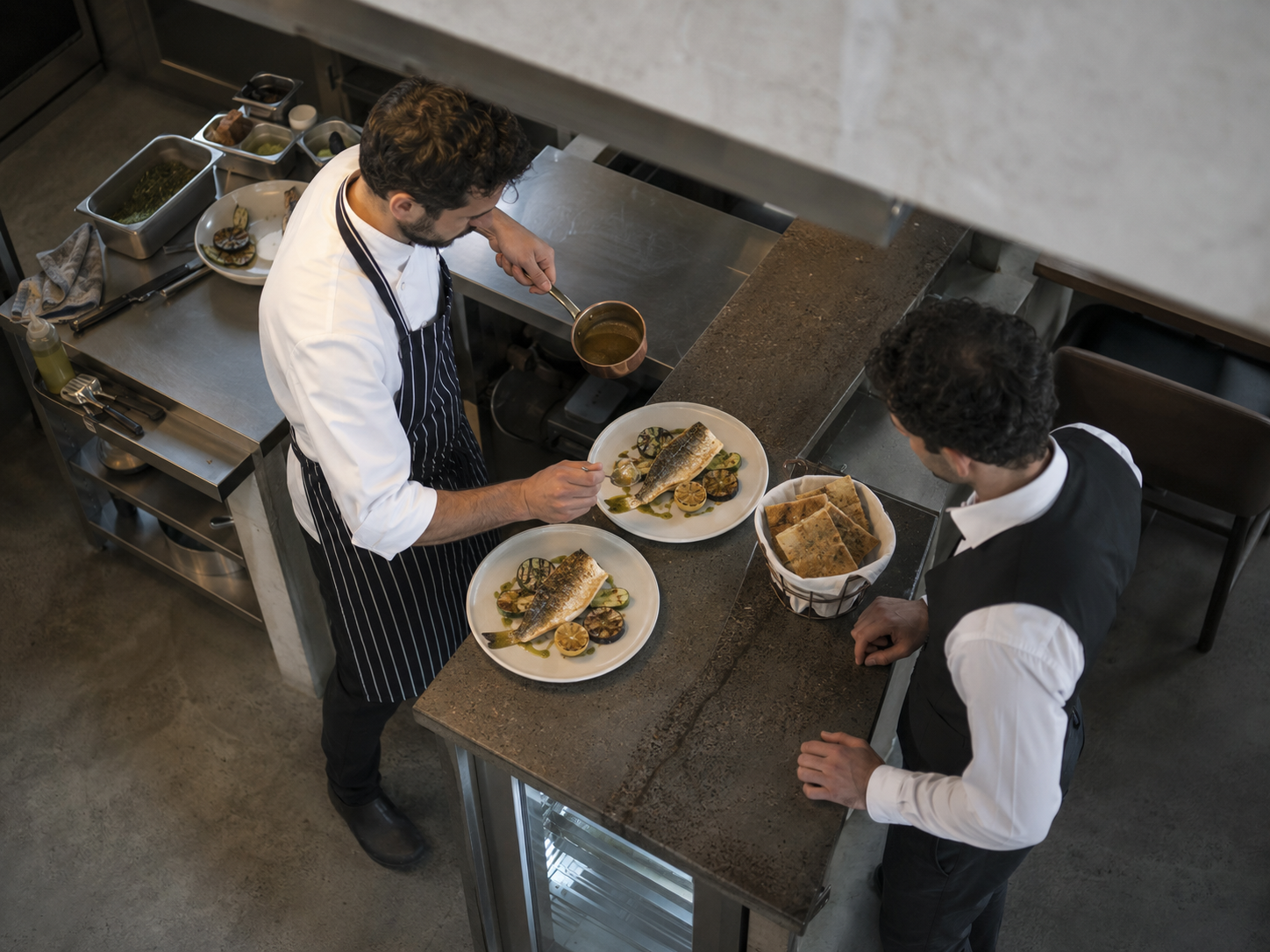
Plating is often spoken about as though it were the final decorative stage of cooking. The food is finished, the preparation is complete, and now we make it look nice. But I think this is one of the reasons plating becomes so easily misunderstood. Plating begins much earlier than the moment when a cook picks up a pair of tongs and starts arranging food on a plate. The moment a cook begins to imagine how the guest will receive the dish, plating has already begun.
And when we say plate, we should not imagine only a round piece of white ceramic. The dish may arrive in a bowl, a basket, a copper pot, a paper cone, a banana leaf, a cardboard container, a wooden board, a folded piece of paper, or directly onto a surface at the table. It may be brought by a waiter, passed through the window of a food truck, placed in the middle of a communal table, assembled in front of the guest, or unpacked from a takeaway bag twenty minutes after it left the restaurant.
The plate is simply the place where the preparation becomes available to the person who is going to eat it. That place may be formal or casual, permanent or disposable, refined or improvised, but it always creates a boundary. It gives the dish a space, a limit, and a frame. Inside that frame, the cook has to decide how the food will be arranged, what the guest will notice first, how the components will relate to one another, and how the dish will be eaten. This is why plating is not only about appearance. It is about arrangement, access, sequence, portion, temperature, texture, and meaning. It is the moment when the restaurant says: this is what we prepared for you, and this is how we want you to receive it. The deeper question is not simply how the dish should look. It is how the dish should be encountered.
The Plate Is a Frame
One of the most useful ways to think about plating is to understand that the plate creates a frame. It gives the cook a defined space in which the elements of the dish have to be arranged. That space may be circular, square, rectangular, deep, shallow, narrow, wide, flat, or curved. It may be ceramic, metal, paper, wood, leaf, glass, or cardboard. But whatever its form, it creates a working area where decisions have to be made.
This may sound obvious, but many cooks are never really taught to think this way. They are taught to cook the components, season properly, prepare the sauce, portion the protein, finish the garnish, and then “put it on the plate.” But placing food on a plate is not the same as composing a dish. A composition asks how elements sit in relation to one another. It asks about weight, space, direction, contrast, proportion, balance, and focus. This does not mean every cook needs to become artistic in some intimidating sense. Plating with intention is not reserved for people who think of themselves as ‘artistic’. It is actually closer to design. You can learn principles of composition by looking carefully at photographs, drawings, paintings, architecture, product design, table arrangements, market displays, or even the way objects sit on a wall. The point is not to copy another discipline. The point is to train the eye to notice how things occupy space.
A plate gives you a limited area. You cannot arrange forever. You cannot keep adding elements beyond the edge of the dish because the idea continues in your head. The frame forces decisions. If there is too much food, the plate becomes crowded, heavy, careless, or physically difficult to eat. If there is too little, it may feel mean, unfinished, or disconnected from the promise of the restaurant. The right amount is not always defined by a minimalist, or an abundantly grotesque approach. It depends on the dish, the menu, the price, the guest, and the type of experience being offered.
There is also a technical side to this. Portioning is not only aesthetic. A restaurant has a recipe, a yield, a number of portions, a cost structure, and a service rhythm. The cook cannot place as much as they feel like placing every time. The dish has to be repeatable. The portion has to make sense visually, but it also has to respect the formula. The plate is where design and discipline meet. It has to look right, eat well, and remain possible for the kitchen to reproduce.
This is where plating becomes a practical composition problem. How do we make the dish look right inside the space available? How do we make it generous without losing control? How do we make it elegant without becoming empty? How do we make it abundant without turning it into a pile? How do we arrange the elements so that the guest understands the dish and can actually eat it? These are questions of design, but they are also questions of cooking.
The Dish Changes When It Leaves the Kitchen
A dish exists differently in the kitchen than it does for the guest. In the kitchen, the cook sees components. The sauce is in one container, the vegetables are somewhere else, the protein is resting, the garnish is ready, the plate is warming, and the final herbs are still waiting to be cut. The guest does not receive those components separately. The guest receives the composition.
This is one of the reasons the plate becomes such an important point of contact between the kitchen and the dining room. A recipe may tell us which ingredients are used and how they are prepared, but plating determines how the result becomes visible and how the guest begins to understand it. Where is the sauce? What does the guest see first? Which element appears dominant? Which texture is protected? What is meant to be eaten together, and what is meant to remain separate? Where does the first bite begin? These are not minor decorative questions. They affect the actual experience of eating.
The vessel itself changes that experience. A bowl allows sauce to collect differently from a flat plate. A paper cone makes sense for food eaten while walking or standing. A wooden board may suggest sharing, fire, or a more rustic kind of eating. A small copper pot can preserve heat and make the dish feel as though it has arrived directly from the cooking process. A banana leaf can hold food, perfume it, and connect the dish to a specific culinary tradition or place. The vessel also changes movement. It changes temperature. It changes how large or small the portion appears. It determines whether the guest can cut the food comfortably, whether the sauce pools in one place, whether something crisp remains crisp, and whether the dish should be eaten with a spoon, a knife, chopsticks, or the hands. A beautiful dish on the wrong vessel can become awkward, while a very simple dish on the right one can feel completely resolved.
Street food often understands this extremely well. Imagine standing in front of a market stall and being passed a small cardboard plate. There is rice, perhaps some meat, a sauce on one side, something fresh, and a small garnish or condiment. Everything has been placed so that you can hold the plate with one hand and reach every part of the meal comfortably. That is excellent plating. It may not involve tweezers, edible flowers, or carefully measured negative space, but the cook has understood the guest, the environment, the vessel, and the way the food will actually be eaten.
At the opposite end of the restaurant world, a high-end kitchen may have several cooks involved in plating one course. Every component has a precise position. The waiters carry the dishes carefully and place them in front of the guests at the same time through a seamless coreography. They may even turn the plate slightly so that the composition faces the diner exactly as the chef intended. That is also plating. The scale is different, but the purpose is the same: food has been intentionally arranged for the experience being offered.
Aesthetics Are Part of Understanding
Appearance matters because food reaches most of us first through the eyes first. Before tasting anything, we see color, shape, volume, steam, moisture, freshness, contrast, and proportion. We see whether something appears crisp, soft, raw, roasted, glazed, charred, cold, or hot. A dark sauce against a pale purée creates a different expectation from the same sauce disappearing beneath it. A fresh herb scattered over a stew may communicate brightness and immediacy. A piece of meat cut open reveals doneness. A layer of crumbs tells the guest that something may be crisp before they have touched it.
Aesthetics are not superficial when they help the guest understand the food. The visual arrangement can reveal texture before the first bite. It can show hierarchy. It can tell us whether the dish is abundant, restrained, rustic, delicate, precise, or generous. It can create anticipation. But the appearance has to belong to the dish. A plate should not become a separate visual performance disconnected from the way the food tastes, moves, and is eaten. This is why plating begins long before the final arrangement. It may begin with the way a vegetable is cut. A carrot sliced into long ribbons creates one visual and physical experience. The same carrot cut into dice creates another. A whole roasted onion has a different presence from an onion purée. A fish served whole creates a different relationship with the guest from a fillet. The geometry of the plate is often decided during prep.
One of the most useful things a plate can do is make texture legible. If something is crisp, let the guest see it. If something is creamy, allow that softness to be visible. If a raw ingredient is meant to contrast with something cooked, help that relationship appear. This does not mean every ingredient must sit separately. Some dishes are meant to be mixed, and some preparations derive their pleasure precisely from ingredients becoming inseparable. But even then, the cook needs to decide what the guest should understand before eating. The plate should support the structure of the dish, not display every component simply because someone worked hard to make it.
The Plate Has to Be Eaten, Not Only Seen
One of the easiest mistakes in plating is to stop evaluating the dish once it looks good. But the plate is not a photograph, or a social media post. The guest begins eating, and then everything changes. The sauce moves, the garnish disappears, the meat is cut, the crisp element begins absorbing moisture, and the hot and cold components begin moving toward the same temperature. The first bite may be completely different from the last.
A good plate has to consider how the food will disappear. Can the guest get enough sauce with the protein? Does the garnish last through the whole dish, or is it gone after two bites? Is all the acidity concentrated in one part of the plate? Does the guest need to chase small ingredients around a surface that is too large? A plate may look beautiful in a photograph and eat terribly. This is why one of the most important tests is simply to sit down and eat the whole thing. Not one perfect bite assembled by the chef, but the entire plate. Begin wherever a guest might begin. Cut into it. Move the food. Let the sauce spread. Wait a few minutes and see what happens to the textures. The plate is not a static image. It is a sequence.
This sequence can also carry the larger culinary language of the restaurant. A restaurant centered on fire, smoke, communal eating, and heritage may naturally use terracotta, wood, shared platters, whole ingredients, charred surfaces, or sauces designed for dipping and passing. A highly technical restaurant may work with another visual language: controlled portions, fine ceramics, precise temperature contrasts, sequential service, or elements revealed at the table.
Neither approach is automatically more authentic. The important thing is that the plating belongs to the culinary approach. A restaurant that speaks constantly about earth, fire, ancestry, and elemental technique may feel disconnected if every dish arrives on anonymous banquet porcelain. In the same way, a restaurant built around speed and convenience may create unnecessary problems if every preparation requires elaborate vessels that are difficult to carry, clean, store, and replace. The plate should reinforce the larger idea, not contradict it.
Service Continues the Plating Intention
The plate does not stop being part of the kitchen’s work when it crosses the pass. How it travels also matters. The server may carry it by hand or on a tray. It may be placed in the center of the table for sharing. It may arrive under a lid. It may need to be turned so the composition faces the guest properly. Something may happen at the table before the guest begins eating: a sauce is poured, a broth is added, a package is opened, a lid is removed, or a final garnish is placed. All of this remains part of plating.
Sometimes the dish is not complete until the guest is present. That can be extremely effective, but table-side finishing should have a reason. It may release aroma, protect temperature, reveal something, create a transformation, or help the guest understand how the dish should be eaten. If it only adds theater and delays the meal, perhaps it does not belong there. This is where the plate has to survive the real restaurant. A dish may look perfect at the pass and fail before reaching the table. The sauce shifts, the garnish falls, the ice cream melts, the crisp element becomes soft, the plate cools, a bowl is too hot for the waiter to carry comfortably, or food slides when someone walks quickly across the dining room. These are plating failures too.
The plate must be tested under service conditions. How far is the table? How long might the dish sit at the pass? Can one server carry it? Can three plates be carried at the same time? Does the composition survive movement? Does the vessel hold enough heat? A plate designed only while standing quietly at the kitchen counter is incomplete. It has to survive the service trajectory. Also, a beautifully designed dish can still be operationally impossible. This happens more often than we like to admit. The chef develops the dish during a quiet afternoon. Each element is placed carefully. One plate takes five minutes to complete, and the result looks excellent. Then service begins. Twenty orders arrive. Now the same five-minute plating process becomes a disaster. Several cooks are trapped at the pass, hot food waits, other dishes are delayed, and plates from the same table leave at different times. The plating has failed, not aesthetically, but operationally.
Every plating design has a labor cost. How many hands are required? How many tools? How many containers? How many squeeze bottles? How many small garnishes? How much clean surface does the cook need? Can one person reproduce the plate during peak volume? The answer depends on the restaurant. A tasting-menu restaurant serving a limited number of guests can invest much more time in each plate than a high-volume casual operation. The plate has to belong to the service model. In this calculation, heat is more important than perfection. A beautifully plated hot dish that arrives cold is badly plated. If the cook needs so much time to arrange everything that the protein loses temperature, then the composition needs to change. If the garnish process delays the pass, simplify it. If several plates have to wait for too long before a table can be served together, review the sequence. Sometimes the slightly less perfect-looking plate that reaches the guest hot is the better plate. A restaurant is serving food, not photographs. Temperature is part of the dish.
Consistency, Cost, and Portion Are Part of the Plate
A restaurant dish needs a recognizable identity. The guest may have seen it online, received a photograph from a friend, or arrived because someone recommended it. They come with an expectation. If the pizza that was covered generously with mushrooms now has only a few pieces, if the composed garnish has become a handful of herbs scattered on top, or if one cook places the sauce underneath while another pours it over and another forgets it completely, the restaurant is no longer serving variations. It is breaking its promise.
This is why plating needs a standard. Which vessel? Which portion? How much sauce? Which garnish? What must always be present? How should the main element face? Food does not need to look industrially identical. A leaf will not bend the same way every time, and a piece of fish may vary slightly in shape. Handmade food carries natural differences. But the identity should remain. The guest should receive the dish that the restaurant promised. That standard has to be teachable. A plating design that only the chef can reproduce is not yet a restaurant system. The team needs to understand it. A photograph may help, a diagram may help, and a short plating sequence may help, but what matters is that the critical points are visible. The sauce cannot touch the crisp element. The herb is cut at the last moment. The bowl must be warm. The protein rests before slicing. The plate is turned toward the guest in a specific direction. This is where plating moves from personal instinct into shared practice.
Plating is also financial. Every extra element costs something: the garnish, the sauce, the oil, the flower, the extra slice of cheese, the decorative crumb, the larger portion. One small amount may look irrelevant on one plate, but across hundreds of plates, it is not. A dish can be popular and still be unprofitable. I once managed a brewery restaurant where a cold-cuts board sold extremely well. Guests liked it, it suited the environment, and people ordered it constantly with beer. The problem was that the restaurant made almost no profit from it. The ingredients were expensive, and the board was so generous that it had to be sold close to cost. The owners argued that guests ordered other profitable things with it, and that may sometimes be a legitimate strategy. But if that strategy has not been measured carefully, it can also become an excuse for keeping an unprofitable dish. The fact that something sells does not automatically mean that it works financially. Plating determines how much product leaves the kitchen, and that amount has to be controlled. Portioning also changes the way the guest perceives value. Too little food on a large plate may look mean. Too much food on a small plate may look careless. A generous portion can communicate abundance. A smaller portion can communicate precision or restraint. But there is no universal correct amount. The plate needs to fulfill the restaurant’s promise.
Returned plates give information. If the same dish repeatedly comes back with a large amount of food untouched, perhaps the portion is too large. Perhaps one component is not enjoyable. Perhaps the balance is wrong. Plate waste is feedback. This is also where generosity needs to be examined carefully. Cooks often try to show generosity by adding more sauce, more garnish, more meat, more fries, or more cheese. But uncontrolled generosity can damage both the dish and the business. A guest may not need more. They may need a better proportion. Generosity should be analyzed and designed accordingly.
The Guest, the Final Test
Chefs can become attached to the image of a dish, but the guest has to eat it. Can the guest cut it comfortably? Can the spoon reach the bottom? Does the bowl move across the table? Is the knife appropriate? Are there bones that were not explained? Does the paper tear? Does the sauce leak? These are plating questions.
Takeaway and delivery make this especially clear. A restaurant cannot always take a dining-room dish and simply place it inside a container. A preparation designed to be eaten immediately may fail after twenty minutes. Sauces move, steam accumulates, fried food softens, hot and cold components become the same temperature, and garnishes wilt. The restaurant has to rethink the composition. Perhaps the sauce travels separately, perhaps the garnish is added by the customer, perhaps the container needs ventilation, perhaps the portion needs to change, or perhaps the dish should not be offered for delivery at all. This is not a lesser form of plating. It is another form. The plate simply happens to be a box. The guest still receives a composition, and the restaurant still has to decide how that composition arrives.
Like every other part of a dish, plating should be tested. Make the first version and eat it. Carry it to a table. Leave it for five minutes. Photograph it. Serve it to someone who did not develop it. Watch how they eat. Measure the plating time. Cost the portion. Repeat the plate under pressure. Ask another cook to reproduce it. The first attractive arrangement is not necessarily the final one. A plate may need to change because the garnish falls, the last bites become dry, the portion is too large, the sauce cannot be controlled, the vessel is difficult to wash, or the guest has no idea how to begin. The final plating should emerge through tested use. For repeatable restaurant work, the plate eventually needs to become part of the formula. Not only the ingredients and method, but the sequence, portion, vessel, temperature, timing, final check, and the way the dish leaves the pass. The creative idea remains, but now it can be executed again. This is the point where authorship becomes restaurant practice.
Social media has made the appearance of food more visible than ever. A dish may now be seen thousands of times before anyone tastes it, and that matters. A recognizable plate can bring guests to a restaurant and become part of its identity. But a dish cannot be designed only for the camera. The camera does not taste temperature, struggle to cut through an awkward stack, notice that the crisp garnish becomes soft after thirty seconds, or pay the bill. The guest does. The strongest plates survive both. They communicate visually and eat well.
There is no universal style of good plating. Until the preparation is placed in front of the guest, the dish remains partly an idea inside the kitchen. Plating makes it real. It gives the food a boundary, a direction, a scale, and a visual language. It decides what the guest sees first, what remains hidden, what touches, what stays separate, what is shared, what is eaten by hand, what requires a spoon, what arrives hot, and what needs explanation. The best plating does not simply make food look better. It makes the intention clearer. It helps the restaurant serve the dish consistently, and it helps the guest eat it as well as possible. The plate brings the work of the kitchen to its final point. Here is what we made for you.
Plating Is Part of the Dish: How Presentation Shapes Service and Meaning