The Scale
The Mechanics of Proportion
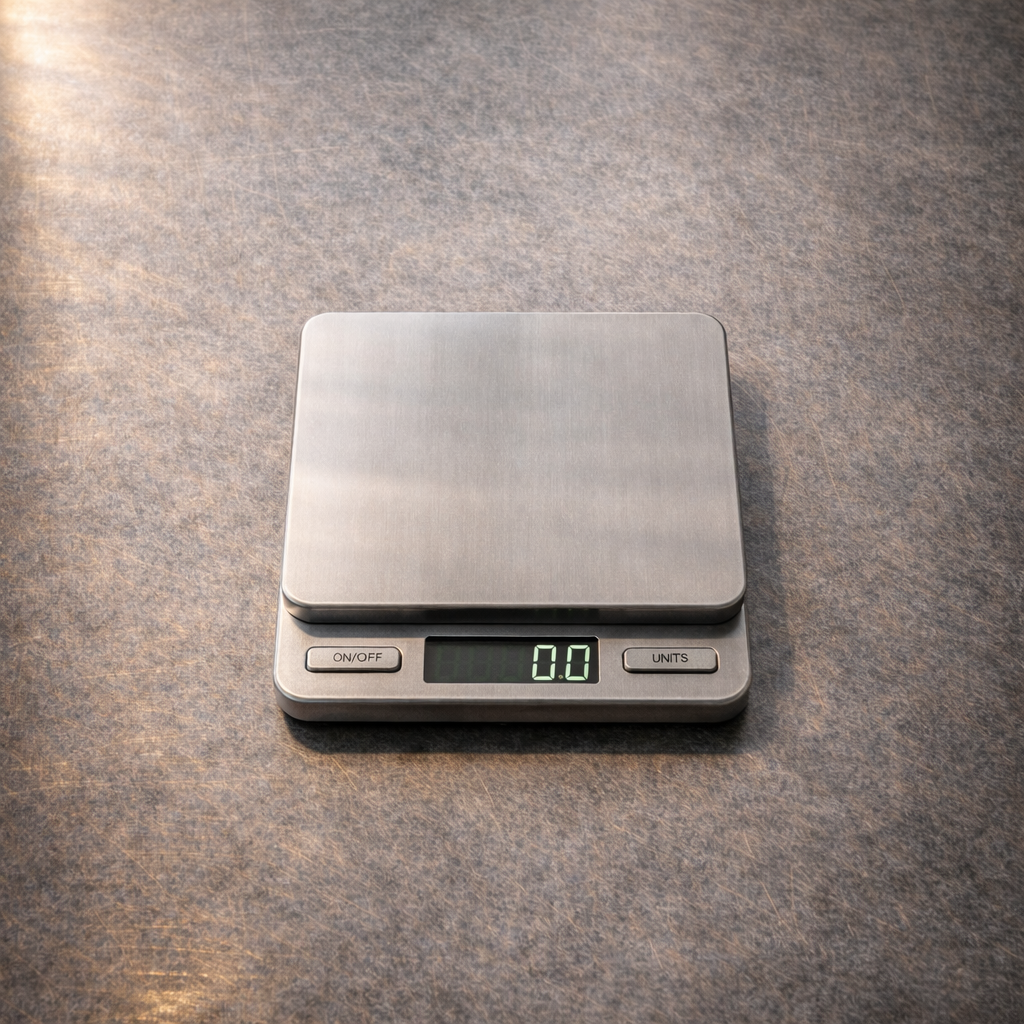
Cooking often begins with instinct. A cook tastes, adjusts, and balances flavors until a preparation feels right. But the moment a recipe succeeds, another question appears: can it be repeated? The scale provides the answer. By measuring ingredients precisely, the scale allows cooks to record proportions and consistently recreate successful preparations. It also introduces discipline into the kitchen, transforming creative discoveries into reliable formulas. In professional kitchens, the scale becomes not only an instrument of precision but also a tool of organization, consistency, and economic control.
Function
The primary function of the scale is to measure ingredients accurately. This simple task has profound consequences in professional cooking. Weight measurements allow recipes to be standardized and repeated with consistency. Even small variations in proportions can alter texture, flavor, or yield. In pastry and baking, scales are indispensable because the balance between ingredients determines the structure of the preparation. But even in savory kitchens, scales are used to ensure that sauces, marinades, spice blends, and garnishes maintain consistent proportions. Through measurement, the scale transforms cooking into a process that can be replicated, documented, and refined over time.
Geometry
Scales appear in different sizes depending on the type of work being performed in the kitchen.
Precision Scales
Small precision scales measure extremely light quantities. These are often used for ingredients such as spices and stabilizers, as well as for expensive products like saffron. They can measure down to fractions of a gram and are frequently found on service stations where small adjustments are made.
Preparation Scales
Medium-sized scales are the most commonly used in kitchens. They are typically used during preparation to weigh ingredients such as flour, sugar, liquids, or produce. These scales balance accuracy with practical capacity and are used repeatedly throughout the day.
Industrial Scales
Large kitchens, hotels, and production facilities often require heavy-duty scales. These scales are used in receiving areas to weigh large deliveries such as sacks of flour, crates of produce, or bulk ingredients. Because of their size and calibration requirements, they are usually kept in fixed positions and not moved frequently.
Materials
Scales typically combine metal, glass, and electronic components. The weighing surface is usually stainless steel or tempered glass, allowing the instrument to be cleaned easily and withstand regular use. Because scales contain sensitive measuring mechanisms, they must be protected from excessive impact, moisture, and heavy stacking during storage.
Ergonomics
Scales are designed to simplify measurement during fast-paced kitchen work. Key ergonomic features include:
• a stable flat weighing surface
• easy-to-read measurement displays
• quick unit conversion between grams and ounces
• a tare function that allows the scale to reset to zero
The tare function is particularly important. By placing a bowl or container on the scale and resetting it to zero, cooks can measure ingredients sequentially without including the container's weight. This allows multiple ingredients to be added to the same bowl while maintaining accurate measurements.
Analog vs Digital
Both analog and digital scales remain common in kitchens.
Analog Scales
Analog scales operate mechanically and do not require batteries or electricity. They are durable and often easier to recalibrate. However, they usually provide less precise readings when measuring very small quantities.
Digital Scales
Digital scales provide highly precise measurements and can display small decimal values. Many compact models are portable and easy to use. Because of their electronic components, they require batteries or power sources and may need periodic recalibration. Both types remain useful, and many kitchens use a combination of the two.
Choosing the Tool
A professional kitchen rarely relies on a single scale. Different tasks require different levels of precision and capacity. A well-equipped kitchen may include several scales so that multiple cooks can measure ingredients simultaneously without interrupting workflow. Selecting the correct scale depends on the type of preparation being performed. Precision scales are ideal for delicate measurements, while larger scales handle bulk ingredients and heavy preparations.
The Scale in the Creative Process
The scale plays an important role in culinary creativity. When a cook develops a successful preparation, recording the exact proportions of ingredients allows the recipe to be repeated later. Without measurement, even a perfect preparation may be impossible to reproduce consistently. Many cooks have experienced the frustration of creating a successful dish only to realize that the exact proportions were never recorded. The scale transforms those moments of discovery into repeatable knowledge.
The Scale and Kitchen Economics
Beyond cooking, the scale also plays an important role in managing a kitchen's resources. Precise measurement allows kitchens to control portion sizes, calculate recipe costs, and monitor ingredient usage. If portions vary from plate to plate, the kitchen loses control over both quality and cost. By weighing ingredients and portions consistently, cooks maintain both culinary and economic balance. In this way, the scale becomes not only a tool for cooking but also a tool for business intelligence in the kitchen.
Common Misconceptions
One misconception is that experienced cooks no longer need scales because they can measure ingredients by eye. While intuition improves with experience, precision remains essential for consistency. Even small variations can accumulate across multiple preparations. Another misunderstanding is that scales are used only during preparation. In many kitchens, scales are used during service to ensure consistent portioning and plating.
Closing Reflection
The scale represents a moment of discipline within the creative process. It allows cooks to translate intuition into measurable proportions and to transform successful preparations into reliable recipes. Through weight and proportion, cooking becomes not only expressive but also repeatable. In this way, the scale anchors creativity in precision.