The Thermometer
The Instrument of Temperature Awareness
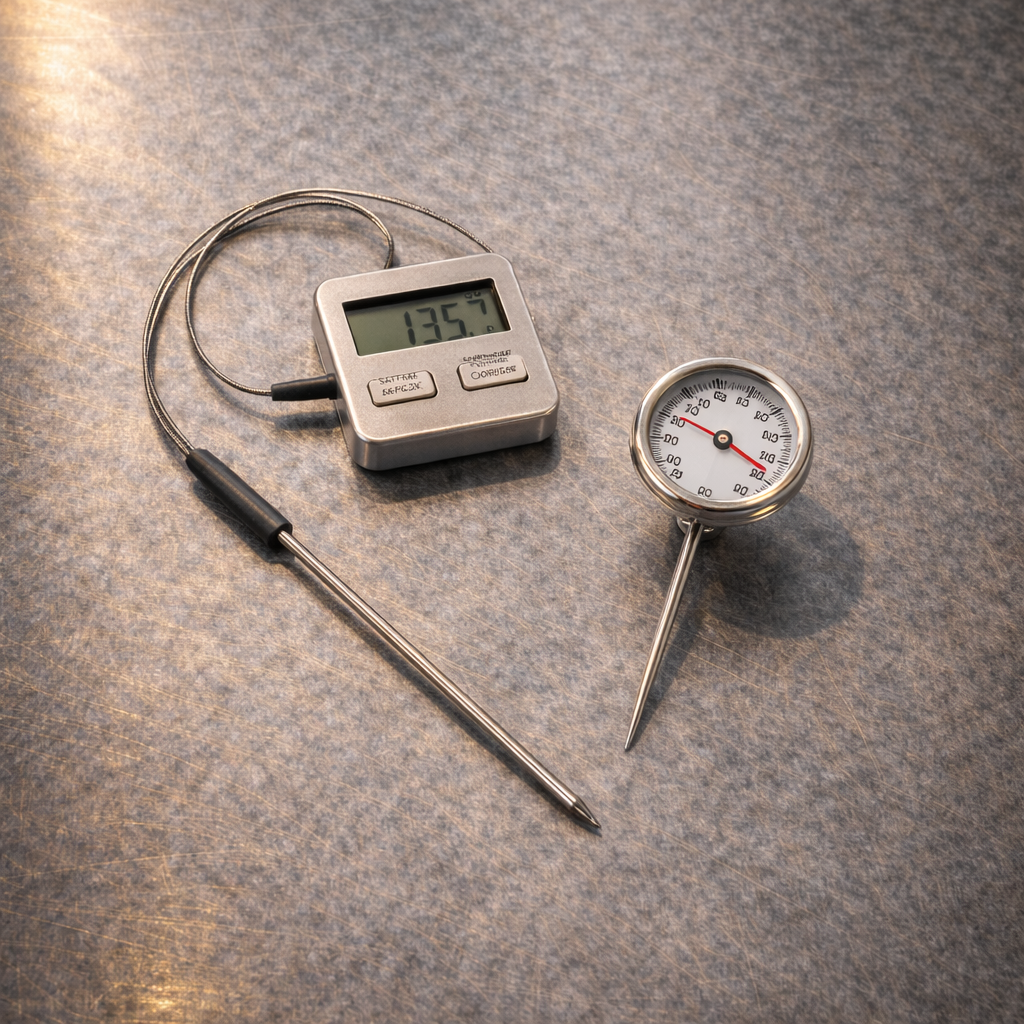
Heat transforms ingredients. Eggs coagulate, sugar caramelizes, butter emulsifies, and proteins firm or relax depending on the temperature they reach. Yet these transformations are often invisible until it is too late. The thermometer allows cooks to observe what cannot be seen directly. By measuring temperature, cooks gain awareness of the precise moment when ingredients change from raw to cooked, from stable to unstable, or from perfect to ruined. In professional kitchens, the thermometer is therefore not only a cooking tool but also a safeguard for quality, safety, and consistency.
Function
The thermometer measures temperature in order to monitor the transformation of ingredients. Temperature affects nearly every stage of cooking. It determines how ingredients cook, how long they remain safe to store, and how stable certain preparations will be. Thermometers are used to:
• verify the internal temperature of meats and fish
• control sugar work and caramelization
• temper chocolate
• regulate frying oil
• monitor fermentation processes
• verify refrigerator and freezer temperatures
• check the temperature of ingredients upon delivery
Without temperature awareness, cooks often rely solely on visual cues, which may appear too late in the process.
Temperature and the Preservation Chain
Temperature management begins before cooking even starts. When ingredients arrive in a professional kitchen, thermometers are often used to verify that products have been transported under proper refrigeration conditions. Milk, meat, fish, and dairy products must remain within safe temperature ranges during transport. If this chain is broken, ingredients may spoil even before they are used. For this reason, thermometers also play an important role in receiving deliveries and maintaining food safety standards.
Geometry
Thermometers appear in several forms depending on the type of measurement required.
Probe Thermometers
Probe thermometers measure internal temperature. A metal probe is inserted into the center of a preparation, allowing cooks to determine how hot the product's interior has become. These are essential for roasting meats, cooking large cuts, and verifying doneness without cutting the product open.
Immersion Thermometers
Immersion thermometers are used for liquids and mixtures. They are placed directly into sauces, custards, syrups, or frying oil to monitor temperature changes during cooking.
Infrared Thermometers
Infrared thermometers measure surface temperature without contact. These devices use a laser pointer to estimate the temperature of a surface from a short distance. They are useful for quickly checking pans, griddles, and cooking surfaces.
Installed Thermostats
Many appliances include built-in thermometers. Ovens, refrigerators, freezers, and proofing cabinets rely on thermostats to regulate temperature automatically. However, these built-in systems are not always perfectly accurate and often require verification with independent thermometers.
Materials
Most thermometers combine metal probes with glass, plastic, or electronic components.
Probe thermometers are typically made with stainless steel sensors that can withstand heat and moisture. Digital thermometers use electronic sensors to convert temperature into numerical readings.
Because thermometers are precision instruments, they must be handled carefully and protected from impacts or extreme humidity.
Ergonomics
Thermometers are designed to provide fast and readable temperature feedback. Key ergonomic features include:
• clear temperature displays
• fast response times
• heat-resistant probes
• compact and portable designs
Many digital thermometers now provide instant readings, allowing cooks to check temperatures quickly without interrupting the cooking process.
Choosing the Tool
Different tasks require different types of thermometers. Probe thermometers are essential for cooking meats and thick preparations. Immersion thermometers are ideal for syrups, custards, and frying oils. Infrared thermometers provide quick surface readings. Professional kitchens often maintain several thermometers so that cooks can monitor temperatures at multiple points in the cooking process.
Precision and Verification
Like all measuring instruments, thermometers must be periodically verified. If a thermometer becomes inaccurate, it can mislead the cook and compromise a preparation. Comparing measurements between two thermometers is one simple method of verifying accuracy. In highly precise cooking, even small temperature differences can affect results. Pastry work, chocolate tempering, and sugar work require particularly accurate temperature readings. In these contexts, a difference of only a few degrees can determine whether a preparation succeeds or fails.
Temperature in the Creative Process
Temperature also shapes culinary creativity. Many techniques rely on controlling precise temperature thresholds. Sugar changes stages as it heats, chocolate crystallizes at specific temperatures, and custards thicken within narrow thermal ranges. Understanding these transformations allows cooks to manipulate texture, structure, and flavor. In this sense, the thermometer becomes an instrument that reveals the hidden physics of cooking.
Common Misconceptions
One misconception is that experienced cooks can judge temperature without tools. While experienced cooks develop intuition, many transformations occur within temperature ranges that cannot be reliably estimated by sight or touch. Another misunderstanding is that appliance thermostats always provide accurate readings. In reality, ovens and refrigerators often vary in temperature depending on their position and calibration. Independent thermometers help verify these conditions.
Closing Reflection
Heat is one of the most powerful forces in the kitchen. It can preserve ingredients, transform them into new textures, or destroy them if uncontrolled. The thermometer allows cooks to navigate this invisible territory with awareness. By revealing temperature, the thermometer makes the hidden transformations of cooking visible.