The Strainer & The Sieve
The Mechanics of Refinement
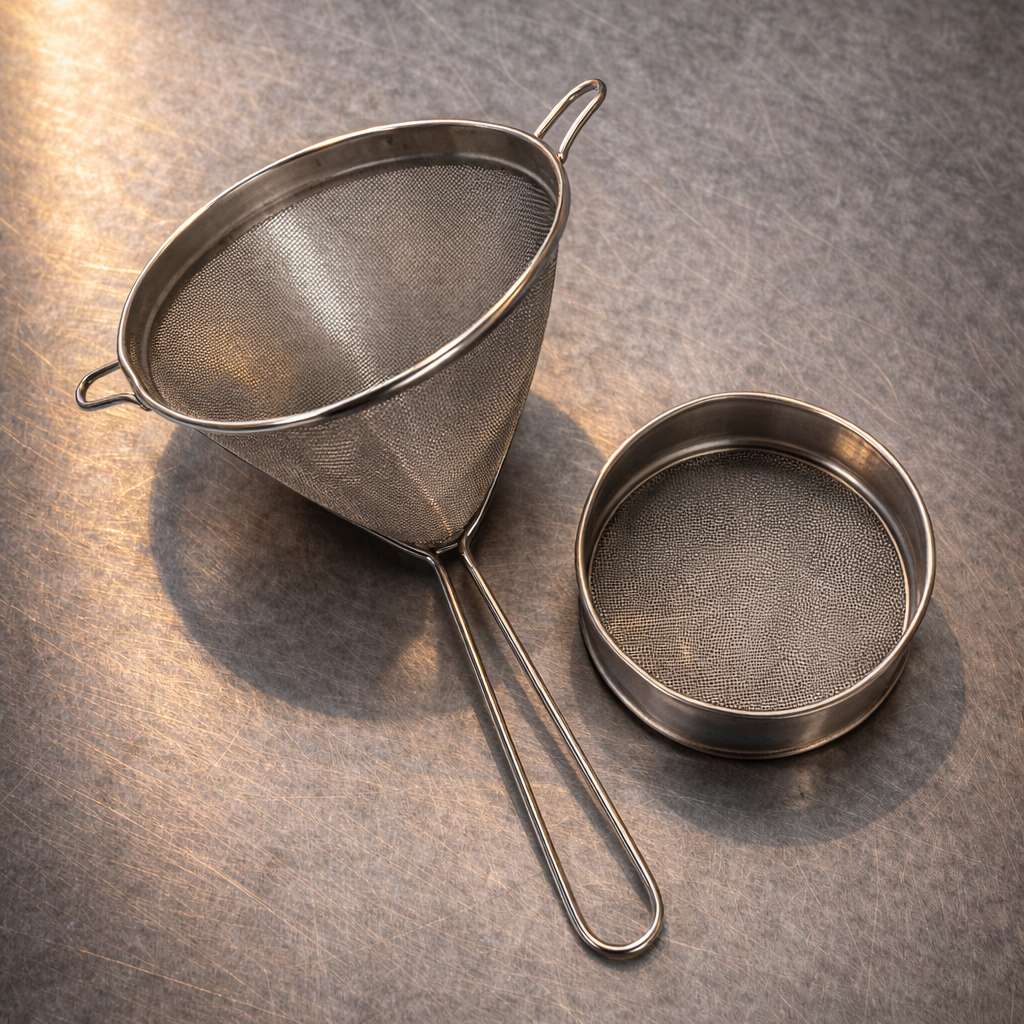
Not every preparation reaches its final form directly from the pot or mixing bowl. Many must pass through a moment of refinement. This is where the strainer and the sieve enter the process. These instruments separate liquids from solids, smooth sauces, clarify broths, refine purées, and break apart powders. Through them, texture becomes controlled and consistent.
At the center of their operation lies a simple but powerful principle: the mesh. The size, resistance, and structure of the mesh determine what passes through and what remains behind. In this way, strainers and sieves allow cooks to filter, refine, and standardize preparations with precision.
Function
Strainers and sieves perform the essential task of separating and refining ingredients. Their applications in the kitchen are extensive. They can be used to:
• strain stocks and broths
• remove solids from sauces
• refine purées
• sift powders such as flour or cocoa
• filter juices and infusions
• control the texture of ingredients through granulometry
In professional kitchens, the difference between a rustic and a refined preparation often depends on whether it has been strained or passed through a sieve.
Geometry
The geometry of strainers and sieves varies according to their intended use.
Bowl Strainers
These are the most common forms. They consist of a metal mesh basket supported by a rigid metal frame and handle. They are often used for everyday filtration tasks such as straining sauces, draining pasta, or removing solids from liquids.
Conical Strainers (Chinois)
The conical strainer allows gravity and pressure to work together. Because of its tapered shape, liquids collect and flow downward efficiently, making it ideal for refining sauces or clarifying stocks. These strainers are often paired with ladles or spatulas used to push preparations through the mesh.
Drum Sieves (Tamis)
Drum sieves provide a flat filtration surface and are commonly used for powders and purées. They allow cooks to push ingredients across the mesh to produce smooth, consistent textures.
The Role of the Mesh
The most important characteristic of a strainer or sieve is its mesh. Mesh size determines how much material passes through and how much remains behind. Some meshes are delicate and designed only to filter liquids or fine powders. Others are reinforced and built to withstand pressure when ingredients are pushed through them with a ladle or spatula. A strong mesh allows cooks to extract the maximum amount of liquid or refined purée from a preparation while leaving unwanted fibers or solids behind. Understanding mesh strength and density is essential to selecting the correct instrument.
Granulometry
When cooks begin to work with precise formulations, another concept becomes important: granulometry.
Granulometry refers to the measurement and control of particle size. In some sieves, the mesh is numbered. These numbers indicate the exact size of the openings in the mesh, allowing cooks to obtain ingredients of a consistent grain size. This is particularly important in preparations such as:
• finishing salts
• spice blends
• cocktail rimmers
• powdered ingredients
• pastry work
By passing ingredients through specific meshes, cooks can ensure that each particle falls within a defined size range. This allows textures and appearances to remain consistent from one preparation to the next.
Materials
Professional strainers and sieves are almost always made from stainless steel mesh supported by a metal frame. Metal meshes are preferred because they:
• resist heat
• maintain structural integrity under pressure
• tolerate both hot and cold preparations
• remain stable during repeated use
Plastic meshes exist but are rarely suitable for professional culinary work. They can absorb food dyes, and smells, and they can deform under heat or pressure, and do not provide the same durability as metal constructions.
Ergonomics
Strainers are frequently used while holding or transferring hot liquids. Their design must therefore provide stability and control. Important ergonomic features include:
• a rigid handle
• a stable supporting rim
• reinforced mesh capable of withstanding pressure
• a balanced geometry that allows liquids to flow smoothly
When pushing ingredients through a strainer, cooks often use a ladle or spatula. For this reason, stronger strainers include structural reinforcement that allows pressure to be applied safely.
Choosing the Tool
Different tasks require different types of strainers. A cook may use:
• a small fine-mesh strainer for filtering juices or sauces
• a reinforced chinois for pushing purées or stocks
• a drum sieve for powders and pastry work
• a coarse strainer for draining ingredients
Selecting the correct mesh size ensures that the desired texture is achieved without damaging the instrument. In practice, most kitchens maintain several strainers with different mesh densities.
Common Misconceptions
One misconception is that all strainers perform the same function. In reality, the mesh density and structural strength of a strainer determine its proper use. A delicate mesh used for filtering citrus juice cannot withstand the pressure required to push dense purées through it. Another misunderstanding is that strainers are used only to remove unwanted solids. In many cases, strainers are used precisely to extract the valuable material, pushing refined textures through the mesh while leaving coarse material behind.
Closing Reflection
Strainers and sieves represent an important moment in the transformation of ingredients. They allow cooks to separate what belongs from what does not. Fibers, seeds, and coarse matter remain behind, while the refined texture continues forward. Through this simple act of filtration, preparations gain clarity, smoothness, and consistency. In this way, the strainer and the sieve become instruments not only of separation, but of refinement.
Related Instruments
Mixing Bowl
Whisk
Scale
Thermometer
Spoon