The Mixing Bowl
Where Ingredients Become
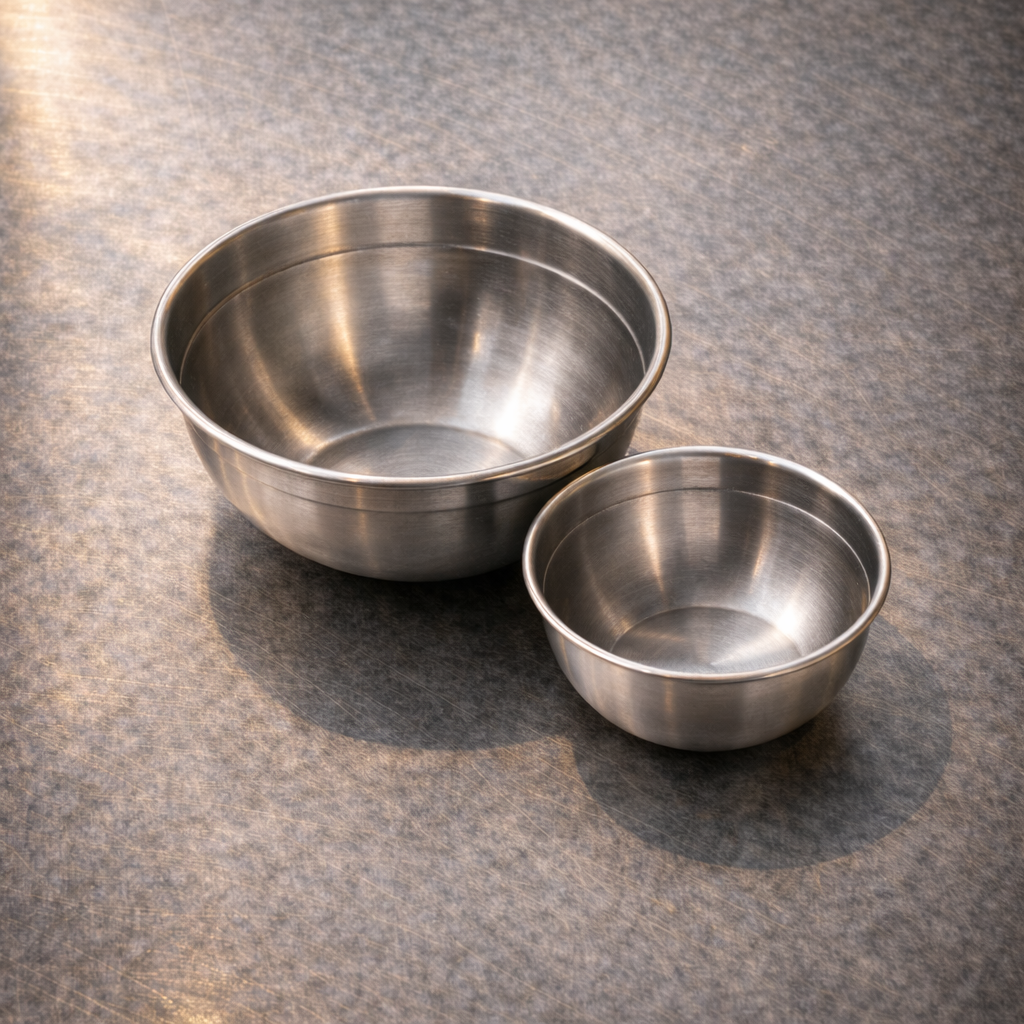
Before heat transforms ingredients, they must first be combined. The mixing bowl provides the space where this transformation begins. Flour meets water, oil meets vinegar, and herbs meet spices. In this simple vessel, ingredients are whisked, folded, marinated, rested, and assembled. Though it may appear modest, the mixing bowl is one of the most frequently used instruments in the kitchen.
From professional kitchens to home cooking, bowls organize the rhythm of preparation. They hold ingredients temporarily, support mixing techniques, and allow cooks to move smoothly between steps in a recipe. In many ways, the bowl is the workspace of mixtures.
Function
The mixing bowl provides a controlled container for combining ingredients. Unlike cooking vessels designed for heat, bowls primarily support manual preparation techniques. Typical uses include:
• whisking emulsions such as vinaigrettes or mayonnaise
• combining batters and doughs
• marinating ingredients
• holding chopped ingredients before cooking
• cooling preparations over ice baths
• staging ingredients for recipes
Because bowls are lightweight and easy to handle, they allow cooks to move quickly between preparation stages.
Geometry
The shape of a bowl affects how it performs in different tasks.
Flat-Bottom Bowls
Flat-bottomed bowls sit securely on work surfaces, making them ideal for mixing, stirring, and whisking. Their stability allows the cook to work efficiently without the bowl moving during vigorous mixing.
Rounded-Bottom Bowls
Rounded bowls are commonly used for techniques involving bain-marie or double boilers. Their curved shape allows them to sit comfortably over pots of hot water when gently heating preparations such as:
• hollandaise
• crème anglaise
• melted chocolate
• sabayon
The curved interior also allows a whisk to move smoothly along the sides of the bowl.
Depth
Depth determines how well a bowl contains ingredients during mixing. Deeper bowls reduce splashing when whisking or tossing ingredients, while wider bowls may be more comfortable for folding delicate preparations.
Materials
Mixing bowls are produced in several materials, each with distinct characteristics.
Stainless Steel
Stainless steel bowls are widely used in professional kitchens. They are lightweight, durable, and resistant to temperature changes. They can move safely from the refrigerator to room temperature without risk of cracking. If dropped, they may dent but rarely break.
Glass
Glass bowls allow the cook to see the mixture clearly and are often used for measuring and presentation. However, they are heavier and can break if dropped.
Plastic
Plastic bowls are lightweight and inexpensive. They are useful for many tasks but may absorb odors or stains over time.
Copper
Copper bowls are traditionally used in pastry work, especially when whipping egg whites. Copper stabilizes proteins in egg whites, allowing them to form stronger foams.
Ergonomics
Because bowls are handled frequently, their usability matters greatly.
Weight
Bowls are generally lighter than other cooking vessels, making them easier to lift, tilt, and handle during mixing.
Thickness
Very thin bowls can bend or become unstable, especially in large sizes. Heavier bowls maintain their shape and provide better stability during mixing.
Stackability
Many kitchen bowls are designed to stack efficiently for storage. This allows large numbers of bowls to be kept without occupying excessive space.
Choosing the Tool
Selecting a bowl depends largely on the task. Consider the following:
• size appropriate for the quantity of ingredients
• material suited to the technique
• stability during mixing
• ease of cleaning and storage
Professional kitchens typically keep multiple sizes of bowls because many preparations occur simultaneously. During busy preparation periods, it often feels as though there are never enough bowls available.
Common Misconceptions
One misconception is that all bowls serve the same purpose. In reality, the material, size, and geometry of a bowl strongly influence how comfortable it is for specific techniques. Another misconception is that bowls are only for mixing. In practice, they serve many roles: staging ingredients, marinating foods, cooling preparations, or temporarily holding components during cooking.
Closing Reflection
The mixing bowl is one of the most quietly essential instruments in the kitchen. It does not cook, cut, or transform ingredients directly. Instead, it provides the space where ingredients meet, combine, and prepare for the next stage of cooking. Simple in appearance but endlessly useful, the bowl supports the invisible choreography of preparation that precedes every dish. In this humble vessel, ingredients take their first step toward becoming a finished preparation.
Related Instruments
Whisk
Spoon
Tongs
Cutting Board
Serrated Knife