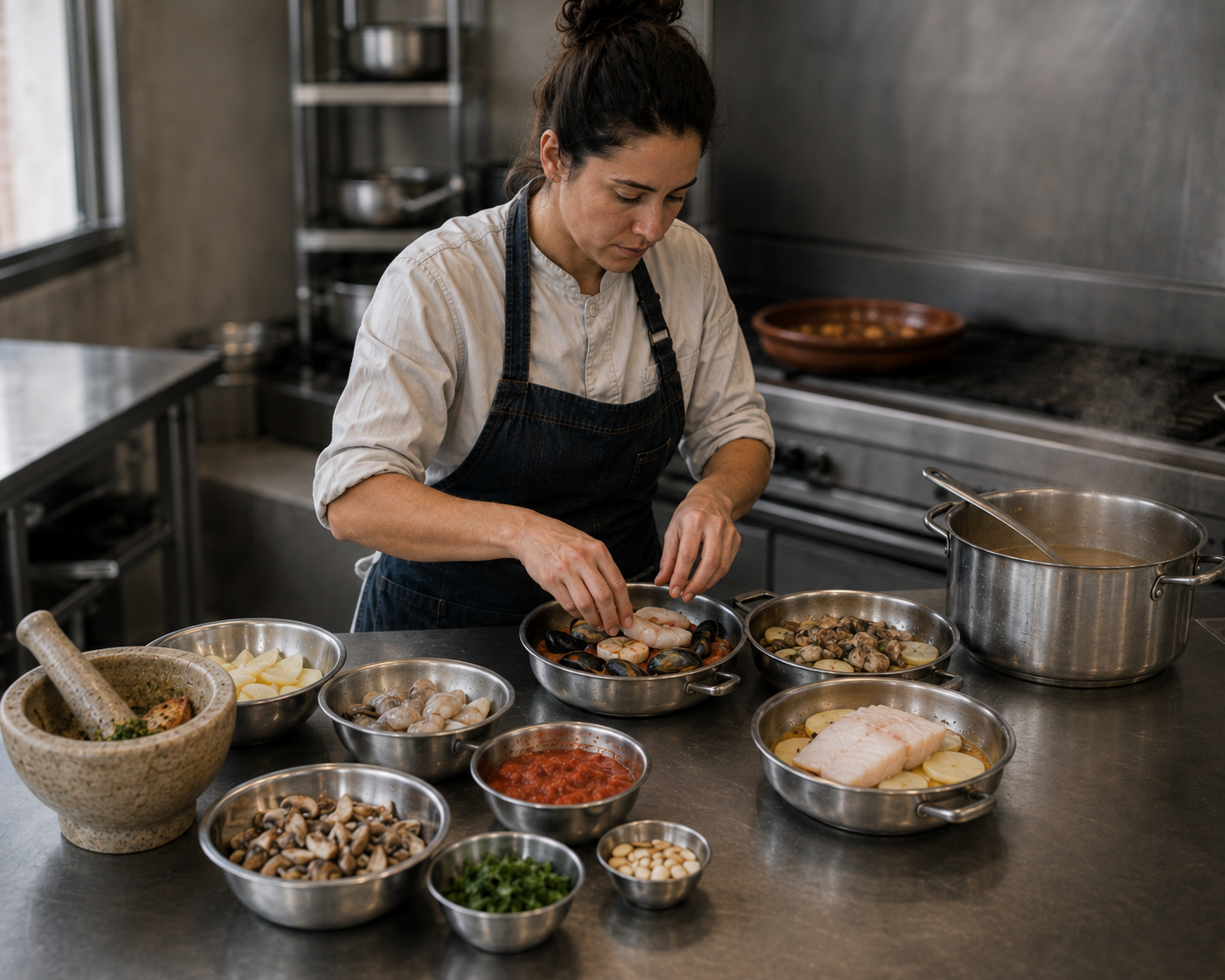
Suquet begins with the Mediterranean sea. It is a Catalan coastal dish, rooted in fishermen’s cooking, built from seafood, broth, sofrito, potatoes, olive oil, and picada. Its grammar belongs to the Mediterranean: fish bones, shellfish shells, tomato, garlic, onion, saffron, almonds, bread, parsley, potatoes, and the shallow logic of the cazuela. Before suquet becomes a broader creative method, it should be understood as itself.
This article gathers 23 departure points for studying suquet as a regional technique and as a source of culinary thinking. The first movement stays close to its Mediterranean logic: broth building, seafood, sofrito, potatoes, saffron, almonds, picada, reduction, and the way a cooking liquid becomes sauce. Only after that foundation is clear can we begin to ask how the method might travel into vegetables, pulses, plant-based interpretations, or cross-cultural applications. The goal is not to call every seafood stew a suquet. The goal is to understand what the suquet concept teaches, as a cultural dish, and as a technique.
Departure Points is a Materia series built around creative exploration. Each article gathers 23 known or traditionally used applications of an ingredient, technique, region, or culinary material, then organizes them into clusters so cooks can see patterns, possibilities, and relationships. Each point of departure is a catapult for further inquiry: a reference, a context, and a question to carry back into the kitchen. What does this material do? How has it been used before? What changes when we alter the medium, the technique, the temperature, or the cultural context? From there, the work begins.
Cluster I: The Mediterranean Grammar of Suquet
These first departure points stay close to the foundational structure of suquet. They focus on what makes the dish recognizable: seafood, cazuela logic, concentrated broth, sofrito, potatoes, and picada.
1. Fish Broth as Foundation
Suquet depends on a broth that tastes of the sea without becoming muddy or heavy. Fish heads, bones, trimmings, and sometimes shellfish shells can create a marine base that supports the dish.
Fish broth should be handled with restraint. It does not need the long extraction of meat stock. Gentle simmering, clean bones, and careful timing matter.
Try this direction: make a light fish broth with bones, onion, bay, parsley stems, and a small amount of tomato. Use it as the liquid base for a potato and fish suquet.
2. Shellfish Broth for Depth
Shellfish shells can bring sweetness, color, and depth. Prawn shells, shrimp shells, crab shells, or lobster shells can be sautéed or lightly roasted before liquid is added.
This creates a stronger, more perfumed broth, useful when the suquet needs greater intensity.
Try this direction: make a shellfish broth from prawn shells, garlic, tomato, and olive oil. Use it for a suquet with monkfish, potatoes, and picada.
3. Sofrito as the Aromatic Base
Sofrito is not a minor step. It is the base that gives suquet sweetness, acidity, umami, and color. Onion, garlic, tomato, and olive oil must cook long enough to lose rawness and gain concentration.
A rushed sofrito produces a thin suquet.
Try this direction: cook tomato, onion, garlic, and olive oil slowly until reduced and deep. Add broth only once the base has become aromatic and concentrated.
4. Potatoes as Structure
Potatoes are not just filling. They absorb broth, release starch, and help turn liquid into sauce. Their cut affects the dish. Clean slices behave differently from cracked or irregular pieces that release more starch.
The potato is one of the main architectural elements of suquet.
Try this direction: make two small versions, one with neatly cut potatoes and one with cracked potatoes. Compare how the sauce thickens.
Cluster II: Seafood, Timing, and the Cazuela
Suquet is a seafood dish, but not all seafood enters the cazuela at the same moment. The cook must understand timing, texture, and the way shallow stewing protects or damages delicate ingredients.
5. Firm Fish Suquet
Firm fish can tolerate the cooking rhythm of suquet better than delicate fish. Monkfish, hake, rockfish, scorpionfish, or similar local fish can hold structure while absorbing broth and sofrito.
The fish should cook gently, not boil aggressively.
Try this direction: build the sauce and potatoes first, then add firm fish pieces and cook them slowly in the reduced broth.
6. Delicate Fish Added Late
Delicate fish needs a shorter cooking time. If added too early, it breaks apart, dries, or disappears into the sauce.
This teaches sequence: build depth before adding fragility.
Try this direction: prepare the sofrito, broth, and potatoes fully, then add delicate fish near the end. Cover and let the residual steam finish the cooking.
7. Prawn or Shrimp Suquet
Prawns and shrimp bring sweetness, shells, color, and aroma. Their shells can help build broth, while the flesh should be cooked briefly.
The risk is overcooking. The reward is sweetness and marine perfume.
Try this direction: use shells for broth, then add peeled or whole prawns at the end. Finish with picada and rest briefly.
8. Mussels and Clams
Mussels and clams bring briny liquid into the suquet as they open. This can intensify the sauce, but it also changes salinity.
They should usually enter after the base is built.
Try this direction: cook potatoes and broth first, then add mussels or clams near the end. Taste before adding more salt.
9. Squid and Cuttlefish
Squid and cuttlefish require timing discipline. They can be cooked very quickly or slowly until tender, but the middle zone can become tough.
In suquet, they can bring body, ink-adjacent depth if used, and a stronger coastal character.
Try this direction: cook squid gently in the sofrito before adding broth, or add tender pieces late. Compare texture and sauce depth.
Cluster III: Picada, Saffron, Almonds, and Final Thickening
Picada is one of the defining elements of Catalan cooking. In suquet, it can thicken, bind, perfume, and finish the sauce. These departure points study picada as a structural technique.
10. Almond Picada
Almonds bring nuttiness, body, and elegance. When crushed with garlic, parsley, bread, and a little broth, they help thicken the suquet without cream or flour.
The texture should support the sauce, not become pasty.
Try this direction: make a picada with toasted almonds, garlic, parsley, and fried bread. Add near the end and simmer gently.
11. Hazelnut Picada
Hazelnuts bring a deeper, earthier profile than almonds. They can make the suquet warmer and more rustic.
This works especially well with shellfish broth, mushrooms, or stronger fish.
Try this direction: replace almonds with toasted hazelnuts in the picada. Notice how the sauce becomes darker and rounder.
12. Bread as Thickener
Toasted or fried bread is a practical thickening tool. In picada, it absorbs liquid, carries garlic and herbs, and gives the sauce body.
This is a different kind of thickening than starch from potatoes. It has flavor and texture.
Try this direction: compare a picada made with nuts only to one made with nuts and fried bread. Observe how the sauce changes.
13. Saffron in the Picada
Saffron can be introduced through broth or sofrito, but incorporating it into picada helps distribute its aroma and color through the final sauce.
It should be used with restraint. Its role is perfume, not domination.
Try this direction: crush saffron with garlic, parsley, almonds, and bread, then loosen with warm broth before adding to the cazuela.
14. Parsley and Garlic Picada
A simpler picada of parsley and garlic can give freshness and sharpness to the dish. It may be used when the suquet already has enough body from potatoes and reduction.
This direction emphasizes clarity rather than weight.
Try this direction: finish a fish suquet with garlic, parsley, olive oil, and a small amount of broth worked together in a mortar.
Cluster IV: Vegetables, Pulses, and Mediterranean Extensions
Once the seafood grammar is understood, suquet logic can extend toward vegetables and pulses. These should still respect the Mediterranean foundation: broth, sofrito, starch, reduction, and picada.
15. Artichoke Suquet Direction
Artichokes bring bitterness, sweetness, and a strong Mediterranean identity. They work well with olive oil, garlic, parsley, lemon, potatoes, and seafood or plant-based broth.
They can also support a vegetable-forward suquet.
Try this direction: cook artichokes with sofrito, potatoes, light broth, saffron, and almond picada.
16. Fennel and Tomato Suquet Direction
Fennel brings anise aroma and sweetness. Tomato brings acidity and umami. Together, they create a strong Mediterranean base for fish, shellfish, or vegetables.
Try this direction: build a sofrito with fennel, onion, garlic, and tomato, then add potatoes and seafood broth.
17. Chickpea Suquet Direction
Chickpeas can enter suquet logic as a pulse that absorbs broth and adds body. They work well with tomato, garlic, saffron, paprika, parsley, and picada.
This is a useful bridge toward plant-based interpretation.
Try this direction: cook chickpeas with sofrito, potatoes, seaweed or vegetable broth, and almond-parsley picada.
18. White Bean Suquet Direction
White beans bring creaminess and a gentle starch release. They can support seafood or become the center of a vegetable version.
They require careful seasoning because they absorb salt and broth.
Try this direction: combine white beans with tomato sofrito, fish or vegetable broth, potatoes, garlic, and parsley picada.
19. Mushroom and Seaweed Suquet Direction
For plant-based exploration, mushrooms and seaweed can help rebuild marine depth without seafood. Dried mushrooms bring umami. Seaweed brings oceanic salinity and mineral aroma.
This is not traditional seafood suquet, but it can study suquet grammar respectfully.
Try this direction: make a broth with kombu or other seaweed and dried mushrooms. Use tomato sofrito, potatoes, and almond picada.
Cluster V: Reduction, Sauce, and Service Logic
Suquet is defined by liquid becoming sauce. These departure points focus on concentration, serving, and the way the dish is eaten.
20. Broth Reduced Into Sauce
The suquet liquid should not remain watery. It should reduce, thicken through potato starch and picada, and become a sauce that clings to the ingredients.
This is one of the most important lessons of the dish.
Try this direction: cook a suquet with measured broth. Track how the liquid reduces before and after picada is added.
21. Resting the Cazuela
Resting allows the sauce to settle, the potatoes to absorb flavor, and the seafood to finish gently. Like many stewed dishes, suquet can improve after a short pause.
The rest must be controlled so seafood does not overcook.
Try this direction: taste the suquet immediately after cooking, then after five to ten minutes of rest. Observe sauce texture and seasoning.
22. Bread as Part of the Dish
Bread is not an afterthought. It receives the sauce, extends the meal, and changes the eating experience. The sauce is meant to be gathered.
This reinforces that suquet is not only about seafood, but about the broth-sauce that holds the preparation.
Try this direction: serve suquet with grilled bread or rustic bread. Taste how the sauce behaves when eaten with bread rather than spoon alone.
Cluster VI: Cross-Cultural Method Without Losing Origin
Only after the Catalan grammar is understood should the method begin to travel. The departure point here is not imitation, but translation through structure.
23. Suquet Logic Applied Elsewhere
Suquet logic can inspire other dishes when the cook preserves the core method: build a concentrated aromatic base, create a meaningful broth, use starch to absorb and thicken, add delicate ingredients with timing, finish with a mortar-made thickener or aromatic paste, and reduce liquid into sauce.
This could move toward Latin American seafood with chiles and cilantro, a plant-based mushroom-seaweed cazuela, a bean and tomato stew with almond picada, or a local coastal preparation using regional fish.
But the cook should be clear: these are suquet-inspired applications, not replacements for the Catalan dish.
Try this direction: choose another coastal cuisine and build a dish using suquet structure: aromatic base, broth, starch, main ingredient, final paste, reduction, and rest.
What These 23 Points Teach the Cook
Suquet teaches that a stew can be built as grammar.
It is not only seafood in broth. It is a sequence:
build the broth
cook the sofrito
add potatoes for structure
manage seafood timing
reduce liquid into sauce
finish with picada
rest the cazuela
serve with attention to the sauce
Its Mediterranean ingredients matter. Fish, shellfish, olive oil, garlic, tomato, potatoes, saffron, almonds, bread, parsley, and the cazuela itself give suquet its identity. From that identity, broader applications can emerge.
But the order matters.
First, understand the dish.
Then, understand the method.
Then, begin to explore.
Practical Note: Do Not Skip the Foundation
A suquet-inspired dish without broth, sofrito, starch, reduction, or picada may simply become another stew.
To work seriously with this technique, protect the foundation.
Best practices
Use a broth with real flavor.
Cook the sofrito slowly.
Treat potatoes as structure, not filler.
Add seafood according to timing.
Use picada near the end to bind and deepen.
Reduce the liquid into sauce.
Taste for salt after shellfish, picada, and reduction.
Rest briefly before serving.
Study regional variations before inventing too freely.
The technique is generous, but it asks to be understood.
Application Note: Mediterranean First, Then Translation
The first experiments should stay close to the Mediterranean pantry.
Work with fish, shellfish, potatoes, tomato, garlic, onion, olive oil, saffron, paprika, almonds, hazelnuts, bread, parsley, fennel, artichokes, beans, and good broth. Learn how these ingredients behave inside the method.
After that, translation becomes more meaningful.
A cook can begin asking how another cuisine might express similar structure. What replaces sofrito? What broth carries the place? What starch thickens? What aromatic paste finishes the dish? What delicate ingredient must be added late? What sauce should remain after reduction?
That is where suquet becomes a broader method without losing its Catalan origin.
Closing Reflection — The Sea Organized Through Technique
Suquet is a regional seafood dish, but its lessons travel because its technique is clear. It teaches how to build from the sea without drowning the seafood. It teaches how a broth becomes sauce, how sofrito becomes foundation, how potatoes create body, and how picada finishes the dish with depth. It teaches timing, reduction, restraint, and the value of a shallow vessel.
For the creative cook, suquet is not only something to reproduce. It is something to study. A cazuela, a broth, a sofrito, a potato, a piece of fish, and a picada can become a complete grammar of the coast.