The Undocumented Kitchen: Why Your Best Ideas Keep Disappearing
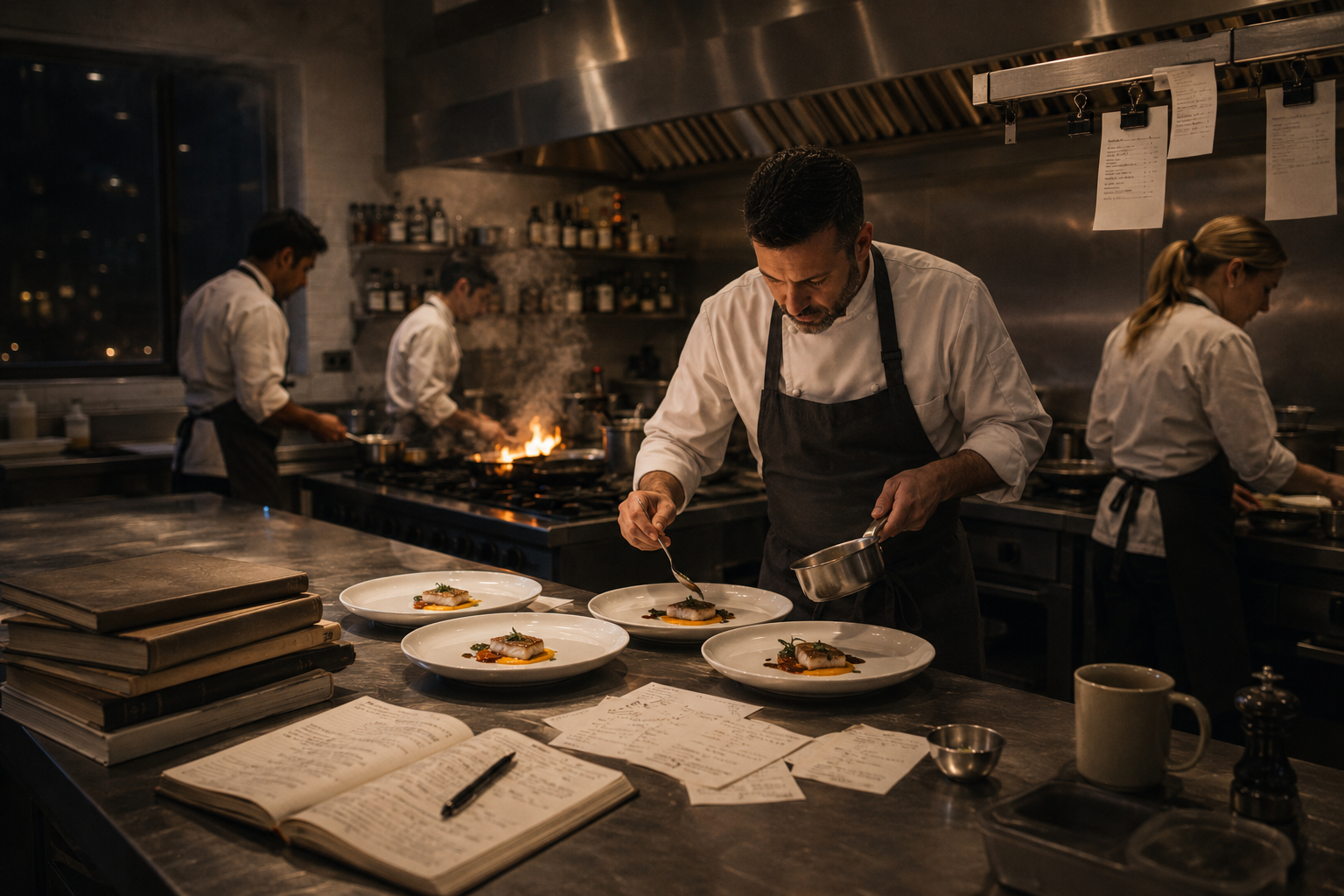
Everyone knows they should write things down. It is one of those concepts that sits somewhere between common sense and good intention. You hear it early. You repeat it to others. You agree with it completely. Of course you should document your work. Of course you should keep notes. Of course it matters. And yet, in the middle of a working kitchen, it almost never happens the way you imagine.
Not because cooks do not care, but because of how the work unfolds. You are in the middle of prep, or service, or the quiet hour before everything begins. You are moving quickly, focused on what needs to happen next. You adjust something almost without thinking. A little more acid. A different cut. A longer reduction. A shorter rest. More heat at the beginning. Less heat at the end. You change a proportion, correct a texture, improve a process, and suddenly the preparation works better than before. Sometimes it works much better. But the moment passes. There is another task. Another pan. Another tray. Another person asking where something is. Another order printing. Another container to label. Another surface to clean. By the time you return to the idea, the details have already started to disappear. Not entirely. But enough.
You remember the direction, but not the exact path. You remember that something worked, but not the amount. You remember the result, but not the sequence. You try to recreate it and get close, but not quite there. This is how ideas disappear in kitchens. Not dramatically. Quietly. They disappear because the kitchen keeps moving. A sauce improves, but no one records why. A cook finds a faster way to prep an ingredient, but the knowledge stays with that cook. A garnish becomes cleaner after three small adjustments, but no one writes them down. A dish begins to evolve through service, but the evolution remains informal. Everything feels fine while the same people are there. Then someone leaves. Or the chef is off for two days. Or the cook who “just knew how to do it” moves to another job. Suddenly, the preparation feels different. The same task takes longer. The result becomes less consistent. People remember that things used to be done a certain way, but no one can say exactly how.
Without documentation, the kitchen relies on memory. And memory is not a reliable system. It is useful. It is powerful. It is part of the cook’s intelligence. But memory alone is not enough to sustain creative work over time. It changes. It fills gaps. It simplifies. It forgets the small details that made the difference. In a kitchen, the small details are often the reason why a recipe works. This is why documentation is one of the pillars of a serious culinary R&D practice. Research gives you material. Experimentation gives you movement. Refinement gives you precision. But documentation gives the process memory. Without it, the method breaks.
You may still be creative. You may still have ideas. You may still test, adjust, taste, and improve. But the work does not accumulate properly. You keep starting again. You rediscover things you already knew. You repeat experiments without realizing you have done them before. You lose the path that led to the result. And in creative cooking, the path matters. The final dish is important, of course. But the notes that led to the dish are often where the real knowledge lives. What failed. What almost worked. What changed when the ingredient was cut smaller. What happened when the sauce rested overnight. What improved when the salt was added earlier. What collapsed when the heat was pushed too far. Those details are not secondary. They are the archive of the work.
I remember managing a restaurant where the owner wanted to introduce a set of dishes he had experienced elsewhere. On the surface, the idea was attractive. There was enthusiasm behind it. The dishes sounded appealing, and it was easy to imagine them entering the menu. So we approached the idea properly. We tested. We adjusted. We calculated. We looked at prep time, product cost, service rhythm, and how the dishes would fit into the menu structure we were building. The result was clear: the dishes did not make sense for that restaurant. They were expensive to produce, slow to execute, and disconnected from the operational logic of the menu. They were good ideas in another context, but not in ours. A month later, the owner called for my attention to question why we had never implemented those dishes?
Without documentation, that conversation could have become personal. A matter of opinion. A matter of memory. One person saying, “I think we decided this,” and another saying, “But I remember it differently.” But we had the notes. We had the trials. We had the costs. We had the reasoning behind our decision. We could return to the process, not just the conclusion. That changed everything. Documentation, in that sense, is not about accumulating information for its own sake. It is about preserving decisions. It allows a kitchen to explain itself to itself. This becomes especially important in creative work, where ideas often begin in fragile ways. A thought appears while you are doing something else. A preparation reacts in a surprising way. You taste something and it reminds you of another dish. A mistake opens a possibility. A failed test suggests a better direction.
In that moment, the instinct is often to keep going. But the better habit is to capture it. Not to analyze it immediately. Not to decide whether it is good. Not to edit it before it has had a chance to exist. Just write it down. Documentation is not always the place for judgment. Sometimes it is simply the place of capture. This is an important distinction. Many cooks hesitate because they think notes should already be organized, clean, useful, and intelligent. They imagine documentation as a polished record, something almost official. So they wait until the thought becomes clear. But by then, the thought may be gone. In the first moment, documentation should be generous. Record more than you think you need. Write the strange idea. Write the failed observation. Write the quick association. Write the question. Write the thing that bothered you. Write the thing that surprised you. Write the ingredient amount, the temperature, the time, the texture, the smell, the comment from the cook standing next to you.
Do not edit too early. There will be time later to organize. During the work, your job is to capture the material before it disappears. This can actually free the mind. Once an idea is written down, you do not have to keep holding it while doing everything else. You can return to the task in front of you. The note becomes a small container for the thought. It says: this will not be lost. We can come back. And often, you will come back later and realize that the note was more valuable than it seemed. A quick sentence written during a test may become the beginning of a new formula. A photo of a failed texture may help you avoid the same mistake later. A small observation about one sauce may solve a problem in another dish months later.
Documentation creates connections across time. That is one of its quiet powers. Of course, not every kitchen can be documented in the same way. There are different conditions for different kinds of work. Some kitchens have a dedicated R&D space. A quiet table, a computer, notebooks, cameras, scales, labeled samples, maybe even a full system for testing and archiving. In that environment, documentation can be more complete. You can photograph each stage. You can record conversations. You can build tables, diagrams, tasting sheets, formulas, and controlled trials. That is ideal. But many kitchens do not have that. Many cooks experiment in the small spaces the day allows. A corner of the prep table during a quiet hour. A low shelf near the dry storage. A notebook next to the scale. A voice note recorded after service. A photo taken quickly before the container goes into the fridge. A label with three words and a date.
That can also be documentation. It does not have to be perfect to be useful. The form matters less than the habit. A notebook. A binder. A phone. A spreadsheet. A printed template. A voice recorder. Photos. Labels. Diagrams. Tasting notes. Recipe cards. A shared kitchen folder. A private R&D journal. All of these can work. What matters is that the documentation fits the rhythm of the kitchen where the work is happening, and that it gets done. A system that is too heavy will be abandoned. A system that is too vague will become useless. The right system is usually the one that is simple enough to use when you are busy, but structured enough to make sense when you return to it. At minimum, every note should help you answer basic questions later. What was this? When did it happen? What were we testing? What did we change? What was the result? What could happen next? A title and a date already change everything. They give the note a place in time.
This sounds basic, but it matters. Without dates, the archive becomes foggy. You may think you tested something recently and realize it was three years ago. Or you may find a note from five years earlier and recognize the beginning of an idea you are finally ready to understand. A title gives the work a handle. A date gives it a position. Together, they allow memory to become searchable. This is one of the reasons I like physical documentation. A notebook carries traces. It holds stains, diagrams, corrections, urgency, handwriting, arrows, side thoughts. It becomes a record not only of what was tested, but of how the cook was thinking at that moment. But physical documentation has risks. A notebook can get lost. A binder can fall apart. Pages can be removed. A recipe can be taken. A shelf can flood. A fire, a move, a busy service, a careless moment, and years of work can disappear.
Digital documentation has different risks. Files can be deleted. Drives can fail. Folders can become disorganized. Passwords can be lost. A beautifully structured digital archive is useless if no one knows where anything is. So documentation also needs protection. Scan important notebook pages. Photograph tests. Back up digital files. Keep copies of essential formulas. Decide what belongs in the shared kitchen system and what belongs in a private archive. Keep sensitive recipes, formulas, supplier notes, and proprietary processes in places that are controlled. This is not paranoia. It is respect for the value of the work. Not every note should be available to everyone. Some documentation belongs to the kitchen team because it allows consistency: prep sheets, recipes, plating references, production schedules, station notes. Some belong to the chef, the owner, or the R&D archive because it contains future concepts, formulas, unfinished ideas, costing strategy, or details that give the food its particular edge.
A kitchen should know the difference. Documentation is not only about access. It is about stewardship. Who needs this information to do the work well? Who is responsible for updating it? Where is the latest version kept? What should remain private? What should be shared so the kitchen can function without depending on one person’s memory? These questions matter because documentation can serve different purposes. There is documentation for execution: the recipe that must be followed. There is documentation for training: the explanation that helps someone understand the standard. There is documentation for R&D: the messy record of trials, ideas, failures, and possibilities. There is documentation for leadership: the notes that explain why decisions were made. There is documentation for legacy: the archive that shows how a kitchen developed its identity over time. Confusing these forms can create problems.
An R&D notebook does not need to look like a finished recipe manual. It can be messy, exploratory, open. A recipe manual, on the other hand, needs clarity. Another cook must be able to follow it. A costing sheet needs precision. A plating guide needs visual reference. A private creative notebook may include unfinished thoughts that are not ready to become part of the team’s work. Each form has its role. Together, they create continuity. And continuity is the real value of documentation. A kitchen without documentation lives in the present tense. It reacts. It remembers partially. It depends on whoever is standing in charge that day. A documented kitchen can be revisited and return its creative investment. It can return to a decision. It can return to a test. It can return to an old failure with new understanding. It can return to a dish and improve it instead of reinventing it. It can train new cooks without diluting the work. It can preserve the identity of a menu even as people change.
This is not about making the kitchen rigid. It is about giving the kitchen memory. Memory allows evolution. If you know where you have been, you can move forward with more intelligence. You can see patterns. You can recognize that you keep returning to certain textures, certain acids, certain techniques, certain ingredients. You can identify what belongs to your style and what was only a passing idea. In this way, documentation also supports authorship. A chef’s signature does not appear only through inspiration. It appears through accumulated decisions through time. But those decisions have to be visible in the present. You have to be able to see what you have repeated, what you have refined, what you have protected, what you have rejected. Otherwise, style remains a feeling. Documentation helps style become legible. It allows you to say: this is how I work. This is what I tested. This is why I chose this direction. This is what changed. This is what the dish needs in order to be aligned to the ethos of my kitchen.
That clarity has practical consequences. It saves time. It reduces confusion. It improves training. It protects good ideas. It makes refinement possible. It gives decisions weight. And perhaps most importantly, it keeps the creative process from becoming a series of isolated moments. Because a kitchen can be full of ideas and still fail to develop them. Ideas are not rare. The ability to keep them, test them, and return to them is rarer. As we said before, that is why the habit matters. Not perfect documentation. Not beautiful documentation. Not a complicated system that nobody uses. A real habit. Write the title. Write the date. Write what changed. Write what happened. Photograph the result. Label the container. Record the thought. Save the version. Return to it later. Small acts, repeated consistently.
That is how an archive begins. And for a creative kitchen, the archive is not separate from the work. It is part of the work. In the end, documentation is not the opposite of intuition. It is what allows intuition to flow. It is not the opposite of creativity. It is what allows creativity to continue. Without documentation, even your best ideas remain temporary. With documentation, they become material. Something you can revisit. Something you can test again. Something you can teach. Something you can protect. Something you can refine into a recipe, a formula, a dish, a product, a menu, or a way of working. The undocumented kitchen may still produce beautiful moments. But the documented kitchen can build from them.
The Undocumented Kitchen: Why Your Best Ideas Keep Disappearing