The Chef’s Notebook: Why Thinking on Paper Still Matters in the Kitchen
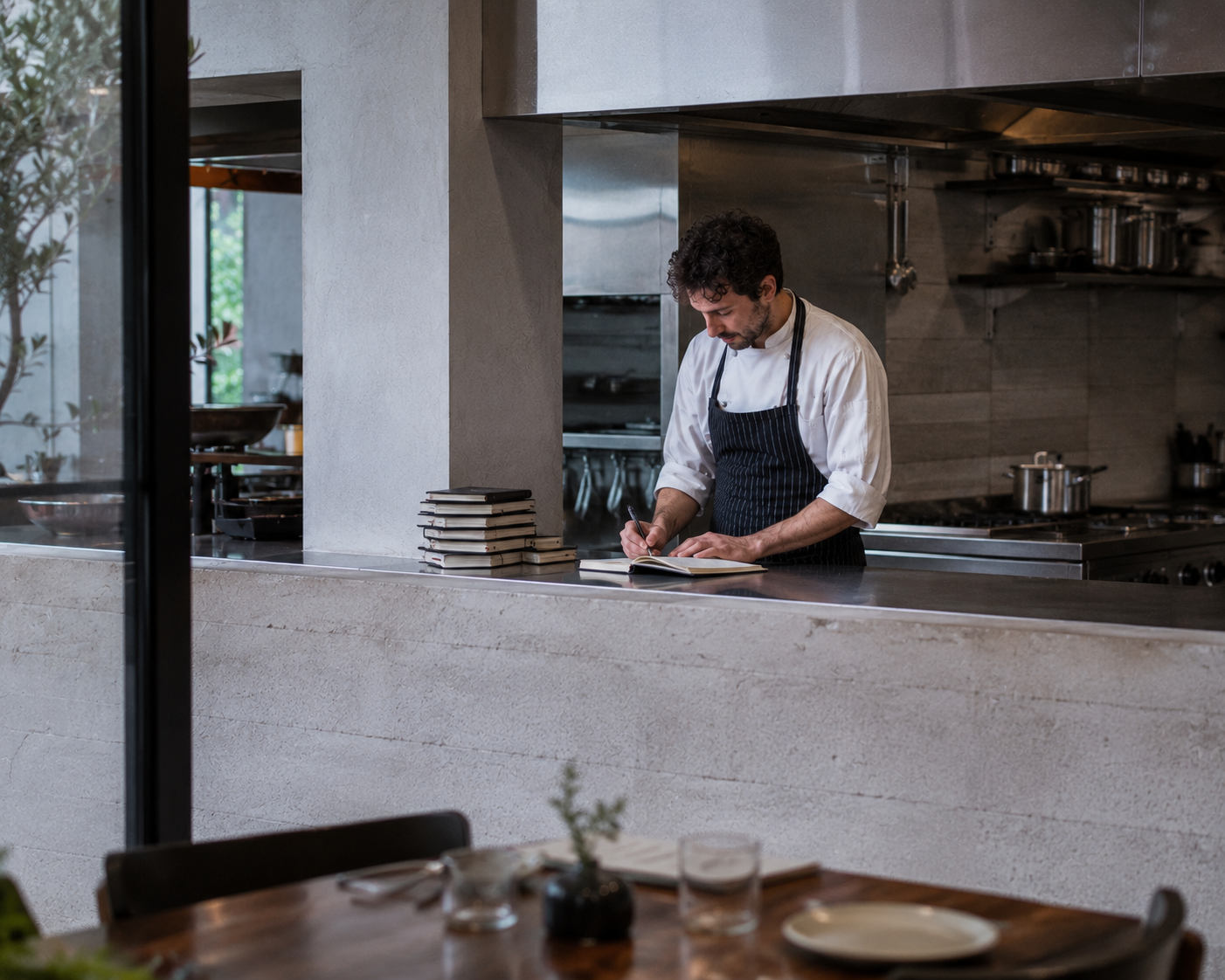
Every cook needs a place where ideas can land before they disappear. That place may be a notebook, a binder, loose pages held in a folder, or a stack of sheets beside the cookbooks. It may be small enough to travel in a backpack or large enough to remain on a desk, near the kitchen, or in the office of a restaurant. The form is personal, but the function is not. A chef’s notebook is where thought becomes visible before it becomes a recipe, a system, a menu item, or a decision.
A dish idea, a supplier note, a mistake from service, a possible garnish, a temperature, a question about an ingredient, a book recommendation, a plating sketch, a sauce that needs to be tested again, a guest comment, a reminder to speak with the sous chef, a list of seasonal products, or a preparation that almost worked but not quite: these things often arrive small and unfinished. Most of them usually arrive at inconvenient moments, during prep, after a conversation, while tasting something, walking through a market, sitting in another restaurant, reading a book, talking with another cook, or looking into the walk-in and realizing there are too many onions. If thoughts are not recorded, they vanish. The notebook gives them a place to wait.
Paper Allows Thought to Remain Unfinished
Digital documents are useful, and eventually many notes need to become formal recipes, shared files, cost sheets, prep lists, training documents, or digital archives. A recipe that belongs to a team cannot remain forever as a half-legible note in one person’s notebook. But paper does something different at the beginning of thought, before the work is ready to become clean, structured, and shareable.
A computer often asks us to organize too soon. The page opens and immediately feels like a document, with a title, a format, a folder, a template, and an expectation of sequence. The work begins asking for completion before the idea has had enough space to move. A notebook is more forgiving. You can write badly, scratch something out, draw an arrow, circle a word, add a question in the margin, make a quick diagram, leave the page unfinished, return later, and change your mind without feeling that the page has failed.
That matters because early ideas are often unclear. They are not yet recipes, systems, or decisions. They are fragments looking for direction. Paper gives those fragments a physical field. A page with crossings-out, arrows, stains, lists, and half-drawn plates shows the movement of thought in a way a clean digital file often hides. You do not only read what you wrote. You see how you were thinking. A chef’s notebook does not need to be treated as a polished book. That pressure can kill its usefulness. Some pages may be clear, while others may be chaotic. Some may contain careful measurements, and others only a few words written quickly before service. Some ideas may be crossed out. Others may return months later and suddenly matter again. This is part of the value. A notebook preserves not only conclusions, but also the path toward them.
You may find a dish idea you abandoned too early, an experiment you believed you had completed but had only written down, or three versions of a sauce where the second one was closer to what you wanted than the final one. Memory is rarely reliable enough for this. The notebook becomes an extension of the memory, not perfect and not complete, but present.
A Notebook Gives Brainstorming a Surface
Consider a simple page. At the center, you write one word: onions. Perhaps a supplier has told you that three varieties will be excellent and inexpensive for the next month. The restaurant has access to abundance, and now the question is how to use it intelligently. If you keep the question only in your head, the first weak idea may block the next one. Onion soup. Too hot for the season. Then the mind hesitates.
On paper, the weak idea can stay there without stopping the movement. Onion soup can sit beside pickled red onions, charred onion dressing, onion tart, onion jam for a burger, crispy battered onions, roasted onion purée, raw onion salad with citrus, onion stock, or fermented onions. You add another note to ask the supplier about quantity and price, another to speak with the sous chef about pickling, another to test red onion with grilled fish, and perhaps another to try the idea first as a staff meal. Now the page has movement. The ingredient is no longer only an item in inventory. It has become a field of possibilities.
This is why paper can be such a powerful creative device. It allows the mind to externalize the problem. Once the problem is on the page, you can look at it, move around it, return to it, and develop it without holding everything internally at once. The notebook carries part of the weight. It also allows creative work to continue across time. A cook may have ten minutes before a supplier arrives, fifteen minutes after service, a short break between prep and family meal, or a quiet moment at home. The notebook allows the thought to begin even when there is not enough time to finish it. You write the beginning, close the book, and the idea waits. Later, when you return, you are not starting from zero. The page reminds you where you were, and sometimes, with rest, the idea becomes clearer. This is one of the hidden values of documentation. A thought does not have to be completed in the same moment it appears. It only has to be preserved well enough to be found again.
The System Should Serve the Work
There is no single correct notebook system. Some cooks prefer one notebook where everything goes: recipe tests, ideas, drawings, market notes, supplier information, reflections, mistakes, and reminders all entering the same book in sequence. This has a certain honesty because it follows the life of the cook as it happens. Others prefer specialized notebooks. One for recipes, one for plating ideas, one for restaurant operations, one for ingredient research, one for books and references, and one for personal reflections. A binder can also be useful because pages can be added, removed, reorganized, copied, or placed into sections. Binder pages may work especially well for an R&D system, where each ingredient, formula, test, or project needs its own place.
The important thing is not the format. The important thing is that the system is usable. If the notebook is too precious, you may hesitate to write in it. If it is too large, you may never carry it. If it is too small, it may not give enough room for sketches and diagrams. If the system is too complex, you may abandon it. A cheap notebook used every day is more valuable than an expensive one left untouched.
The system should grow from use, not from the fantasy of perfect organization. Many people delay documentation because they want the right notebook, the right categories, the right template, the right app, or the right filing method before beginning. Meanwhile, the ideas continue disappearing. Begin with the simplest possible structure: date the page, write the subject, record the note. That is enough to start. You can create indexes later. You can number pages, use tabs, move to binders, scan, reorganize, or separate notebooks once patterns appear. A working notebook will teach you what kind of notebook you need.
A Working Archive Begins Quietly
At first, a notebook may not seem important. It holds a few notes, then a few more. After months, it begins to contain a map of your work. After years, it becomes an archive. You can see which ingredients interested you, which problems repeated, which techniques you explored, which suppliers were mentioned, which dishes were abandoned, and which ideas returned again and again.
This archive becomes useful in ways you cannot predict. You may return to an old note because a new menu suddenly needs that idea. A failed experiment may become relevant under different conditions. A book recommendation from another cook may lead to an ingredient you had not considered. A temperature written in a hurry may save a preparation later. The notebook accumulates references from your own practice. That is different from a cookbook. A cookbook gives you someone else’s finished work. The notebook shows your unfinished work, your questions, attempts, conditions, and decisions. It becomes part of your culinary authorship because it records how your thinking develops, not only what you finally serve.
It can also hold references that are not strictly original ideas. A dish seen in a restaurant, a market stall, a tool, a plating arrangement, a supplier comment, a wine pairing, a cook’s favorite book, a phrase from a conversation, or a technique mentioned in passing can all enter the notebook. One useful practice is to ask cooks about the books that shaped them: what taught you something, what should I read, what changed the way you cook? Over time, those answers become a reading list built from the people who pass through your kitchen. These notes are not there to be copied blindly. They are there to expand the field of what you notice.
Notes Turn Experience Into Knowledge
A chef’s notebook is not only for creativity. It can hold practical memories: the temperature used for a stew, the pot that gave the best result, the time a preparation needed in a particular oven, the reminder that one sauce should not be covered because condensation changes the texture, or the fact that a certain batch of flour absorbed more liquid than usual. In many restaurants, not every recipe exists in a formal digital system. Some kitchens operate for years with recipes, corrections, and house knowledge living in notebooks, binders, taped sheets, and written notes. This may not be ideal for a large operation, but it is often real. A notebook can function as a bridge between memory and system.
Someone asks how long the chef cooked the stew last time, and the answer is there: two hours, not three, in the brass-lined braiser, uncovered for the final thirty minutes. That note may seem small, but it prevents the kitchen from improvising blindly. The notebook keeps instruction close to practice. This becomes even more important during experimentation. If you test five ingredients and remove two halfway through because they clearly do not belong, notice that one behaves unexpectedly, another improves texture but damages flavor, and the final version is promising only if the amount is reduced, those details will blur quickly if they remain only in conversation. The next day, everyone remembers something slightly different.
On paper, the experiment begins to hold. What was tested? What changed? What failed? What surprised you? What should be repeated? What should be eliminated? The notebook allows trial and error to become knowledge. Without documentation, experimentation can become an activity. With documentation, it becomes a process. The notebook is not the final formula. It is the place where the formula begins to emerge.
Writing Slows the Work Enough to See It
Kitchens are fast. The body moves quickly, and decisions happen under pressure. A cook adjusts, tastes, reacts, corrects, and continues. Writing slows part of that process down, not during the rush, and not everything at once, but enough to create reflection. When you write a note, you have to name what happened. The sauce split after adding the citrus. The purée was brighter when steamed. The onions were sweeter after resting overnight. The plate looked heavy with both garnishes. Naming an observation forces attention because you cannot write everything. You choose what matters, and that act of choosing already begins to organize the experience.
This is why writing is not only storage. It is thinking. The hand moves, the sentence forms, and a second thought appears while writing the first one. A diagram clarifies what a paragraph could not. A crossed-out idea shows that a decision changed. The notebook is not passive. It participates. It also protects continuity. A kitchen without written memory depends heavily on the people present. When those people leave, part of the knowledge leaves with them. Some notes will remain personal to the cook, especially early sketches, reflections, and unfinished ideas. Others belong to the restaurant because they describe how the work is done. A mature operation knows the difference. Finalized recipes, procedures, specifications, training notes, and operational decisions should eventually become part of the shared archive.
This is why documentation matters ethically as well as practically. If a kitchen depends on knowledge but never writes it down, new employees are forced to learn through guessing, imitation, and correction. Standards become unstable, and the strongest people hold power because only they know how things work. A written system makes knowledge more accessible. The notebook can be the beginning of that system.
Paper and Digital Systems Should Work Together
A notebook is vulnerable because it is an object. It can be lost, damaged by water, forgotten in a taxi, stained, burned, torn, or misplaced during a move. That risk is real, and it should be respected, but it should not become a reason to avoid the practice. Write your name and contact information inside the cover. Photograph important pages periodically. Scan finished notebooks when possible. Keep older notebooks in a safe place. Transfer essential recipes or systems into a digital archive once they become important to the team.
Paper and digital systems do not need to compete. They can serve different stages of the work. Paper captures the living thought. Digital tools preserve, organize, share, and formalize what needs to travel beyond the notebook. The mistake is asking one system to do everything. At some point, a note may outgrow the notebook. A recipe needs to be shared with the team, a formula must be costed, a training document has to be printed, a menu idea needs to become part of a proposal, or a process must be standardized. That is when the notebook becomes source material.
You review the pages, identify what matters, and translate the rough notes into a clearer document. This translation is not mechanical. It is refinement. The notebook may contain five versions of the same idea, several crossed-out directions, and a note in the margin that suddenly becomes essential. When digitizing, you decide what the final version needs to carry. The rough page becomes a recipe. The recipe becomes a formula. The formula becomes a training document. The training document becomes part of the kitchen’s system. This is how private thinking becomes shared practice.
A Creative Device, Not a Romantic Object
The chef’s notebook can easily be romanticized. The stained pages, hurried handwriting, private sketches, old recipes, and image of the cook carrying a book full of secrets all have a certain beauty. But the notebook matters because it works. It catches ideas, supports memory, slows thought, stores experiments, builds references, allows return, and turns scattered observations into material that can be used again. For a creative cook, this is essential. Not every note will become something. Most will not. But the act of writing creates a field where ideas can accumulate, collide, disappear, return, and eventually become usable.
The notebook is not there to make the cook look serious. It is there to help the cook think seriously. The kitchen asks for action constantly. Prep the onions, check the sauce, clean the station, fire the fish, call the supplier, fix the schedule, taste the purée, answer the question, move faster. Without a place for thought, the cook becomes trapped in reaction. The notebook creates another rhythm, a slower one. It gives the day a place to leave traces. It gives an ingredient room to open into possibilities. It allows mistakes to become knowledge and unfinished ideas to wait until the cook is ready to return.
That is why thinking on paper still matters. Culinary creativity is not only what happens in the pan. It is also what happens before, after, beside, and between the acts of cooking. The chef’s notebook gives those moments a place to exist. Over time, that place becomes more than paper. It becomes evidence, and the visible memory of a cook learning how to think through food.
The Chef’s Notebook: Why Thinking on Paper Still Matters in the Kitchen