Designing a Culinary Test — How a Question Gives Experimentation Direction
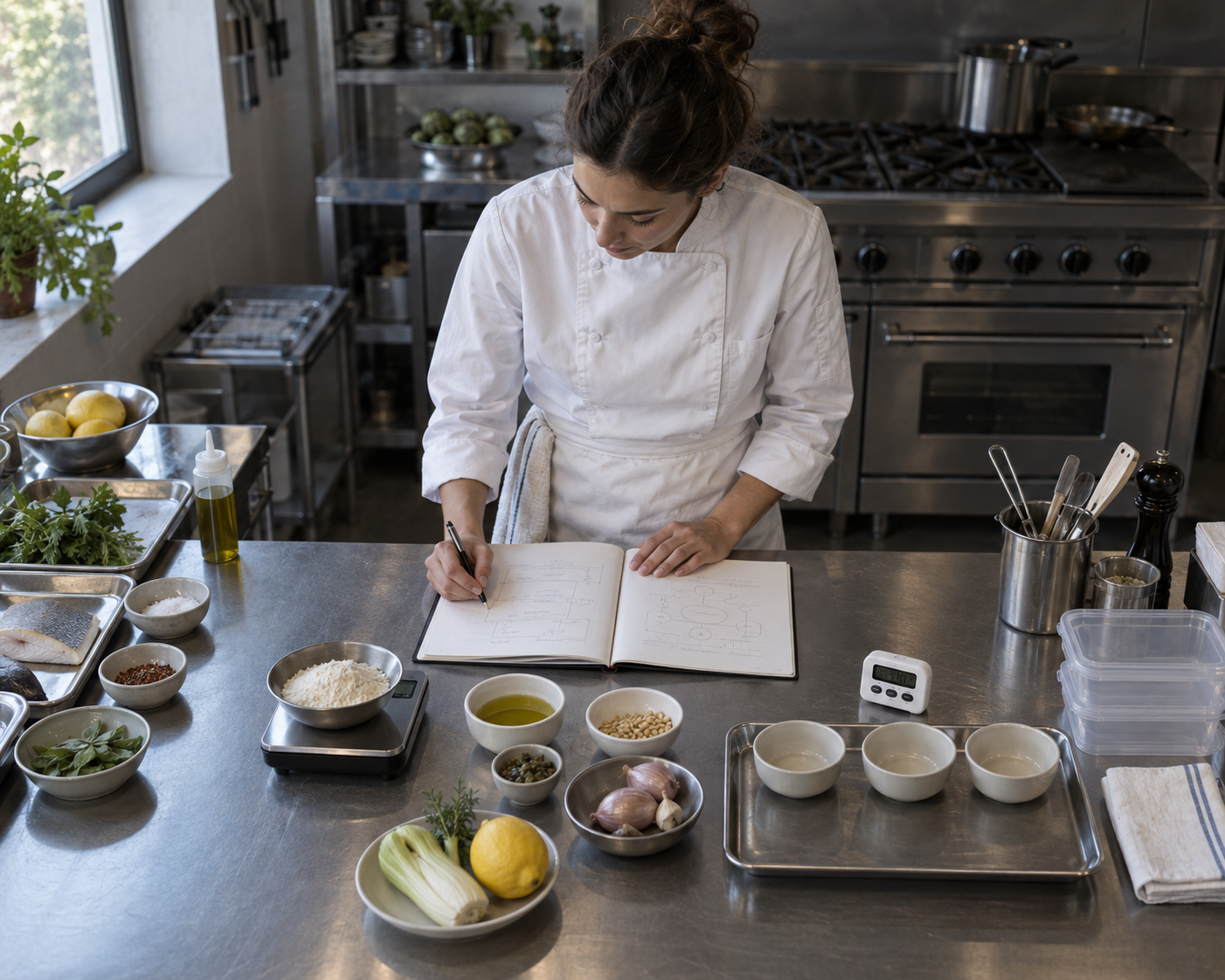
We have probably all had that moment. We are eating somewhere and taste something that stops us for a second. There is a flavor in the sauce that we cannot quite place. Maybe we think it is a spice, a fermented ingredient, a particular kind of acidity, or something we have tasted before in another context. We ask what is in it and suddenly one ingredient explains the whole thing. Or perhaps nobody tells us, and the question follows us home.
The same thing can happen while reading a cookbook, walking through a market, talking with another cook, or simply thinking about food when we are nowhere near the kitchen. An idea appears: what would happen if I treated this ingredient that way? Could this technique work here? What if I brought these two things together? Sometimes the starting point is not even a dish. It is a texture, an aroma, a memory, a color, or one small detail we want to understand better.
That kind of spark is valuable because it gives us somewhere to begin. But the moment we walk into the kitchen with that idea, another question appears: what exactly are we going to do with it? There is a difference between trying something and designing a culinary test. We can certainly enter the kitchen, take some ingredients, follow our intuition, add a little of this and a little of that, and end up with something delicious. Cooks do this constantly, and there is nothing wrong with it. The problem comes afterward, when we ask ourselves what actually happened.
Was it the ingredient we were curious about? Was it the change in temperature, the extra fat, the longer cooking time, or the acid we added at the end? Did two changes work together? Would the same result happen if we made it again? Sometimes we have created something interesting but cannot trace our own steps well enough to understand why it worked. That is where a culinary test becomes useful. Instead of entering the kitchen only with an idea, we enter with a question.
The Question Comes Before the Test
Suppose we taste a sauce and become fascinated by the smoky depth of one particular chile. We could go home, buy the chile, put it into a completely new sauce with different tomatoes, another fat, more garlic, a new cooking method, and perhaps some ingredients we have also been wanting to try. We might make something excellent. But if the original curiosity was about what that chile contributes, we have made it difficult to find out.
A more useful starting point might be much simpler: What happens to this sauce when I replace the chile I normally use with this one? Now we have something to work with. The question does not tell us what the answer will be. It simply gives the experiment a direction. We know what we are looking at and, equally importantly, what we are trying not to change yet.
This is one of those small shifts that can completely change the quality of experimentation. Instead of asking only, “What can I make?”, we begin asking, “What am I trying to understand?” The question may be about flavor: what happens if we toast this spice before grinding it? It may be about texture: what happens if this purée is passed through a finer sieve? It may concern technique: what changes if we roast the vegetable rather than boil it? Or perhaps the problem is connected to the restaurant itself: can we create the same effect with a method that the kitchen can actually execute during service?
Once the question becomes clearer, the test becomes easier to design because we no longer need to investigate everything at the same time.
We Need Something to Compare Against
Comparison is at the heart of most useful culinary testing. If we want to know what changed, we need something that did not change. This is where a baseline becomes helpful. The word can sound more technical than the idea really is. The baseline is simply the version we are comparing against.
Perhaps we already have a tomato sauce that works and want to understand what happens if we roast the tomatoes first. The existing sauce becomes our baseline. We make it the way we normally do, and beside it we make the roasted version. Now the difference has somewhere to appear.
Without that first version, we may taste the roasted sauce and think it is delicious, but we are judging it mostly from memory. Was it actually sweeter? More concentrated? Less acidic? Did roasting improve it, or did we simply enjoy making something new? The comparison gives the question more clarity.
Sometimes the baseline can be very simple. We may be testing three cooking times for the same vegetable, comparing two vinegars in the same dressing, or testing the same dough at two hydration levels. What matters is not creating a laboratory-perfect control. We are simply giving ourselves enough stability that the difference means something.
This is also why testing becomes much harder when everything changes at once. If one version uses a different ingredient, another cooking temperature, another seasoning level, and another finishing technique, the dishes may all be interesting, but we have created several questions at the same time. That is not necessarily bad cooking. It is simply a difficult experiment to read.
Change Enough to Learn, Not So Much That the Question Disappears
This is where variables enter the conversation. Again, the language can sound scientific, but cooks work with variables constantly. Salt is a variable. Temperature is a variable. Cooking time is a variable. The variety of potato, the cut of the onion, the amount of water, the type of fat, the thickness of a sauce, the resting time, and the order in which ingredients enter the pan can all change the result.
When we design a test, we are deciding which of those changes we want to pay attention to. Imagine we are trying to understand whether browning butter improves a particular cake. If version one uses regular butter and version two uses browned butter while everything else stays reasonably similar, the comparison is easy to read. If the second version also contains more sugar, a different flour, orange zest, and another baking temperature, we may still make a wonderful cake, but browned butter is no longer the only question.
This does not mean we have to become rigid. Cooking is too alive for that. Ingredients vary, pans behave differently, ovens have personalities, and cooks themselves make small adjustments almost without noticing. The goal is not to pretend that the kitchen is a perfectly controlled environment. It is simply to reduce unnecessary noise around the thing we are trying to understand. That is enough to make a test much more useful.
A Test Is a Small Frame for Creativity
There is a misconception that structure somehow diminishes creativity. In practice, the opposite often happens. Give ourselves complete freedom and the possibilities can become endless. We could change the ingredient, the shape, the technique, the cooking vessel, the garnish, the seasoning, the service style, and the entire context of the dish. That can be exciting for a few minutes and then strangely paralyzing because we no longer know where to begin.
A test gives us a frame. For this afternoon, perhaps we are only exploring what happens when one ingredient is fermented for different lengths of time. Or we are comparing three ways of cooking the same onion. Or we want to understand whether one particular aromatic ingredient can give a broth the quality we tasted somewhere else. Inside that frame, creativity has something to push against.
We begin noticing possibilities we might not have seen if we were trying to invent an entire dish at once. Perhaps the shortest fermentation gives us an unexpected freshness. Perhaps roasting the onion creates sweetness but removes the sharpness we actually needed. Perhaps the aromatic ingredient we thought was responsible for the effect barely changes the broth at all, while another detail suddenly becomes more interesting. The test has not limited the work. It has made the work visible. This is one of the reasons a clear question can be so productive. Even when the result is not what we expected, we have learned something about the territory.
The Result Does Not Have to Confirm the Idea
One of the pleasures of testing is that the kitchen does not have to agree with us. We may begin completely convinced that one approach will be better. We have tasted something elsewhere, imagined the result, perhaps even explained to the team what we think will happen. Then we cook it and discover that the version we expected to succeed is the least interesting of the group.
That is not a failed test. In fact, it may be a very good one. The purpose of testing is not to prove that our original idea was correct. It is to create a situation where we can learn something clearly enough to decide what to investigate next.
Sometimes the answer is very direct: yes, roasting gives us the depth we were looking for. Sometimes the answer complicates the question: roasting improves the aroma but makes the sauce too sweet. Sometimes the result sends us somewhere completely unexpected, and the ingredient we thought would matter turns out to be almost irrelevant while a by-product of the process becomes the most interesting part of the experiment. This is where the cook has to remain curious enough not to force the result back toward the original idea. A test is useful because it gives reality an opportunity to answer.
Designing the Test Also Helps a Team Work Together
This becomes even more important when experimentation is not happening alone. Imagine three cooks are asked to help develop a new sauce. If the instruction is simply, “Try something interesting,” each person may head in a completely different direction. One adds smoked chile, another makes the sauce sweeter, another changes the base entirely. At the end, we may have three good sauces and very little common information because the effort has spread outward instead of moving toward a shared question.
If the team begins with something more specific, the situation changes. Perhaps the question is whether a particular fermented chile can replace the chile already used in the sauce without making service more complicated. One cook may test the chile raw, another may toast it, another may incorporate it into the cooking process. The ideas are still different, but they belong to the same investigation.
Now the team can talk about the results together because everyone was working inside a recognizable frame. This is one of the practical advantages of designing a test before starting. It allows several people to contribute creatively without dissolving the project into a collection of unrelated ideas, and it also makes the use of ingredients, labor, and time easier to justify because the kitchen understands what the work is trying to discover.
Without that direction, experimentation can quickly look like waste. Ingredients disappear, several people spend hours cooking, and the owner or manager eventually asks a perfectly reasonable question: what did we actually learn? A designed test gives us a better answer.
The Test Has to Belong to the Reality of the Kitchen
There is another question worth asking before the first ingredient is cut: what kind of result are we actually looking for? A beautiful preparation may be fascinating in isolation and completely useless to the kitchen that is developing it.
Perhaps we make an extraordinary sauce that requires forty-five minutes of attention every time it is prepared. That may be perfectly acceptable for one kind of restaurant and impossible for another. Perhaps a garnish is spectacular but cannot survive ten minutes at the pass. Perhaps one version depends on an ingredient the supplier can only provide occasionally. Perhaps a technique works beautifully when one chef makes it slowly in the afternoon and collapses when five cooks have to reproduce it during service.
The test does not need to solve all of these questions immediately. That would take us far beyond the purpose of this first investigation. But the frame should at least acknowledge the destination. If we are developing something for a restaurant menu, we are not testing in a vacuum. If we are developing a recipe for publication, the person eventually cooking it may not have the same equipment or experience we do. If we are exploring purely for ourselves, the constraints may be very different.
The question gives direction, but the context gives the question meaning. That keeps experimentation connected to actual culinary work rather than becoming an exercise detached from where the result will eventually live.
We Are Trying to Learn From Difference
At the end of a culinary test, the most useful question may not yet be, “Which one is best?” First, we want to understand what changed. What did roasting do? What did the different chile contribute? What happened when the cooking time increased? How did the texture move? Did the ingredient become more prominent or disappear into the preparation? Did something unexpected happen that deserves another look?
That is the information the test was designed to reveal. We will eventually have to taste more critically, decide what matters, repeat results, establish criteria, and refine the work. Those are different parts of development, and they deserve their own attention. At this point, the important thing is that the experiment has given us something legible enough to continue from.
This is the difference between collecting attempts and building knowledge. A spontaneous idea can absolutely begin the creative process. It may come from a restaurant, a book, a market, another cook, a memory, or something that appears unexpectedly while we are walking down the street. We should protect that spontaneity because it is one of the places curiosity enters the kitchen. But once we decide that the idea deserves development, we can do something more with it than simply hope we get lucky.
We can ask what we want to understand, establish something to compare against, decide what we are changing and what we are trying to keep stable, and create a small frame where several possibilities can be explored without losing sight of the question that brought us there. That frame is not the opposite of creativity. It is one of the ways creativity begins to accumulate. And perhaps that is the most useful shift in designing a culinary test. We stop asking only, What can I make? We begin asking, What am I actually trying to find out?
→Read further about recipe development, culinary experimentation and R&D, in the framework of the culinary creative process:
What is culinary R&D? → How do I design a culinary test? → What is the difference between testing and refining? → How do I evaluate the test? → How do I decide what is better? → Why should I document it?