Testing, Repeating, Refining — Why Development Is More Than Trying Again
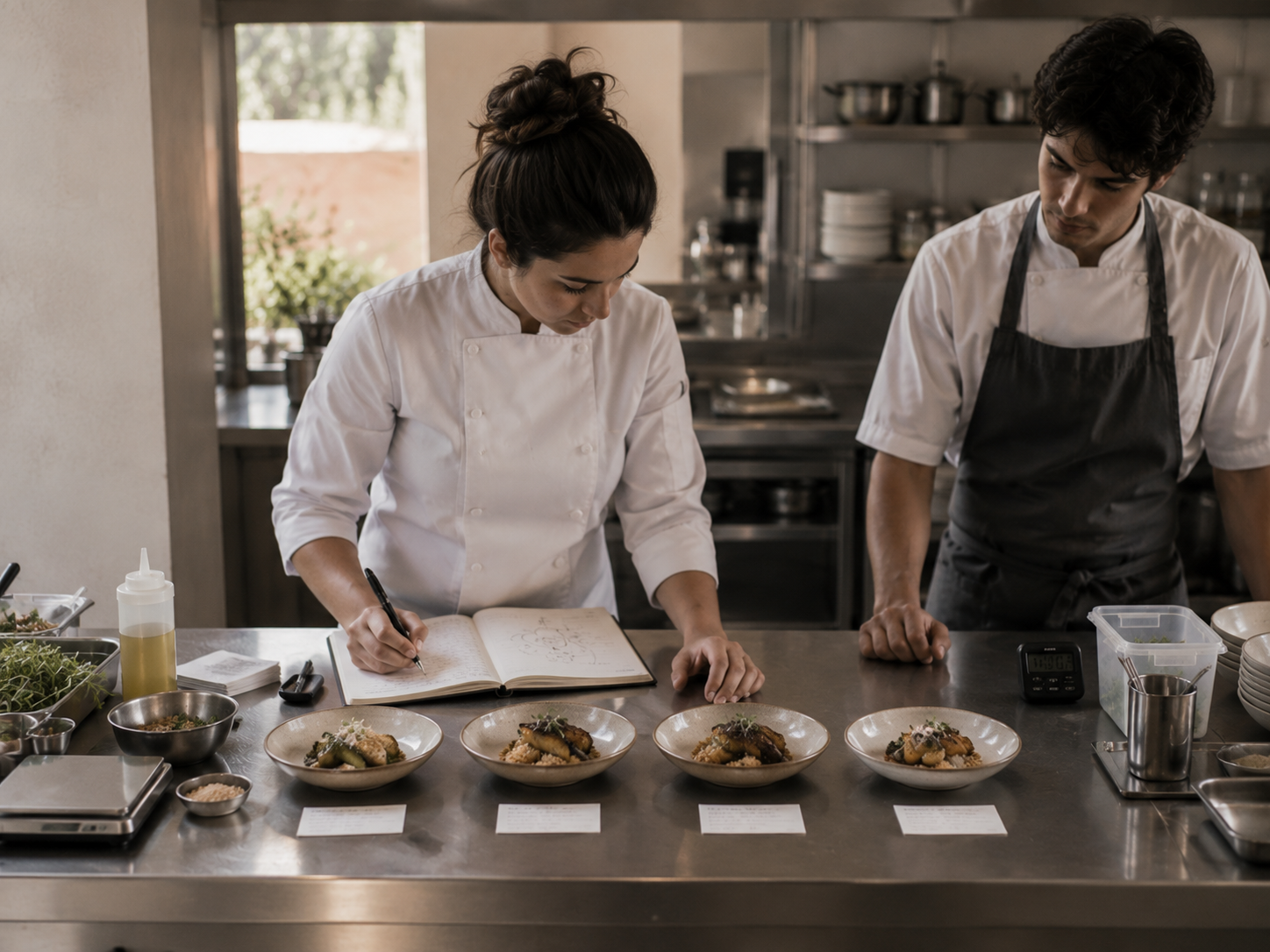
There is a phrase we hear constantly in kitchens when something is being developed: “Try it again.” It sounds reasonable enough. The first version was not quite right, so we try again. Someone tastes the sauce and says, “I don’t know, maybe try something else.” Another version appears, then another. Before long there may be five containers on the table, each one slightly different, while nobody is entirely sure what changed or what the next version is supposed to accomplish.
That is where development can begin to lose its shape. We are still cooking, still making versions, still spending ingredients and time, but the work is not necessarily moving forward. “Try again” only becomes useful when we know what we are trying again, and “try something else” only becomes useful when we understand what kind of change we are looking for. Once a culinary test gives us something worth pursuing, we begin entering another kind of work. We repeat. We compare. We make variations around what we have already learned. Then, once the direction becomes clearer, we refine.
These actions can look almost identical from the outside because they all involve making the preparation again. But they are not doing the same job. Testing helps us discover something. Repetition asks whether that result can happen again. Refinement asks what still needs to change now that we know which direction we are taking. That distinction matters because one successful result can create a false sense of completion. Something works beautifully once, everybody tastes it, everybody is excited, and suddenly we say, “Great, we have the recipe.” Maybe we do. Or maybe we simply had one very good afternoon.
A Good Result Is Information, Not Proof
Cooks compensate constantly. We add a little more water because the pan feels dry. We lower the heat because the sauce is catching. We let something cook another two minutes because it does not look ready. We taste, adjust salt, add acid, move the pan, change the flame, and make dozens of small decisions almost without noticing. That ability is part of being a good cook, but it is also one of the reasons a successful preparation can be difficult to reproduce.
Perhaps the sauce worked because the cook intuitively added more liquid halfway through. Perhaps the onions contained less water that day. Perhaps one batch simmered more aggressively than another. Perhaps the chef says the preparation takes twenty minutes, but in reality they always let it go for twenty-seven. Then another cook follows the written version and something very different appears. Repetition begins exposing these hidden conditions because we are no longer asking only whether the idea can work. We are asking whether the result belongs to the process or whether it depended on a particular moment, ingredient, cook, or accidental adjustment.
The first version may tell us that something is possible. Repetition begins asking whether it is reliable. That is a different question, and it changes what we are paying attention to. A good result is not proof that the preparation is finished. It is information worth returning to.
Repetition Is Still Investigative
Repeating something does not mean turning off our attention and producing the same version mechanically. In development, repetition is still investigative. Suppose we have developed a sauce with a particular emulsion and the consistency seems close to what we want. We make it again exactly as written, but this time it separates. That is useful information.
Perhaps the first version depended on temperature more than we realized. Perhaps the order of incorporation mattered. Perhaps we skipped a step the second time. Perhaps the quantity written in the notes was approximate rather than exact. The repetition has exposed something that the original success concealed. If we make the preparation again and discover that the sauce works consistently as long as one particular step is respected, we now know something more than “this sauce can be good.” We begin to understand the conditions under which it works.
This becomes particularly important when somebody else has to make it. It is easy to believe a preparation is simple when we have already made it twenty times. Our hands know what the written recipe does not say. Another cook may reveal those invisible assumptions immediately. We hand over the instructions, something goes wrong, and the first reaction may be to think they did not follow the recipe correctly. But perhaps the recipe still contains too much of the original cook.
What does “cook until ready” actually mean? What temperature? What visual change? How thick should it be? How quickly should the fat be incorporated? How much reduction are we expecting? Repetition begins exposing the difference between what we know intuitively and what the preparation itself actually requires.
Iteration Needs a Direction
Once we have a result that resembles what we are trying to achieve, we can begin iterating more deliberately. This is where “try again” becomes useful because we know what we are trying again and why. Perhaps the sauce is almost where we want it, but the texture is too loose. Now we can make several versions around that specific question. Version A contains less emulsifier, version B uses the current amount, and version C uses more. We can place them beside one another and see how the preparation responds.
Or perhaps salt seems to be the issue. We do not need to redesign the entire sauce. We may simply make a few controlled adjustments and observe where the seasoning becomes more complete without dominating the rest of the preparation. Iteration works because the differences are legible. We are not hoping one of the versions gets lucky. We are making variations that tell us something about the preparation.
That does not mean every test needs three perfectly labeled samples lined up like a scientific demonstration. Sometimes the work is much less formal. But the logic should remain visible. What are we changing? Why are we changing it? What are we trying to learn from the difference? Without that direction, versions multiply very quickly, and version four is not automatically better than version three simply because we made it later.
Sometimes version two was the strongest, and we moved away from it because we kept changing things simply to feel that development was continuing. This happens more often than we admit. Once we enter experimentation, it can become difficult to stop because there is always another possibility. Iteration needs a reason to continue.
Repetition Also Builds Confidence
There is another kind of knowledge that appears when something works again and again: confidence. If a sauce works once, we know that the result is possible. If we make it repeatedly, under slightly different normal kitchen conditions, and it continues to work, we begin trusting the preparation differently.
That confidence matters because recipes eventually have to leave the development environment. A chef may ask, “What happens when I’m not here? What if another cook has to make it?” If the preparation has only been made once, that is a legitimate concern. If it has been produced repeatedly, if other cooks have followed the method, and if the steps have been clarified along the way, then the answer becomes much stronger. There is no magic going on. There is a process.
This is one of the great advantages of repetition. It gradually separates the preparation from the person who first created it. The knowledge becomes more transferable, and something begins to move from an idea toward a formula the kitchen can actually use.
How many repetitions are enough will depend on what is being developed and where it is going. A dish served occasionally in a small restaurant does not need the same validation as a sauce intended for several locations or large-scale production. The important point here is not the number. It is understanding what repetition is giving us: evidence that the result can return.
Refinement Begins After the Direction Is Clear
At some point, the preparation stops feeling like an open question. We know what the sauce is. We know the direction we want to take. We know the main ingredients, the general technique, and the character we are trying to protect. That is when the work changes again.
Refinement is not the moment when we suddenly decide to make an entirely different preparation. If tomatoes are fundamental to the identity and structure of the red sauce we have been developing, removing tomatoes completely is not a refinement. It may lead to something interesting, but we have opened another development path.
Refining means staying with the preparation we have chosen and improving the way it performs. Perhaps we discover another variety of tomato with a better balance of sweetness and acidity, less water, stronger color, and a better price. The sauce remains recognizably the same preparation, but the ingredient choice improves it. Perhaps the technique can be shortened without losing quality. Perhaps the sauce can become more stable. Perhaps the amount of oil can be reduced because several people describe a greasy aftertaste. Perhaps one step can be moved earlier in prep so the station does not have to finish it during service.
These are refinements because they strengthen the direction rather than replace it. That distinction is useful because development can become endless if we refuse to recognize when the fundamental creative decisions have already been made. At some point, we need to stop asking what else the dish could become and start asking how well this version can work.
Refinement Is Often Less Dramatic
Early experimentation tends to produce obvious differences. One version is roasted, another is raw. One uses one chile, another uses something completely different. The changes are visible and exciting. Refinement is often much quieter.
We adjust three grams. We change the tomato. We reduce the cooking time. We alter the order of incorporation. We remove something that nobody notices directly except that the preparation suddenly feels cleaner. This can make refinement less glamorous than the beginning of the creative process, but it is often where professional quality appears.
A preparation can be conceptually interesting and still be awkward to execute. It can taste excellent and still be too expensive. It can work beautifully when fresh and deteriorate after twenty minutes. It can be balanced when we taste one spoonful and become heavy when eaten as a full portion. Refinement begins dealing with those realities. By this stage, we have already decided that the idea deserves to continue. Now we are asking how to make it stronger, clearer, more stable, and more appropriate for the place where it needs to live. That is not a smaller creative task. It is a more precise one.
Other People Begin to Matter More
As the preparation becomes more resolved, it also becomes useful to let it leave the narrow circle of the cooks who have been staring at it for days. There is a strange thing that happens during development: we become accustomed to our own work.
We know what changed in every version. We know what we were trying to accomplish. We remember the disappointing first test and the breakthrough that happened later. All of that history enters the way we taste the current version. Someone outside the immediate development process does not carry that history. They simply taste what is in front of them.
That perspective can be useful. Perhaps several cooks agree that the sauce is complete, but someone else immediately says it feels too oily. Perhaps a preparation everyone inside the kitchen finds sophisticated comes across as confusing outside it. Perhaps the thing we have been obsessing over for a week is not even what another person notices first. This is where feedback begins to enter refinement.
We do not need to go deeply here into sensory evaluation or criteria because those questions deserve their own attention. It is enough to recognize that development eventually has to meet people who were not inside the experiment. The preparation has to survive that encounter too.
Time Reveals What the First Test Cannot
This may be the larger difference between testing, repeating, and refining: time enters the work. A first test gives us a moment. Repetition gives us recurrence. Refinement gives us development across those repeated encounters. We learn things on the third version that we could not have known on the first. We discover hidden steps because someone else tries the recipe. We realize that an ingredient we thought was essential is not doing much. We find that a preparation is more stable than we expected, or much less stable. We become more precise about what the dish actually needs. The work begins to accumulate.
That is why development is different from producing a succession of random versions. Version one, version two, version three, and version four only become meaningful when there is a relationship between them. What did we learn from the first that informed the second? What did repeating the second reveal? Why did we change something in the third? What are we trying to improve now? Those questions create continuity. Without that continuity, we are simply making more food.
Development Is a Series of Encounters
There is something reassuring in understanding culinary development this way because it removes the pressure for the first good version to carry everything. A successful test does not need to be the finished recipe. It only needs to give us enough information to continue.
We can repeat it and see whether the result returns. We can make controlled variations and understand where the preparation is sensitive. We can allow another cook to make it and discover what we forgot to explain. Once the direction feels clear, we can refine the preparation until it begins to fit the actual conditions where it will be used. The dish becomes more resolved because we have encountered it several times, and each encounter is asking a slightly different question.
Testing asks what happens. Repeating asks whether it can happen again. Refining asks, now that we know where we are going, what still needs to become better. Those are not three names for the same activity. They are three different moments in development, and recognizing the difference gives us something much more useful than simply saying, “Try it again.” It gives the next attempt a reason.
→Read further about recipe development, culinary experimentation and R&D, in the framework of the culinary creative process:
What is culinary R&D? → How do I design a culinary test? → What is the difference between testing and refining? → How do I evaluate the test? → How do I decide what is better? → Why should I document it?