The Culinary Creative Process: How Cooks Develop Ideas
Creativity is a Method, Not a Talent
At some point, almost every cook arrives at the same quiet question: Why should I be creative? The recipes already exist. The internet is full of them. Books, videos, archives, libraries, social feeds; endless instructions, endless formulas. Now even machines can generate recipes. So why bother? For many cooks, creativity feels optional. Sometimes even intimidating. It can feel like something reserved for “talented people,” for chefs with names, for artists, or for those who seem to already know what they are doing. And if your relationship with cooking has been built through effort, repetition, discipline, if it has been something you had to earn rather than something that came easily… the idea of creativity can even feel distant. Almost irrelevant.
But creativity is not a luxury. And it is not decoration. It matters because it is the moment where cooking stops being a labor routine and becomes a presence at work. Without it, you follow. With it, you begin to author. There is a common misunderstanding of the topic. Creativity is often confused with originality, with the pressure to invent something new, something never seen before. But in the kitchen, creativity rarely looks like that. It is quieter. Slower. More cumulative. It lives in the decisions you make again and again: what you care about, what you repeat, what you refine, what you reject, and what you protect.
Over time, those decisions begin to align. They start to form a pattern. And that pattern becomes visible. That visibility is what we later call a signature. Not something you choose in advance, but something that reveals itself through consistent practice. Because the truth is simple: no one else has lived your life. Your references, your memories, your mistakes, your preferences, your contradictions; they are already present in how you cook. Creativity is not about adding something new. It is about recognizing what is already there and accounting for it. You already cook like yourself. Creativity is also noticing what you do.
And yet, it’s important to say this clearly. Kitchens are not neutral spaces. They run on time, cost, pressure, and consistency. There are services to execute, teams to coordinate, and margins to protect. In many kitchens, there is simply no room for experimentation. No extra hours for testing, no budget for failed attempts, no space to step outside the rhythm of production. The menu is set elsewhere, the system is defined, and the work is to execute it well, every day. That reality is not a failure of the cook or the owners. It is part of how that kitchen runs inside a particular business system.
There are kitchens where creativity is not expected, not encouraged, sometimes not even possible. And for many cooks, this is where the work happens: through repetition, discipline, and precision. But there are also moments, and sometimes entire environments, where something else becomes possible. Where structure holds firmly enough that exploration can exist within it. Where curiosity is not in conflict with the work, but supported by it. And when that space appears — whether it is given, or something you learn to carve out — creativity begins to take a different role.
Creativity Needs Conditions to Flourish
I understood this more clearly in Barcelona. In that Michelin-starred kitchen, creativity was not treated as something mysterious or heroic. It was treated as a consequence. The kitchen worked. The flow made sense. Stations were clear. Roles were defined. The team trusted each other. And because everything functioned, something else became possible. During slower moments, chefs would turn to us and say, “Go play with that ingredient.” “Try pushing that process a bit further.” “See what happens.” But there was always a condition. Write everything down. At the time, it felt like a small detail. It wasn’t.
Creativity was not separate from discipline. It depended on it. Because if something worked, it could be repeated. If it could be repeated, it could be refined. If it could be refined, it could become part of the kitchen. What began as a curiosity could become part of the structure. What began as play could become a dish. I saw the opposite working as a chef de partie in a Michelin-starred kitchen back in Amsterdam. That kitchen did not lack ideas. It lacked conditions. Poor flow. Constant friction. Weak communication. Energy is spent solving problems rather than developing anything new. Nothing had space to stabilize. Ideas appeared — and disappeared just as quickly. Not because they were bad, but because they could not survive the environment.
That’s when it became clear: Creativity doesn’t fail because of a lack of ideas. It fails because there is nowhere for those ideas to land. Without structure, creativity suffocates. And so the role of a cook, and even more, the role of the chef, is not only to create dishes, but to create conditions. Conditions where people want to come to work. Where effort feels meaningful. Where repetition still has direction. Where curiosity has space to exist. Creativity, in that sense, is not ego. It is energy.
A Menu is not just a list of dishes
There are many reasons why creativity matters in the kitchen. Sometimes, it is practical. A menu is not just a list of dishes. It is a point of view. It communicates what kind of kitchen this is, what kind of care is present, and what kind of experience someone is about to enter. Designing that requires more than technique. It requires composition awareness. Balance. Rhythm. Editing. In other words, creative action. But sometimes, it is about survival. Cooking without meaning drains faster than long hours ever could. Repetition without direction becomes heavy. Creativity gives that repetition a sense of purpose. It keeps the work alive.
Sometimes, it is requested as part of your profession. You may be asked to develop recipes. To consult. To create products. To build a concept. To communicate your work. In those moments, creativity is not optional. It is the tool. And sometimes, it is a personal quest. You might work in a structured kitchen, with fixed menus and clear rules. But outside of that, at home, in your own time, you want to explore. To test ideas. To follow curiosity. To stay awake to what excites you. Creativity becomes the place where that part of you continues to breathe.
Some People are Creative, Others are not
There is another misconception worth addressing. The idea that some people are creative, and others are not. This is simply not true. What exists is not a difference in creativity, but a difference in permission, exposure, and method. Some people are encouraged early. Some find environments that reward initiative. Some learn, consciously or not, how to explore safely. Others don’t. But creativity itself is not a personality trait. It is a methodical practice. People who appear “naturally creative” are often people who have learned to observe closely, allowed themselves to fail without withdrawing, found ways to collect ideas, and built small systems to test and explore. In other words, they have a method.
Even if they don’t call it that. And what separates them is not confidence. It is tolerance. Tolerance for not knowing. Tolerance for uncertainty. Tolerance for staying with a question longer than is comfortable. This is not talent. It is commitment. So perhaps the most important thing to say is this: you do not need permission to be creative. Creativity does not begin with brilliance. It begins with attention. From there, something begins to take shape. Not all at once. Not clearly. But steadily. And over time, that attention becomes direction. That direction activates a process. And that process becomes your way of working.
Creativity matters because it is how you claim authorship over your craft. Not to impress. Not to dominate. But to be honest. To cook in a way that reflects something real. So don’t wait to be chosen. Start where you are. With what you have. With what moves you. Because creativity is not something you receive. It is something you take on. And once you do, the kitchen begins to answer back.
From Philosophy to Practice: The Creative Chef Method
Recognizing that creativity requires attention is the first step. Building a system around that attention is the next. Without a structure, creative energy tends to remain fragile. It appears in flashes, in good days, in moments of intuition, but it does not always become something you can return to, test, improve, and serve again. That is why, over time, I began to understand creativity in the kitchen as a method. Not a formula that tells you what to cook. Not a rigid system that replaces instinct. A method is something different. It is a way of stabilizing an instinct, a bursting thought or a reference long enough for a concrete idea to develop.
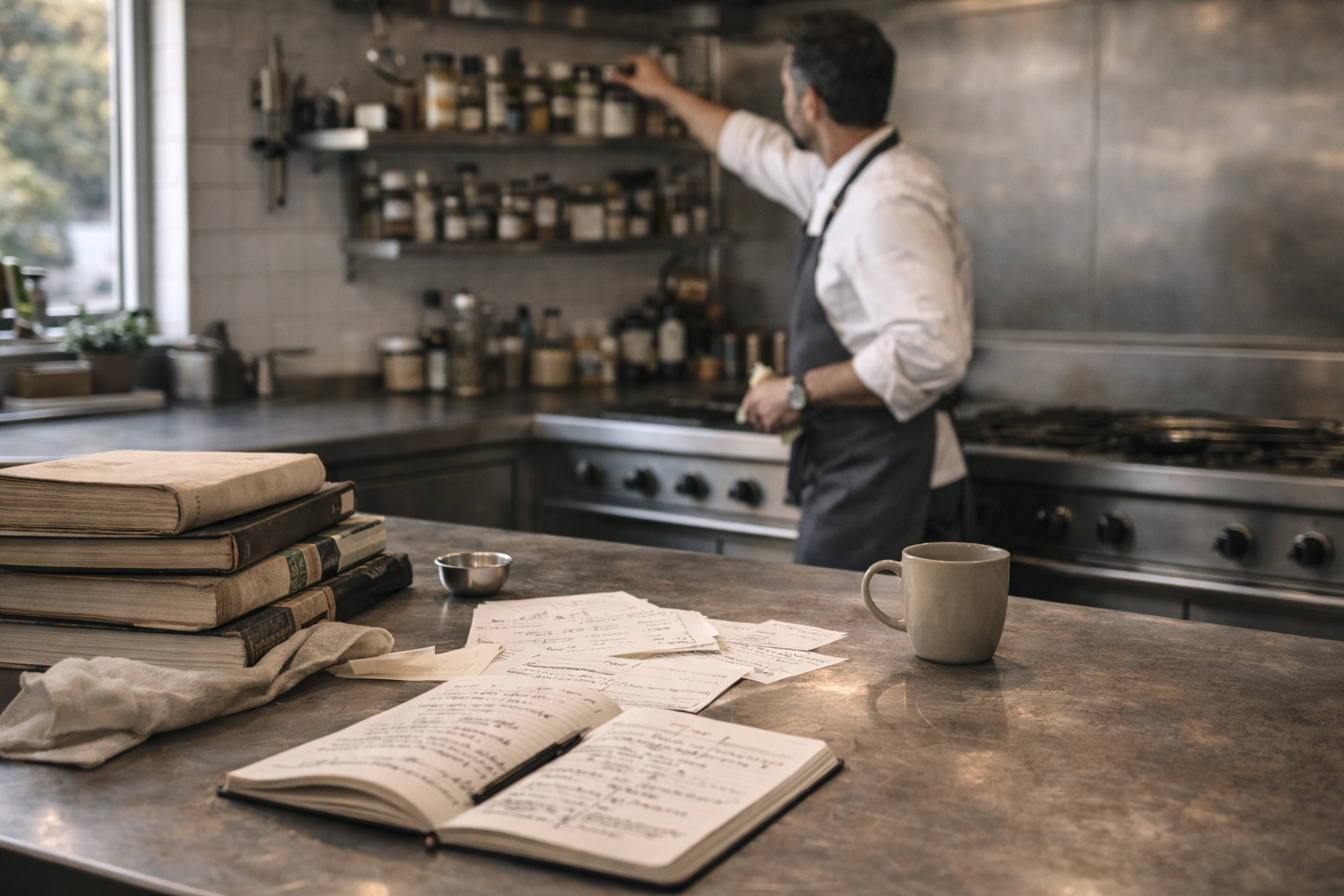
For me, that process has always moved through four essential gestures: research, experimentation, documentation, and refinement. Research is where the cook begins to gather references, ingredients, traditions, techniques, constraints, and possibilities. Experimentation is where those ideas are placed under heat, pressure, taste, failure, and adjustment. Documentation is what prevents the work from disappearing. It is the notebook, the diagram, the formula, the note written after service, the detail you think you will remember but rarely do. Refinement is where the idea is no longer just exciting, but useful, repeatable, and ready to live in a real kitchen. This is the foundation of culinary creativity.
Clearly, I did not invent this method. I put it together in this platform in my own way after years of watching how creative people actually work: artists, chefs, designers, cooks, and makers who were expected to produce ideas not once, but repeatedly. Some worked in quiet studios. Others worked in steaming kitchens, with pressure, noise, heat, and service moving forward regardless. What interested me was not the romance of creativity, but the structure behind it. Again and again, the same pattern appeared: those who developed strong work were not waiting for inspiration. They were always researching, testing, documenting, adjusting, and refining their ideas. Inspiration may open the door, but only learning the process allows you to walk through it, experience it and own it.
The Creative Chef Method exists for cooks who feel that creative urge but need a clearer structure to work with it. Cooks who understand that creativity is not the opposite of consistency; it is the path toward more precise, reliable, and meaningful results. In the end, the goal is not to escape the recipe. The goal is to arrive at one with intention: a formula that can be repeated, improved, taught, served, and trusted. Authorship is not a mood, and your style should not be a culinary trend. Creativity begins with attention. Having a method gives that attention the right place to go.
The Culinary Creative Process: How Cooks Develop Ideas