The Economy of Favors Between Restaurants: When Generosity Needs a Protocol
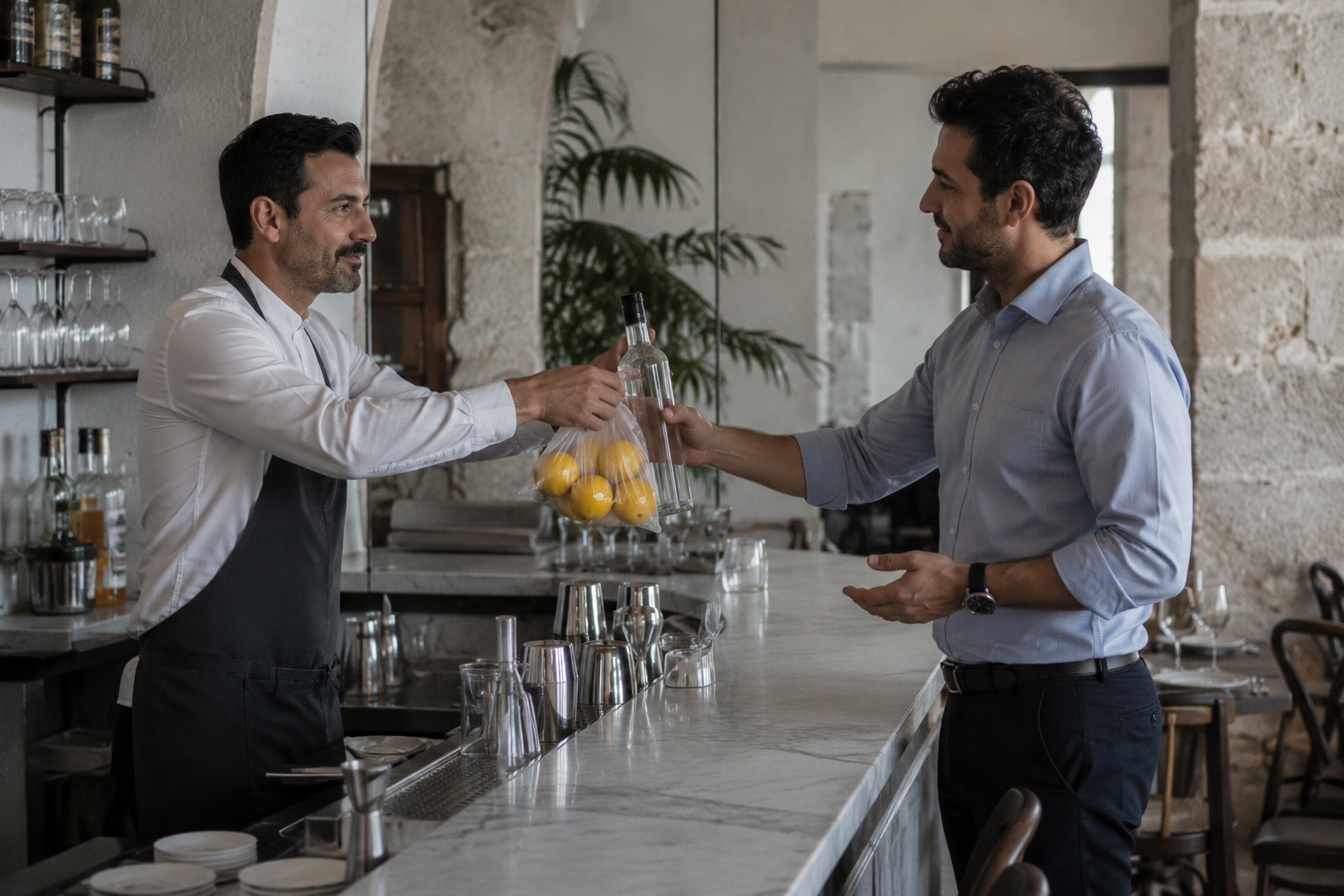
Restaurants help each other. This happens constantly, especially when businesses operate close to one another. Two restaurants share the same street. A bar is around the corner from a kitchen. The chefs know each other, the owners are friends, or people have worked together somewhere else before opening their own places. Then, in the middle of a normal day, something goes wrong. A delivery does not arrive. Someone forgot to place an order. The restaurant becomes much busier than expected. A machine breaks just before service. A bottle needed for the night is suddenly missing. So someone walks next door and asks, “Can you help us?”
Most of the time, the other restaurant wants to say yes because everyone in hospitality knows what it feels like to be caught short at the worst possible moment. You need something now, not tomorrow morning, and the restaurant nearby understands because sooner or later the same thing may happen to them. It may be a few lemons, a bottle of wine, a bag of ice, a stack of napkins, a hotel pan, a blender, or a small quantity of an ingredient that did not arrive. Whatever the object is, the exchange usually begins from a very human place.
That is how an economy of favors begins. There is something valuable in this kind of relationship because a restaurant does not exist entirely on its own. It exists among other businesses, suppliers, technicians, cooks, bartenders, neighbors, and people who understand the peculiar emergencies of the industry. When those relationships are healthy, one place may save another from a difficult night. But what begins as generosity can become informal very quickly. Once products, bottles, tools, and equipment begin moving between businesses without clear control, it becomes difficult to know what left, who authorized it, whether it returned, and in what condition. The favor may still have a good heart, but the business has lost visibility. The question is not whether restaurants should help one another. I think they should. The better question is how to remain generous without allowing generosity to weaken your own operation.
The Favor Begins With Empathy
The first thing to understand is that the restaurant asking for help is usually trying to solve an immediate problem in the most direct way available. Something is missing, something did not arrive, someone forgot to order, or service is approaching and the kitchen realizes that it does not have what it needs. The first solution is often the closest one: ask the neighbor. If the restaurant next door has lemons, ice, a bottle, a tool, or a few trays, then asking them may feel more realistic than calling a supplier, sending someone across the city, or trying to rebuild the preparation at the last minute. In an emergency, people look for the shortest path out of the problem.
That is also why the request often reaches us emotionally before it reaches us operationally. We recognize the situation immediately. We know what it feels like to be short of something before service. We know the embarrassment of having promised a dish or drink and realizing that one essential element is missing. We know that sometimes the supermarket, the corner store, or another supplier may be a last resort, but the restaurant nearby is faster, closer, and more likely to understand the urgency. So when someone arrives asking for help, the instinct is to help them get out of trouble.
There is nothing wrong with that instinct. In fact, it is part of what makes this economy of favors possible. But empathy tends to look only at the problem in front of us. It sees the other restaurant’s immediate difficulty before it measures the consequence for our own service. The restaurant next door asks for six lemons. You have plenty, so you give them six. At four in the afternoon, this seems harmless. Then your own restaurant becomes unexpectedly busy, a preparation needs more citrus than anticipated, and by eight o’clock you are looking for the lemons that are now in another kitchen.
The favor has left a hole. That does not mean the six lemons should never have been lent. It means the answer needed a little more structure. “Yes, we can help you right now, but when can you replace them?” is already a different kind of response from simply handing them over. It recognizes the emergency without pretending that the product has no value for your own operation. Perhaps the lemons need to be replaced before dinner service. Perhaps they need to be returned from the same supplier. Perhaps the neighboring restaurant should send someone immediately to buy replacements, even if the borrowed lemons allow them to survive the next hour. The point is not to make the favor cold. The point is to keep the favor from quietly becoming your problem later.
This is where kindness begins to require management. Will we need those lemons tonight? Are they part of our backup stock? Can they be replaced quickly? Are they connected to a dish or drink we have promised to the guest? If service changes suddenly, can we continue without them? A good favor solves the other restaurant’s immediate problem without creating an unnecessary weakness inside your own.
I saw this very clearly once while managing a restaurant. I arrived for a shift and noticed that a particular bottle of whiskey was missing from the shelf. When I asked the bartender where it was, he explained that another restaurant nearby had run out and had come to borrow it. They were going to replace the bottle the next day. To him, this was perfectly reasonable. No one ordered that whiskey very often, the bottle was sitting there, and the other restaurant needed it. But that was not his decision to make.
The fact that something rarely sells does not mean the restaurant no longer needs to have it. We had chosen to offer that whiskey, and a guest could have ordered it that night. What were we supposed to say then? Sorry, we lent it to the restaurant down the street? The bartender had interpreted the situation through his own idea of common sense. He thought he was being helpful. The deeper problem was that there was no protocol telling him what he was authorized to lend and what he was not.
The failure was not really the favor itself. It was the absence of a system around the favor. This distinction matters because many operational problems begin exactly this way. No one is trying to steal. No one is trying to damage the business. A person simply makes a decision that feels generous and reasonable in the moment, while the consequences belong to the restaurant.
When the Favor Enters the Operation
Borrowing an ingredient is one thing. Borrowing access to the operation is another. I once worked in a restaurant that had a Pacojet. A nearby restaurant had one too, but theirs broke. The owners of both restaurants knew each other, so they arranged for the other kitchen to bring over some containers and use our machine. In principle, this sounded manageable. Their equipment had failed, ours was available, and we could help them through a difficult moment. Then they arrived with a cooler containing around fifteen containers.
At that point, the favor had changed scale. They were no longer asking to get them out of trouble. They were using part of our kitchen and part of our equipment to continue their own production. The problem was not only that the machine was being used heavily. We needed the Pacojet too. Their cooks would process one container, then we would use the machine for our own work, then they would return with another. People were waiting, negotiating access, moving around one another, and interrupting a workflow that had nothing to do with the other restaurant’s problem.
The arrangement had been made between owners, but the operational cost was being carried by the kitchen. That distinction matters. An owner may agree to a favor because the gesture feels small from outside the immediate work. But the owner may not be the person who has to reorganize a station, wait for a machine, supervise someone else’s use of equipment, clean additional parts, or explain why service has slowed. A favor should therefore be evaluated not only by the value of the object, but by what it asks from the operation. Does someone need to supervise it? Does it occupy space? Does it use staff time, electricity, water, or cleaning supplies? Does it create additional wear? Does someone have to stop their own work to help? Something can be free financially and expensive operationally.
At the end of that service, those of us working in the kitchen spoke to the owner, who was also the chef, and told him clearly that we did not want the arrangement repeated. The problem was not that we disliked the other restaurant or objected to helping them. The problem was that their emergency had entered our service. This is why some things simply should not leave the restaurant, and some resources should not be shared during operation.
A critical piece of equipment, a fragile tool, or the only item that allows a preparation to continue may be too important to lend. If the restaurant owns one immersion blender and several preparations depend on it, that blender probably stays in the building. If a particular tray is necessary because it is the only one that fits a specific oven, the tray stays. If a machine is expensive, specialized, or difficult to replace, the answer may simply be no. If helping another restaurant places your own service at risk, the favor has stopped being good management. A favor is voluntary. Good neighboring relationships should be able to survive a limit.
What Leaves Has to Come Back
The next difficulty begins with return. A restaurant lends something and assumes that the equivalent will come back. But equivalent to whom? Imagine that your restaurant buys excellent organic lemons from a supplier. They are large, juicy, carefully selected, and perhaps even connected to the way you describe your food. The restaurant next door runs out, so you lend them half a dozen. The next day, they return six lemons, but the lemons are smaller, drier, conventional, and already beginning to age. From their perspective, the debt has been repaid. Six lemons went out, six lemons came back. But they are not the same product.
This is where very simple objects become complicated. A lemon is not always just a lemon. A bottle is not simply a bottle. A kilogram of one product is not automatically equal to a kilogram of another. Brand, quality, origin, size, condition, and supplier can all matter. The same is true with equipment. A tray leaves straight and returns bent. A blender comes back making a strange sound. A copper pot returns scratched. A knife comes back with a damaged tip. Then the conversation begins: “it was already like that; no, it was not; yes, it was.” Now the person who tried to help feels accused, and the person who lent the item feels treated as though they are inventing damage in order to get some extra benefit.
This is how generosity turns into conflict. The problem is not that the restaurants helped one another. The problem is that nothing was defined before the object moved. What exactly is leaving? What quantity? Which brand? What condition? When is it expected back? If it cannot be returned exactly, what counts as an acceptable replacement? If the item is damaged, who is responsible? These questions may sound excessive when someone is standing at the back door asking for six lemons, and of course the level of formality should match the value and risk of the favor. A few pieces of produce may require very little. A bottle of wine, a power tool, a machine, or a case of spirits requires more. The important thing is that the restaurant knows what left the premises, and has a shared understanding of how it should return.
This becomes even more important because the person saying yes may not own the thing being lent. A cook lends a pot. A bartender gives away a bottle. A server lets another business take a box of glasses. A dishwasher hands over a rack because no one seems to be using it. They may genuinely believe they are helping, but they did not buy the object, they do not pay to replace it, and they may not be responsible for the financial consequence if it disappears.
This does not mean every minor favor needs owner approval. That would make the system impractical. It means the authority should be clear. Perhaps the chef, manager, or shift leader can approve something leaving. Perhaps there is a list of items that can be lent without further permission. Perhaps alcohol is always recorded. Perhaps equipment never leaves. The restaurant can decide what fits its size and model, but someone has to decide, for accountability to be traceable. Otherwise, common sense becomes policy, and everyone has a different idea of common sense.
The Favor Needs a Memory
The economy of favors should not be invisible. If something meaningful leaves the restaurant, record it. This does not need to become a bureaucratic system. A simple notebook log may be enough: the date, the restaurant receiving the item, what left, the quantity or condition, who approved it, and when it should return. For a higher-value tool or piece of equipment, a quick photograph before it leaves may be sensible. For a product with a particular quality or brand, the expected replacement should be clear. For perishable ingredients, perhaps the arrangement is not even a loan. The other restaurant may simply pay for what it took or replace it with the same product from the same supplier.
The form matters less than the principle: the restaurant needs to know where its things are. Documentation also removes awkwardness from the relationship. Instead of someone vaguely asking three weeks later, “Did you ever bring back that tray?” the record already shows what is still outstanding. Memory no longer has to carry the whole arrangement. Once favors are documented, another kind of information begins to appear. Perhaps the same restaurant is borrowing the same things repeatedly. Perhaps one neighboring business often asks for wine or ingredients but rarely returns anything on time. Perhaps several employees are lending products without management realizing how often it happens. Perhaps the restaurant has quietly become known as the place where everyone can come when they are short.
One borrowed bottle is one bottle. Ten unrecorded bottles over several months are something else. One borrowed tray is harmless. Several missing trays may begin affecting service. This is where the manager has to see beyond the individual gesture and look for the pattern. Not every leak in a restaurant comes from theft or bad intention. Sometimes the business simply loses visibility because too many informal decisions are being made around it.
The answer is not suspicion. It is attention. How often is this happening? Who is authorizing it? Does everything return? Does it come back in the same condition? Is one business borrowing constantly? Are certain employees making these decisions more often than others? The pattern tells you whether the restaurant still has an occasional economy of favors or whether an unofficial supply system has developed behind management’s back.
The economy of favors works best when it remains exceptional. The restaurant next door runs out of something once, and you help. A machine breaks unexpectedly, and you help. A delivery fails, and you help. But if the same business is constantly borrowing the same products, equipment, or production capacity, the situation has changed. Perhaps the arrangement should become formal. Perhaps there are designated hours, a fee, a replacement agreement, or another way of sharing the cost. Perhaps the answer is simply that the arrangement has to stop. The important thing is to notice when the relationship has changed.
Generosity With Boundaries
None of this means restaurants should become cold toward one another. In fact, I think the opposite is true. A healthy network between nearby restaurants can be extremely valuable because different businesses have access to different resources, relationships, and forms of knowledge. One may have ice when another runs out, another may have extra storage, and someone else may know a technician who can arrive quickly. A chef may know where to source a difficult ingredient, while a bartender may know a supplier capable of making an emergency delivery.
These relationships create resilience because the restaurant is not completely alone when something unexpected happens. They also create goodwill. One day you help someone, and another day they help you. A small favor at the right moment can preserve a service, save a product, or prevent a difficult night from becoming a disaster. A restaurant that never helps anyone may discover that it has very few people to call when its own emergency arrives. That is why I would not argue against the economy of favors. I would argue for making it visible. A clear protocol does not make the favor less generous. It protects the generosity from becoming resentment. The borrowing restaurant knows what is expected. The lending restaurant knows what left. The staff knows who can approve the exchange. The operation knows which things must remain in-house.
Good boundaries make the relationship stronger because they prevent the quiet accumulation of small grievances. You are not still waiting for the tray that never returned. You are not discovering that someone lent your only tool. You are not arguing over whether a machine was already damaged. You are not realizing halfway through service that the bottle on the menu is in another bar. The generosity remains, but the confusion does not. A small missing item can become a large operational problem in the middle of service, and a little help at the right moment can genuinely save the night. But generosity works best when it has a boundary. The goal is not to turn kindness into bureaucracy. It is to make kindness sustainable.
The best version of the economy of favors is not one restaurant quietly absorbing the cost of another restaurant’s problems. It is reciprocity. One business helps another through a difficult moment, the exchange is remembered, the item returns, and the relationship remains intact. The next time, the direction may reverse. That is the real value of the favor. Not the lemons, the bottle, or the machine, but the relationship.
Explore Further: