Mushrooms — Flavor, Texture, and Versatility
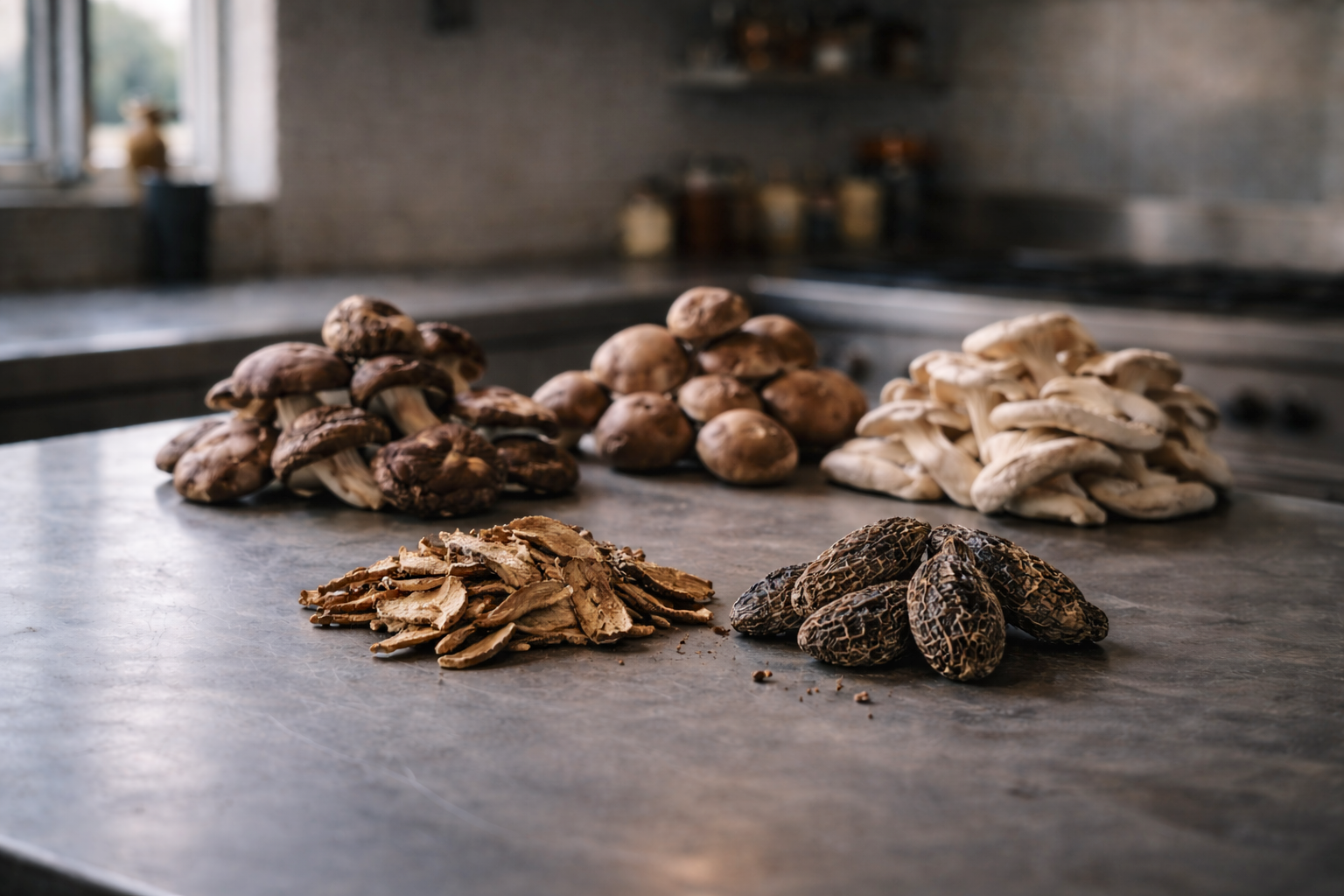
Mushrooms occupy a rare position in the culinary world. They are at once ingredient, structure, and seasoning. Found across continents and traditions, they move easily between roles: from humble accompaniment to centerpiece, from everyday nourishment to highly prized seasonal delicacy.
In many kitchens, mushrooms are treated as secondary elements, something added to a dish for depth or garnish. In plant-based cooking, they are often framed as a substitute. Both perspectives overlook their true potential. Mushrooms are not defined by what they replace, but by what they are capable of becoming.
Their strength lies in transformation. As they cook, mushrooms release and reorganize their internal structure. Moisture evaporates, fibers tighten or relax, sugars caramelize, and umami intensifies. The same mushroom can be delicate and slippery, dense and meaty, crisp and airy, or deeply concentrated, depending entirely on technique.
They are also powerful condiments. A mushroom powder can season a broth. A slow-cooked mushroom paste can anchor a sauce. A crisp mushroom garnish can redefine the texture of a dish. In this way, mushrooms operate across scales, shaping not just flavor, but the identity of a preparation.
The following techniques are not simply methods. They are ways of understanding how mushrooms behave, and how to guide their transformation with intention.
Sautéing / Stir-Frying
One of the most direct ways to reveal the character of mushrooms. This technique emphasizes reduction, concentration, and surface development.
Transformation:
Intensifies umami, reduces moisture, builds sear and caramelization
Best Mushrooms:
Shiitake, cremini, oyster, king oyster
Tips:
Use high heat and avoid crowding the pan
Start dry for water-heavy mushrooms, then add fat once moisture releases
Applications:
Noodle dishes, rice bowls, stir-fries, fillings
Grilling / Roasting
Here, mushrooms take on structure and smokiness. Heat penetrates slowly, allowing fibers to firm up while edges caramelize.
Transformation:
Enhances chewiness, develops smoky notes, creates crisp edges
Best Mushrooms:
King oyster, portobello, maitake, lion’s mane
Tips:
Marinate beforehand for deeper flavor integration
Use skewers or grill baskets to maintain control
Applications:
Skewers, bao fillings, grilled plates, bowl components
Steaming
A more restrained approach that preserves the mushroom’s natural character. Ideal for highlighting subtlety and purity.
Transformation:
Retains moisture, softens fibers, preserves delicate flavor
Best Mushrooms:
Enoki, straw mushrooms, bamboo pith, lion’s mane
Tips:
Pair with aromatics such as ginger, scallion, or light soy
Avoid overcooking to maintain structure
Applications:
Dumplings, light broths, delicate preparations
Deep-Frying / Pan-Frying
This technique creates contrast. Crisp exteriors form quickly while interiors remain tender and juicy.
Transformation:
Crispy exterior, soft interior, textural contrast
Best Mushrooms:
Oyster, enoki, shiitake
Tips:
Use light batters or starch coatings
Season immediately after frying
Applications:
Tempura, garnishes, snacks, layered textures in bowls
Braising / Stewing
Slow cooking allows mushrooms to absorb and redistribute flavor. They become carriers of the surrounding liquid.
Transformation:
Absorbs sauces, deepens flavor, becomes tender and cohesive
Best Mushrooms:
Dried shiitake, king oyster, straw mushrooms, black fungus
Tips:
Build the base with soy, miso, or fermented pastes
Allow time for full flavor integration
Applications:
Curries, stews, clay pot dishes, braised preparations
Drying & Rehydrating
A transformation that extends beyond cooking. Drying concentrates flavor, while rehydration reshapes texture.
Transformation:
Concentrates umami; creates chewiness and depth when rehydrated
Best Mushrooms:
Shiitake, wood ear, black fungus, bamboo pith
Tips:
Use soaking liquid when clean and aromatic
Ideal for long-cooked preparations
Applications:
Broths, congee, stews, fillings
Pulverizing / Powdering
At this stage, mushrooms become seasoning. Their presence is subtle but foundational.
Transformation:
Turns into a fine seasoning that enhances umami
Best Mushrooms:
Dried shiitake, porcini, maitake
Tips:
Blend into fine powder
Combine with salt, seaweed, or spices for custom blends
Applications:
Broths, rubs, sauces, dumpling fillings
Shredding / Pulling
A structural transformation that highlights the fibrous nature of certain mushrooms.
Transformation:
Creates layered, strand-like textures that hold seasoning well
Best Mushrooms:
King oyster, lion’s mane
Tips:
Pull by hand or fork before cooking
Season assertively to define the final flavor
Applications:
Tacos, sliders, skewers, grain bowls
Mushrooms invite a different way of thinking about cooking. They reward attention, respond to technique, and shift identity depending on how they are handled. When approached with intention, they are not just an ingredient within a dish; they are a medium through which texture, flavor, and structure are expressed.
→ Explore the following studies and applications on Mushrooms