Molecular Cuisine Tools — 23 Departure Points for Precision, Texture, and Control
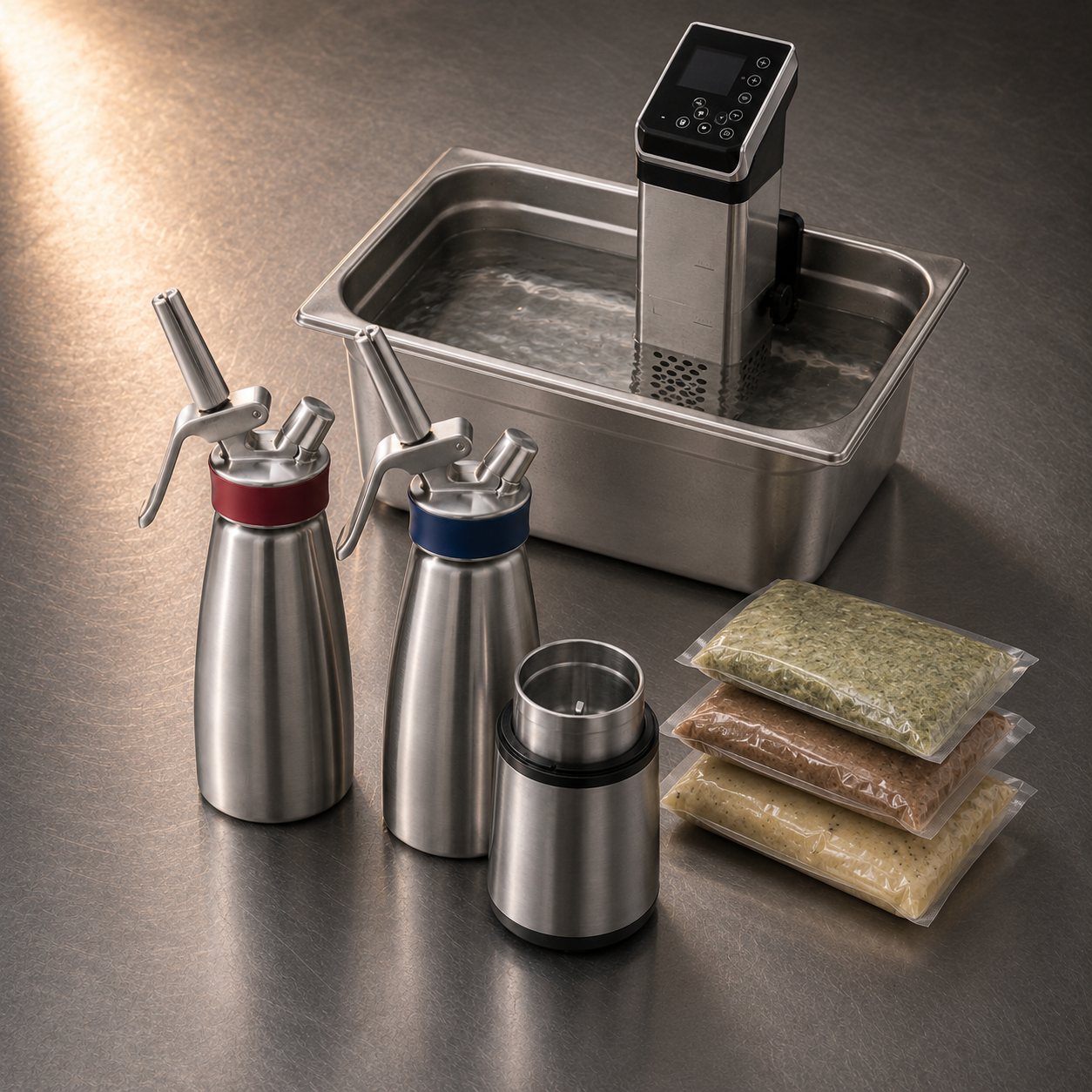
Molecular cuisine is often associated with unusual tools: siphons, circulators, vacuum chambers, precision scales, molds, and laboratory-style instruments. But the tools are not the point. They are the means by which a cook gains control over transformation.
A good tool allows you to ask better questions. How precise is the temperature? How stable is the foam? How fine is the powder? How clear is the liquid? How much air, pressure, time, or weight is being applied? In this sense, molecular tools belong naturally inside Materia, because they reveal the mechanics behind texture, flavor, and structure.
This article gathers 23 tools and instruments used in molecular cuisine, organized into clusters so we can understand what each one makes possible. The goal is not to create a shopping list, but to offer a structured beginning: a way to see tools as instruments for experimentation, documentation, and refinement.
Safety and scope note: Some tools in molecular cuisine involve heat, pressure, vacuum, blades, gases, or cryogenic materials. Use proper training, food-safe equipment, and manufacturer instructions. Liquid nitrogen, pressurized siphons, vacuum systems, and high-speed blending require particular care.
Departure Points is a Materia series built around creative exploration. Each article gathers 23 known or traditionally used applications of an ingredient, technique, region, or culinary material, then organizes them into clusters so cooks can see patterns, possibilities, and relationships. Each point of departure is a catapult for further inquiry: a reference, a context, and a question to carry back into the kitchen. What does this material do? How has it been used before? What changes when we alter the medium, the technique, the temperature, or the cultural context? From there, the work begins.
Cluster I: Precision, Measurement, and Control
Molecular cuisine begins with measurement. Before texture can be designed, proportions must be understood. These tools help the cook move from approximation to repeatable experimentation.
1. Precision Scale
A precision scale measures small quantities with accuracy, often down to tenths or hundredths of a gram. This matters when working with hydrocolloids, stabilizers, enzymes, acids, salts, and powders, where a small variation can completely change the result.
2. Digital Thermometer
A digital thermometer gives immediate feedback on temperature. It is essential for custards, gels, sous-vide verification, sugar work, chocolate, dairy, emulsions, and any preparation where heat changes structure.
3. pH Meter or pH Strips
pH measurement helps monitor acidity and alkalinity. This is important in fermentation, spherification, pickling, gels, dairy systems, and preservation. It teaches the cook that acidity is not only flavor; it is behavior.
4. Timer and Temperature Log
A timer may seem basic, but in controlled cooking it becomes a documentation tool. Paired with temperature notes, it helps track how long a gel sets, how a sous-vide bath performs, or when a dehydration texture is reached.
Cluster II: Temperature, Water Baths, and Thermal Stability
Temperature is one of the great forces of transformation. These tools help stabilize heat or cold so ingredients can behave predictably.
5. Immersion Circulator
An immersion circulator controls water temperature for sous-vide cooking. It allows precise cooking of proteins, vegetables, fruits, custards, and infusions. Its value is consistency: the same temperature produces the same result, again and again.
6. Water Bath Container
A dedicated water bath container supports sous-vide and temperature-controlled processes. It provides enough volume for even circulation and helps maintain stable heat during longer cooking.
7. Blast Chiller or Ice Bath Setup
Rapid chilling protects texture, slows cooking, and improves food safety. While a blast chiller is professional equipment, an organized ice bath can serve many practical functions: cooling custards, stopping vegetable cooking, setting gels, or preparing ingredients for storage.
8. Induction Burner
An induction burner offers responsive heat control. It is useful for sauces, gels, reductions, sugar work, frying, and controlled heating when precision matters.
Cluster III: Air, Foam, and Pressure
Air can become texture when handled correctly. These tools help incorporate, stabilize, or pressurize air and gases into liquids, creams, purées, and foams.
9. Whipping Siphon
A whipping siphon uses gas cartridges to aerate liquids, creams, sauces, and foams. It can create espumas, light creams, carbonated preparations, and rapid infusions. Used properly, it gives flavor lift without heaviness.
10. N₂O Chargers
Nitrous oxide chargers are used with whipping siphons to create foams and aerated textures. They help dissolve gas into fat- or protein-containing liquids, creating stable volume and lightness.
11. CO₂ Carbonation System
A CO₂ system can carbonate liquids, fruits, and some infusions. It introduces effervescence, acidity, and tactile energy. Carbonation becomes a texture, not just a beverage effect.
12. Vacuum Chamber
A vacuum chamber removes air from a container, allowing liquids to enter porous ingredients more quickly. It is used for vacuum infusion, compression, degassing, and controlled marination.
Cluster IV: Extraction, Filtration, and Clarification
These tools help separate, clarify, strain, infuse, and capture flavor. They reveal the invisible: aroma, clarity, purity, and concentration.
13. Fine Mesh Sieve
A fine mesh sieve is one of the simplest and most essential tools. It removes solids from purées, sauces, broths, gels, and infusions, improving texture and clarity.
14. Cheesecloth or Filter Cloth
Filter cloth supports clarification, straining, and gentle separation. It can be used for broths, nut milks, herb oils, fermented liquids, and gel clarification.
15. Coffee Filters / Paper Filtration
Paper filters create finer clarification than a sieve or cloth. They are useful for clarified juices, consommés, infused oils, syrups, and liquids where transparency matters.
16. Centrifuge
A centrifuge separates components by density through high-speed rotation. In advanced kitchens, it can clarify juices, separate oils, concentrate purées, or isolate layers. It is a powerful tool, but belongs more to specialized laboratories or professional kitchens.
Cluster V: Blending, Shearing, and Texture Refinement
Texture often depends on how finely an ingredient is broken down or how completely it is dispersed. These tools refine particles, emulsions, purées, powders, and gels.
17. High-Speed Blender
A high-speed blender creates smooth purées, emulsions, nut creams, herb oils, foams, and sauces. It is essential for particle refinement, especially when texture must be seamless.
18. Immersion Blender
An immersion blender allows blending directly inside a container or pot. It is practical for emulsions, sauces, soups, foams, and small-batch tests.
19. Spice Grinder
A spice grinder turns dried ingredients into powders. In molecular and Materia work, this includes dried mushrooms, seaweed, citrus peel, spices, dehydrated sauces, or frozen-dried ingredients.
20. Microplane or Fine Grater
A microplane creates fine shavings and delicate particles. It is useful for citrus zest, chocolate, frozen ingredients, hard cheeses, dried mushrooms, nutmeg, and aromatics.
Cluster VI: Forming, Molding, and Controlled Presentation
Molecular cuisine often depends on form. These tools shape gels, spheres, sheets, cubes, droplets, and repeated structures.
21. Silicone Molds
Silicone molds allow gels, creams, frozen preparations, mousses, and shaped components to set consistently. They help make texture repeatable and presentation controlled.
22. Pipettes and Droppers
Pipettes and droppers allow precise placement of liquids, acids, oils, gels, or aromatic concentrates. They are useful for spherification, plating, testing, and controlled dosing.
23. Syringes
Syringes help inject, fill, portion, or shape liquids and gels. They can be used for spheres, fillings, infusions, decorations, or controlled applications where accuracy matters.
What Molecular Cuisine Tools Teach the Cook
Molecular cuisine tools teach that creativity depends on control. A tool is not valuable because it looks technical. It is valuable because it reveals, stabilizes, or repeats a transformation.
Across these 23 departure points, several patterns emerge:
precision scales make formulas repeatable
thermometers make heat visible
pH tools make acidity measurable
circulators stabilize temperature
siphons turn air into structure
vacuum systems accelerate infusion
filters create clarity
blenders refine texture
molds create repeatable form
pipettes and syringes control placement
The creative lesson is clear: tools are extensions of attention. They help the cook move from guessing to observing, from observing to testing, and from testing to refinement.
Creative Exploration Prompt
Choose one preparation and test it through three tools.
For example, use a simple herb oil, fruit syrup, mushroom broth, or citrus cream.
Try:
Measurement: weigh every ingredient and record ratios
Transformation: use a blender, siphon, circulator, or filter
Documentation: record temperature, time, texture, and result
Ask yourself:
What did the tool make possible?
Did it improve clarity, texture, aroma, or repeatability?
Did the tool serve the dish, or did it complicate it?
What would happen if you used a simpler method?
From there, the work begins.