Mole & Curry: The Thousand-Layer Sauces
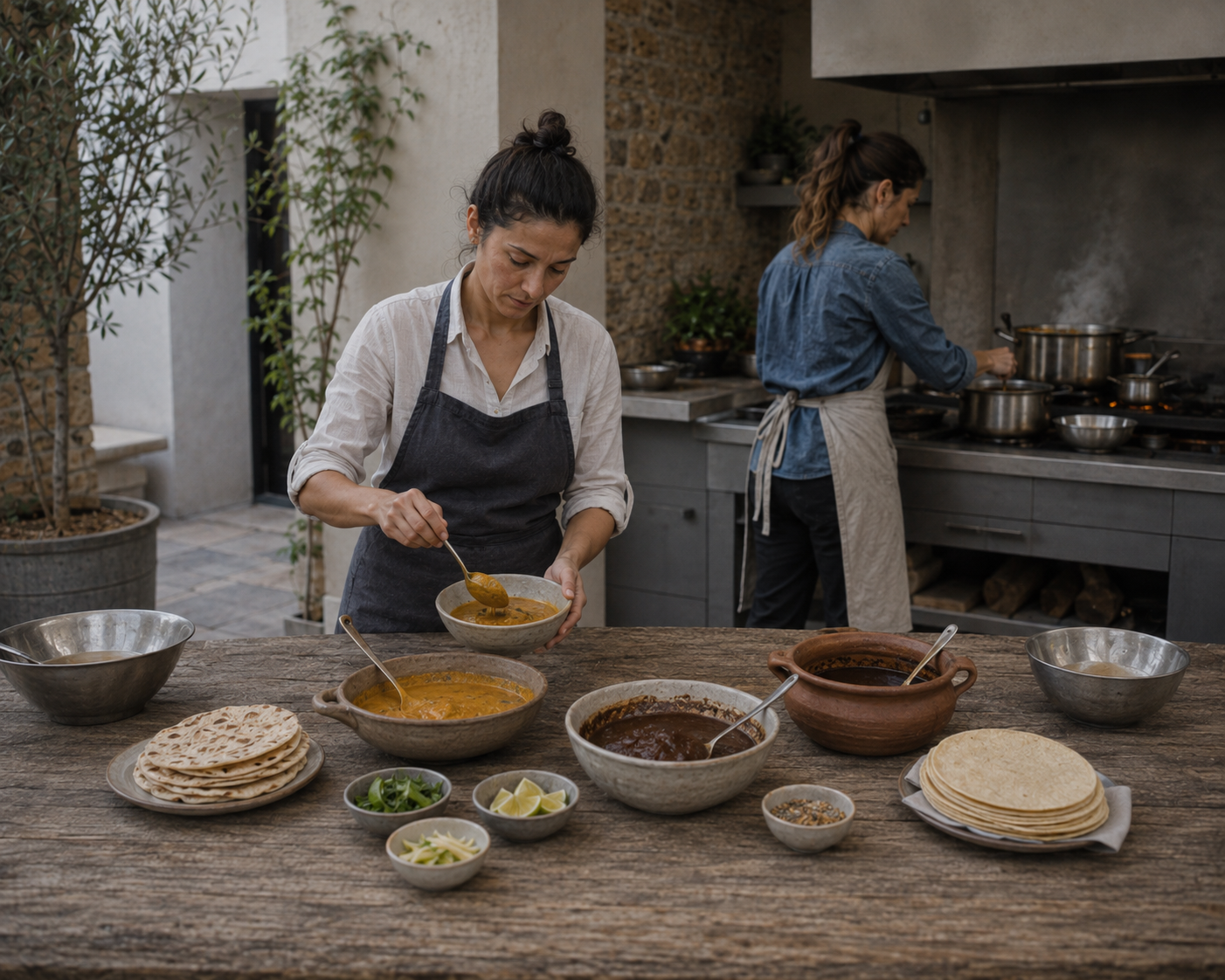
A Meeting of Depth and Devotion
Some sauces aren’t just condiments; they are cosmologies. Mexican Mole and Indian Curry tell stories of time, patience, and inheritance. They reveal the path of slow-cooked archives—trade routes, colonization, and creativity. Each holds within it a world of spice, heat, and memory.
When Mole meets Curry, something extraordinary happens. Their differences—one rooted in roasted seeds and cacao, the other in bright spices and coconut or cream—dissolve into a shared purpose: transformation through layering.
Both are acts of faith in the kitchen. They rely on intuition more than recipe and balance more than rule. This challenge asks: What happens when the slow brown richness of Mole meets the golden radiance of Curry? The answer is a new language of complexity. Mole and Curry are proof that recipes can hold worlds. They show that complexity isn’t confusion; it is harmony achieved through patience.
The Fusion Logic — Brown Meets Gold
At their core, mole and curry share a structure:
Aromatic Base — onion, garlic, or shallot, simmered.
Spice and Heat — ground chiles or masalas.
Body and Binder — nuts, seeds, bread, or coconut.
Liquid and Length — broth, stock, or water for depth.
Time and Transformation — long simmering, patience, and tasting.
Where mole leans toward smoke, cacao, and roasted depth, curry gravitates toward brightness, perfume, and freshness. Bringing them together is an exercise in contrast and calibration, layering without losing identity.
7 Ideas from the Mole–Curry Encounter
Each suggestion blends technique, not dominance; a true collaboration of worlds.
1. Cacao–Coconut Curry Sauce
A golden curry enriched with a spoon of mole paste and a touch of cacao nibs.
→ Serve with roasted cauliflower or shrimp. The cacao rounds out the sharpness, and the curry adds light to the mole’s shadow.
2. Mole Masala Marinade
Crush toasted cumin, coriander, and clove into mole poblano; thin with yogurt and lime.
→ Marinate chicken or paneer before grilling—a smoky, fragrant cross between tandoor and mercado.
3. Curry de Oaxaca
Simmer lentils and vegetables in a coconut curry base, then finish with toasted sesame, chile pasilla, and a whisper of chocolate.
→ Vegan, rich, and full of layered resonance.
4. Tamarind–Curry Mole Glaze
Mix red mole with tamarind pulp, brown sugar, and mustard seeds.
→ Brush on pork ribs or roasted eggplant for a tangy-sweet lacquer that bridges continents.
5. Cashew–Ancho Cream
Blend soaked cashews, ancho chiles, and curry powder into a velvety paste.
→ A sauce for fish, tofu, or dumplings — warm, nutty, and subtly spiced.
6. Curry–Chocolate Demi
Dark mole sauce thinned with beef stock and spiced with curry leaves and black cardamom.
→ Drizzle over grilled beef, mushrooms, or smoked vegetables — rich like a memory of earth and spice.
7. Green Mole Korma
Cilantro, pumpkin seeds, and green chiles blended with coconut milk, cumin, and ginger.
→ Serve with rice or naan. Fresh, green, alive — the meeting of Puebla and Kerala in a single bite.
Cultural Note — When Trade Became Taste
Mole, from the Nahuatl word mōlli, means “sauce” or “mixture.” Pre-Columbian cooks ground chilies, nuts, and seeds on volcanic stone; after the Spanish arrived, cacao, almonds, and cinnamon joined the mix. Puebla’s mole poblano became a synthesis of Old and New World ingredients, an edible archive of contact and exchange.
There is Curry leaves the spice, and “Curry”, as a term shaped by British colonial vocabulary, is not a single dish but a family of stews from the Indian subcontinent. Each region: Kerala, Gujarat, Bengal, has its own interpretation, based on climate, religion, and available ingredients. Turmeric, cumin, fenugreek, and ginger spread through centuries of trade along the same routes that carried cacao, cloves, and chilies. Both sauces are born of empire and adaptation; proof that flavor is history you can taste.
Page-to-Plate Insights
Use them to spark action, refine your notes, and carry your creative process from the open page to a served table.
Take two sauces from your personal or cultural memories — one dark, one bright — and taste them side by side. What happens when you blend a spoon of each? Which dominates, which transforms?.
Write down the textures, aromas, and emotions that arise.