The Container
The Instrument of Storage, Organization, and Mise-en-Place
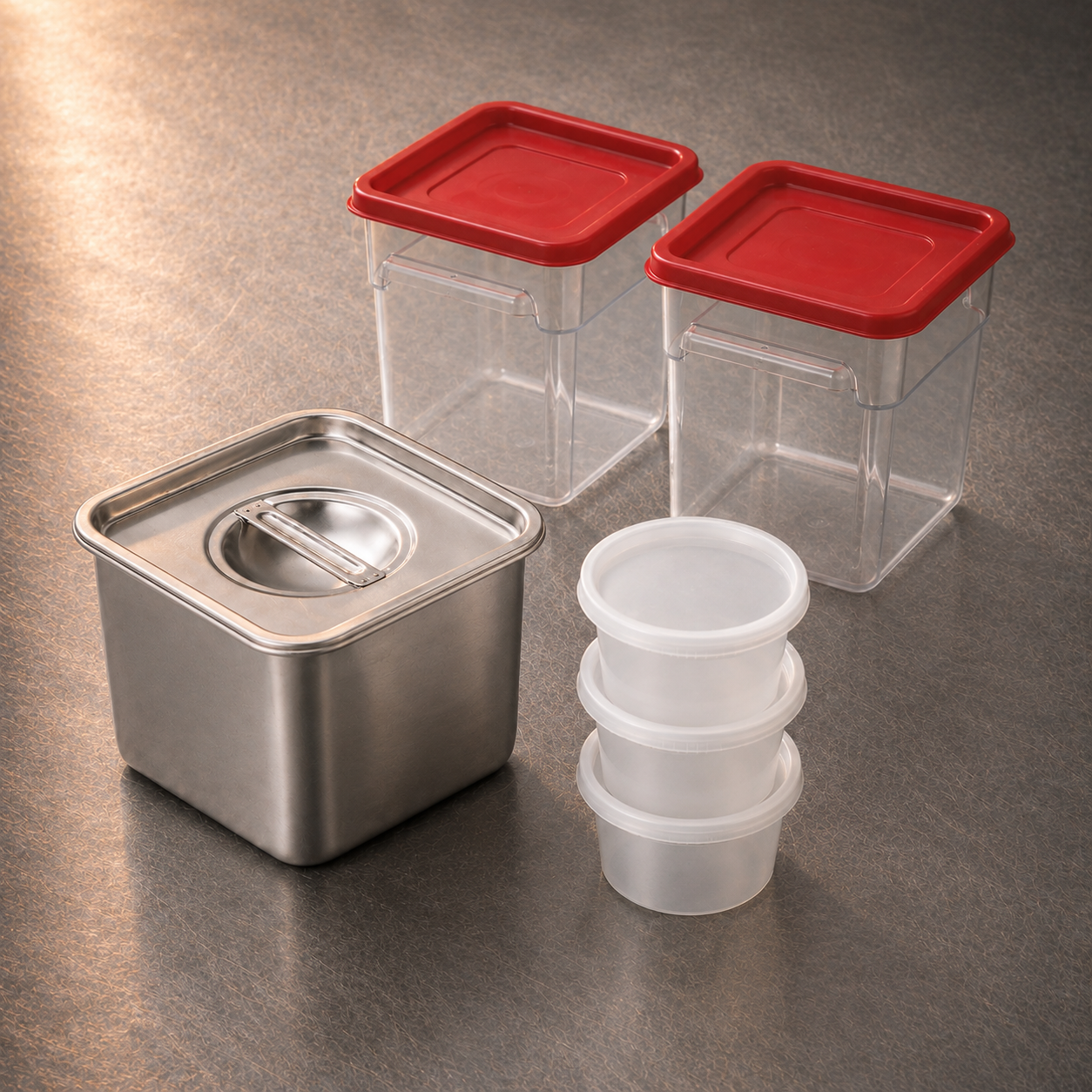
Few instruments are as ordinary, and as essential, as the container. A kitchen can have excellent knives, pans, and appliances, but without containers, its workflow quickly collapses. Ingredients need to be stored. Sauces need to be held. Mise en place needs to be organized. Leftovers need to be protected. Dry goods need to be separated from humidity, light, and contamination.
The container seems passive, but it shapes how a kitchen functions. It determines where ingredients live, how quickly cooks can find them, how safely preparations are stored, and how efficiently service can move. In a professional kitchen, containers are not just storage. They part of the infrastructure.
Function
The container serves several important functions.
It can be used to:
• store dry goods
• hold prepared mise en place
• refrigerate sauces and components
• freeze preparations
• transport ingredients between stations
• protect food from contamination
• organize condiments, garnishes, and prep items
• portion ingredients for service or production
Containers allow a kitchen to divide food into manageable units.
A sauce becomes a labeled container.
A garnish becomes a station component.
A dry ingredient becomes part of a storage system.
This is what makes mise-en-place visible, movable, and controllable.
Geometry
The shape of containers directly affects kitchen organization.
Round Containers
Round containers are common, easy to wash, and useful for liquids, sauces, and general storage.
They are practical, but they do not always use shelf space efficiently.
Square and Rectangular Containers
Square and rectangular containers are often better for storage because they use space more efficiently.
They align well on shelves, stack more predictably, and help create orderly storage systems.
Tall Containers
Tall containers are useful for liquids, stocks, sauces, and dry goods that need vertical storage.
They must remain stable, especially when filled.
Shallow Containers
Shallow containers are useful for cooling preparations quickly, storing mise en place, or arranging ingredients that need easy access during service.
They are especially practical at stations where cooks need to see and retrieve ingredients quickly.
Standardized Systems
The most functional kitchens use containers as systems.
When containers share compatible dimensions, lids, and stacking logic, the kitchen becomes easier to organize. A shelf of mismatched containers wastes space, slows down work, and creates constant lid problems.
Good containers should not only hold food. They should fit into the kitchen’s spatial logic.
Materials
Container material determines durability, temperature tolerance, visibility, and compatibility with ingredients.
Food-Safe Plastic
Plastic containers are common because they are lightweight, stackable, inexpensive, and practical.
However, not all plastics behave the same way. Some are better for refrigeration. Some are freezer-safe. Some tolerate mild warmth. Others crack, stain, absorb odors, or deform over time.
Plastic containers used for strong ingredients, such as garlic sauces, chili oils, spices, smoked preparations, or fermented products, may retain aroma or color.
Stainless Steel
Stainless steel containers are durable, cleanable, and resistant to impact.
They are useful for mise en place, service stations, and preparations that need sturdy handling.
However, stainless steel is opaque, so labeling becomes especially important. It may also react poorly with certain acidic preparations if the material is not appropriate for long-term storage.
A stainless steel bowl may be fine for mixing a marinade, but keep in mind that metal containers are not meant for storing acidic marinades or fluids.
Polycarbonate
Polycarbonate containers are often transparent, durable, and useful for storage systems where visibility matters.
They allow cooks to see contents quickly, which improves workflow.
Glass
Glass is useful in some contexts because it does not absorb odors easily and allows visibility.
In professional kitchens, however, it is often less practical. It is heavy, breakable, bulky, and potentially hazardous if it falls or breaks near food.
Temperature and Storage Conditions
Containers must match the environment where they will be used.
A container for room-temperature dry goods does not have the same requirements as a container for freezing, refrigeration, or hot preparations.
Important storage contexts include:
• dry storage
• refrigeration
• freezing
• short-term holding
• service station mise-en-place
• transport between areas
Freezer containers need to tolerate low temperatures without cracking. Refrigerated containers need reliable lids and stackability. Dry-goods containers often need airtight seals to protect against humidity and pests.
A container is only useful if it can tolerate the conditions it enters.
Ergonomics
Containers are handled constantly, so their usability matters.
Lids
The lid is often the weak point in a container system.
A good lid should close securely, open easily, and match the container reliably. If lids are difficult to find or incompatible with multiple shapes, the system becomes inefficient.
Stackability
Stackable containers save space and improve organization.
This is especially important in kitchens where dozens, or even hundreds, of containers circulate daily.
Transparency
Transparent containers allow cooks to identify contents quickly.
Opaque containers may protect ingredients from light, but they require clear labeling.
Both options can be correct depending on the ingredient.
Labeling Surface
Containers should be easy to label with tape, stickers, or markers.
Labels should include the contents, date, and sometimes the cook, station, or prep batch.
Without labeling, containers quickly become anonymous and dangerous.
Choosing the Tool
Choosing containers should be a strategic decision.
A kitchen should consider:
• what ingredients are stored
• how long they are stored
• whether they are refrigerated, frozen, or room temperature
• whether they need airtight seals
• whether contents should be visible or protected from light
• how containers stack
• how lids are organized
• how often the containers are used and washed
The goal is not to collect random containers.
The goal is to build a storage system.
Recycled containers can be useful if they are food-safe, clean, and appropriate to the task. But they should not create disorder, confusion, or sanitation problems.
Chemical Compatibility
Containers are not neutral. Some ingredients interact with the material that holds them.
Acidic marinades, strong spices, oils, fermented preparations, and deeply colored ingredients can stain, perfume, or react with certain containers.
Plastic may absorb aroma.
Metal may react with acids under certain conditions.
Glass may be clean in flavor but impractical in busy kitchens.
The cook must understand not only what the container holds, but how long it will hold it and under what conditions.
Hygiene and Organization
Containers are central to kitchen hygiene.
Poorly washed containers can retain fat, odors, sauces, and residue. Cracked plastic, warped lids, or stained interiors can become difficult to clean properly.
Good practice requires:
• washing containers thoroughly
• drying them completely before stacking
• matching lids and bases systematically
• labeling contents and dates
• separating containers by station or purpose
• discarding cracked, warped, or stained containers when necessary
• avoiding cross-use between incompatible ingredients
• keeping dry storage, refrigeration, and service containers organized
A container system is only as strong as its labeling and cleaning discipline.
Common Misconceptions
One common misconception is that any container can hold any preparation. In reality, containers differ in material, temperature tolerance, airtightness, durability, and chemical compatibility.
Another misconception is that recycling containers automatically saves money. Reuse can be practical, but if recycled containers create mismatched storage, lid confusion, odor retention, or sanitation issues, they can slow the kitchen down.
A final misconception is that containers are just storage. They are also part of mise en place, costing, portioning, workflow, and food safety.
Closing Reflection
The container is one of the kitchen’s most important organizational instruments. It holds ingredients, protects preparations, structures mise-en-place, and allows food to move through the kitchen with order. A good container system saves time. A poor one creates confusion and wastage.
In professional cooking, containers are not incidental. They shape the rhythm of preparation, service, storage, and sanitation. To organize containers well is to organize the kitchen itself.