Black Garlic — The Quiet Alchemist of Umami & Transformation
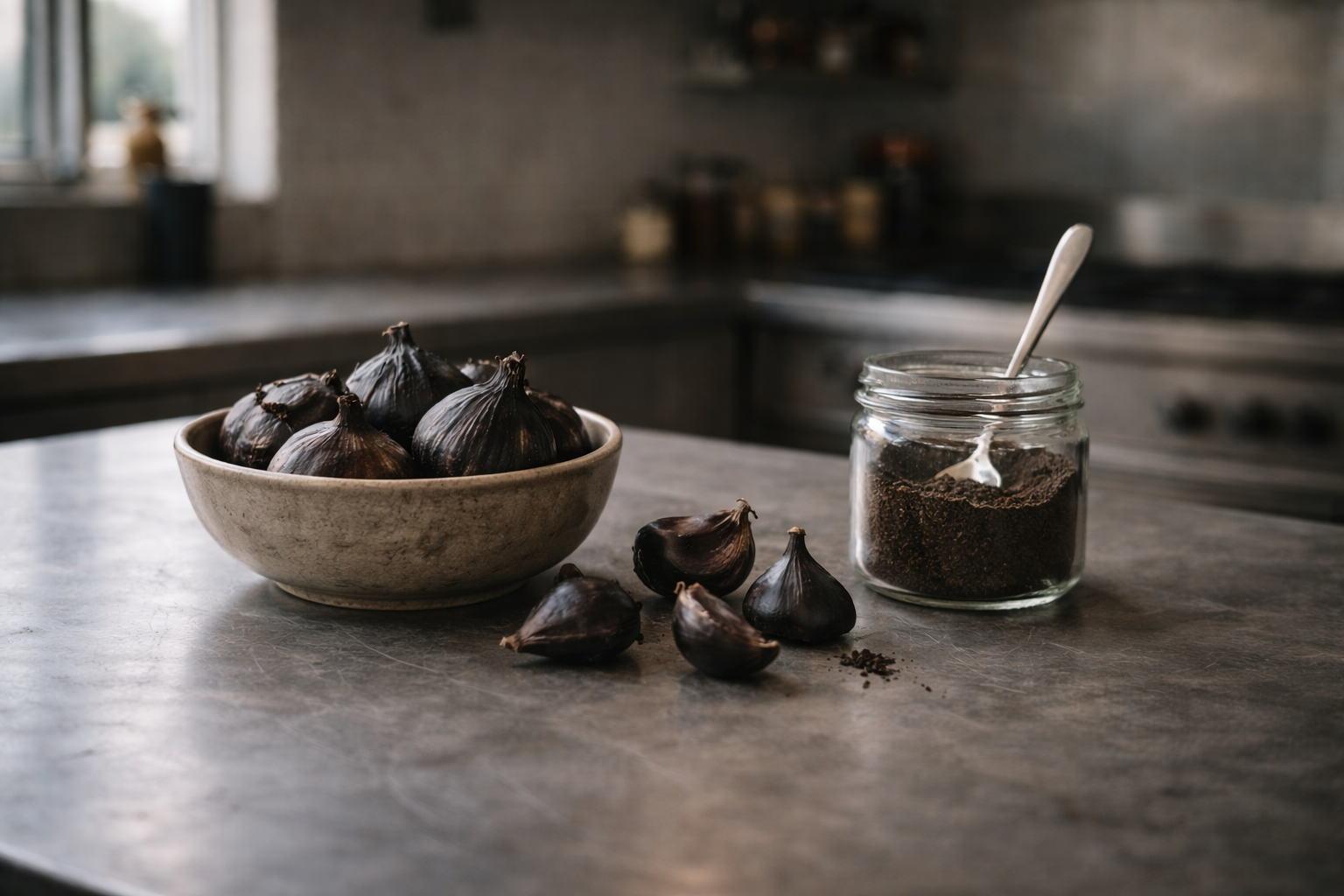
Black garlic doesn’t announce itself with heat or sharpness. It doesn’t sting the eyes or bite the tongue. Instead, it arrives slowly—with velvet depth and a quiet intensity that feels less like an ingredient and more like an unfolding. It is garlic, yes—but entirely transformed. Aged, darkened, and developed through time and controlled heat, black garlic embodies a rare culinary alchemy: the convergence of fermentation, Maillard browning, dehydration, and aging.
Its journey begins as the familiar white bulb. Under low heat and high humidity, over days and weeks, it softens, deepens, and matures. It turns black—not burnt, but ripened. Its flavor evolves into something altogether different: notes of tamarind, molasses, aged balsamic, dried fig, and cocoa. Its texture becomes tender and sticky, reminiscent of a soft date or preserved plum. Black garlic doesn’t simply taste—it resonates. It lingers, expands, and amplifies everything around it.
Black Garlic’s Role in the Kitchen
In a plant-based fusion kitchen, black garlic moves with remarkable versatility. It can act as a quiet foundation, subtly enriching broths, sauces, and marinades with a deep, rounded sweetness that integrates rather than dominates. It melts seamlessly into miso broths, softens the edges of spicy sesame sauces, and bridges contrasts between otherwise competing elements. It is, in many ways, a mediator, and a harmonizer of flavor.
Yet it can just as easily take the lead. Spread onto grilled vegetables, folded into dumpling fillings, stirred through noodles or rice, or paired with soy reductions and fruit-based glazes, it becomes a defining presence. Rich without heaviness. Sweet without added sugar. Salty without relying on salt. Its natural umami allows it to build complexity with elegance, making it especially valuable in low-sodium applications.
Beyond flavor, black garlic offers a practical advantage. With a long shelf life and a stable form, it is a reliable pantry ingredient; resilient, adaptable, and always ready to contribute, whether as a subtle background note or a central component.
A Contemporary Ingredient
Unlike rice or soy, black garlic does not trace its lineage through centuries of Asian culinary tradition. It is a relatively modern creation, emerging in Japan and Korea and gaining global recognition in recent decades. In this sense, it reflects the essence of contemporary fusion: grounded in tradition, yet driven by experimentation and reinterpretation.
It invites a different kind of authorship, one that embraces both process and possibility. Black garlic can anchor a dish or quietly support it from within. It is not just an ingredient, but a storyteller—a quiet alchemist, always ready to deepen the narrative.
The Many Faces of Black Garlic
One of the most compelling aspects of black garlic is its adaptability—not only in flavor, but in form. As it matures and evolves, it lends itself to a range of applications, each offering distinct possibilities within the kitchen.
Whole Black Garlic Bulbs
The most recognizable format: soft, sticky cloves encased in their original husks. These can be eaten whole or mashed into a paste. They are ideal for spreading onto toast, folding into dumpling fillings, or pairing with roasted vegetables and mushrooms. Whole cloves can also be gently warmed in oil to infuse stir-fries or dressings with depth.
Marinade enhancer: Mash with coconut aminos, lime zest, and chili for tofu or mushrooms
Dumpling or spread base: Combine with peanut butter and coconut oil for a savory filling
Broth enrichment: Add whole or crushed cloves to vegetable stock for a sweet-umami backbone
Black Garlic Paste
Blended into a smooth purée, this format is ideal for emulsifying into vinaigrettes, mixing into tahini or nut butters, or building the base of sauces and broths. It integrates easily into warm grains and noodles, delivering immediate depth.
Cooking base: Combine with coconut oil to sauté mushrooms or root vegetables
Curry enhancement: Add to Thai curry pastes for rounded, caramel notes
Dressing foundation: Mix with yuzu, sesame oil, and tamari for a citrus-umami balance
Black Garlic Powder
Dehydrated and finely ground, this is a concentrated seasoning tool. It can be used to finish dishes, enrich spice blends, or introduce subtle sweetness and umami into both savory and unexpected applications.
Bread infusion: Incorporate into dough with herbs for aromatic depth
Sweet applications: Pair with coconut-based desserts for contrast and complexity
Black Garlic Granules
Slightly coarser than powder, granules provide both flavor and texture. They are well suited for spice rubs, dry marinades, and seasoning blends.
Finishing salt blend: Mix with sesame seeds and flaky salt
Grill rub: Combine with smoked paprika and citrus zest
Spice systems: Integrate into chili or pepper-based blends
Black Garlic Salt
A blend of black garlic and salt, used primarily as a finishing element. It adds a final layer of depth to both savory and sweet dishes.
Compound seasoning: Mix into plant-based butter or miso
Snack application: Use on popcorn or chips
Cocktail element: Apply to glass rims for contrast in drinks
Black Garlic Husks
Often discarded, the husks carry subtle but valuable flavor. Used similarly to bay leaves or kombu, they can enrich broths, oils, and reductions.
Broth building: Simmer with mushrooms or fermented bases
Infused oil: Steep in warm oil and strain
Reduction base: Combine with tamari and vinegar for glazes
A Living Ingredient
One of black garlic’s most compelling qualities is its continued evolution. Over time, it may firm up, crystallize, or dry slightly, especially when exposed to air. These changes are not flaws, but opportunities.
A firmer clove can be grated like aged cheese over noodles. A dried piece can be rehydrated in warm broth. A sticky mass can become the base of a concentrated glaze. Stored properly in a cool, dark place, black garlic can last for months while continuing to offer new expressions.
Whether blended into dressings, layered into curries, seasoning grains, or infusing oils, black garlic expands the possibilities of flavor—bringing sweetness, depth, and savory richness into balance. It is a dynamic ingredient, one that rewards curiosity and continuous exploration.
→ Explore the following studies and applications on Black Garlic
Black Garlic: The Alchemy of Sweetness & Smoke
BLACK GARLIC GHEE // Infused Butter No.1
BLACK GARLIC COCONUT OIL // Infused Plant-Based Butter No.1
BLACK GARLIC PASTE — FLAVOR BASE No.1 // Prunes, Honey & Rum — Sweet Deep Umami
MESOTERRANEO BLEND No.2 // A non-spicy Tomato, Chile & Black Garlic Seasoning