Funnels and Bottlenecks: From the Kitchen to the Table
How Small Obstacles Can Disrupt the Flow of an Entire Restaurant
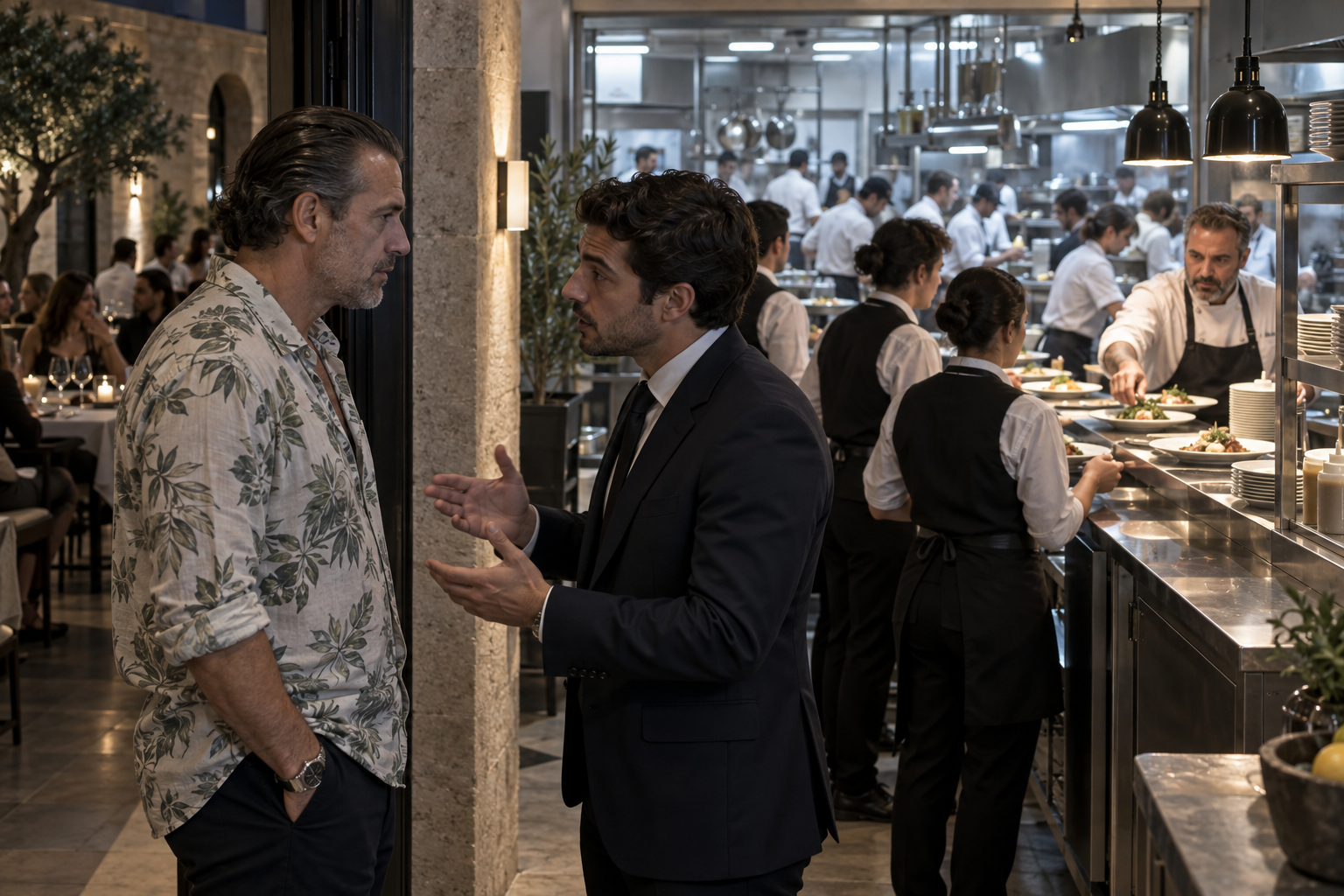
A restaurant is full of funnels. Orders move into the kitchen. Ingredients move through receiving, storage, prep, and service. Plates converge at the pass. Servers collect food and carry it into the dining room. Payments, reservations, requests, complaints, and information all move through different points of concentration. A funnel is not inherently a problem. Restaurants need places where movement comes together.
The problem begins when something stops flowing. Sometimes the obstruction is obvious: a door does not close properly, a printer stops working, a station is missing a piece of equipment, or the pass is too small for the volume of plates moving through it. Those problems are frustrating, but at least we can see them.
Other bottlenecks are more difficult because what we see is only the symptom. This is where I think restaurant managers sometimes have to think a little like plumbers. If a sink is clogged, perhaps the obstruction is right beneath the drain and a few pushes with a plunger solve it. But sometimes the problem sits farther inside the pipes. Grease has accumulated, the drainage system has been badly maintained, or something is blocked much farther downstream. What appears as one slow sink may actually belong to the condition of the whole system.
Restaurant operations work the same way. A bottleneck is often not where the problem begins. It is where the problem finally becomes visible.
First Find Where the Flow Is Stopping
When service slows down, the first instinct is often to look for a person. Who is behind? Who is not moving quickly enough? Who forgot something? Sometimes a person really is the problem, but if we begin there every time, we can miss the structure around them.
A server may appear slow because every time they pick up a dish they have to walk back across the dining room to find the correct cutlery. A cook may appear disorganized because the station was designed in a way that forces them to turn around twenty times during every order. The pass may look chaotic because several dishes require complicated finishing at exactly the same moment. What looks like poor performance may actually be friction built into the workflow.
This is why observation has to move away from people for a moment and toward movement itself. Where are people waiting? Where do they cross each other? Where do plates accumulate? Where is information repeated? Where does somebody repeatedly have to stop what they are doing to ask a question? Where does one person become the only route through which every decision has to pass?
Those are the places worth watching because they show where flow begins to narrow. The manager's job is not simply to notice that service is slow. It is to understand what keeps interrupting movement and whether the obstruction is local or part of something larger.
Some Bottlenecks Are Almost Embarrassingly Simple
Not every operational problem requires new software, another employee, or an expensive redesign. Sometimes something simply needs to move fifty centimeters.
A squeeze bottle sits on the wrong side of the station. Plates are stored just far enough away that the cook has to take two unnecessary steps every time they reach for one. Dirty pans land where somebody else is trying to work. A ticket printer is positioned behind the person who needs to read it. Servers are collecting food from two different places when one clear pickup point would eliminate confusion.
Each movement may cost only a few seconds, which makes the problem easy to dismiss. But repeated movement compounds. If a cook loses twenty seconds on an unnecessary action and performs that action sixty times during service, they have lost twenty minutes. If several people are doing something similar, the restaurant may be absorbing a surprising amount of wasted labor around one very small design problem.
This is where operational thinking becomes surprisingly creative. We are not inventing a new dish. We are improving the conditions under which hundreds of repeated actions take place. A small correction that happens once is insignificant. A small correction repeated throughout every service can change the rhythm of an entire station.
The Problem May Begin Somewhere Else
The more difficult bottlenecks are the ones that appear in one place but originate somewhere else entirely.
Imagine plates arriving at the table with the sauce shifted across the plate. The immediate conclusion may be that the waiter is carrying them badly. Perhaps the waiter is actually doing everything possible to keep the plates stable, but the sauce itself is too fluid for the distance it has to travel. At the pass, the dish looks perfect. Then movement begins. The server turns, walks through a busy dining room, avoids another waiter, steps around a table, and by the time the plate reaches the guest, the composition has changed completely.
Now the question is no longer only about service. Perhaps the kitchen has designed a dish that cannot survive the actual journey from pass to table.
This happens often with highly detailed plating. A chef creates something that requires almost no movement after it is finished, but the restaurant operates at high volume with servers carrying several plates at once. The dish and the service model are working against each other. The solution may not be “train the waiter better.” It may be to change the viscosity of the sauce, reconsider the plate, simplify the construction, adjust the pickup system, or redesign the dish for the restaurant that actually has to serve it.
That is why tracing the route matters. The point where the problem becomes visible may only be the final stage of a chain of decisions that began much earlier.
A Door Can Reveal a Management Problem
Physical details can also expose broader weaknesses in responsibility. Perhaps a kitchen door no longer closes properly. It stays half open, noise travels into the dining room, and customers can see part of the kitchen that was never intended to be visible. Maybe there is a dirty section of floor, a storage area, or simply the disorder of a busy service that suddenly becomes part of the guest experience.
On the surface, the problem is a door. But once we ask why nobody has fixed it, the problem begins to expand. Who is responsible for maintenance? Has the issue been reported? Was it reported several times and never acted on? Is there no maintenance budget? Does everyone assume someone else will handle it? Now the bottleneck is no longer mechanical. It has moved into responsibility and communication.
This is why taking two steps backward can be so useful. What looks like a small physical failure may reveal that nobody owns the problem. And when nobody owns the problem, it tends to remain in the system until something worse happens.
Systems Can Clog Too
The same logic applies to digital systems. A restaurant installs a new POS system, and during the demonstration everything looks fast and elegant. Orders move instantly, reports are clear, and the interface seems intuitive. Then the restaurant begins using it under actual service conditions.
Tickets hesitate before printing. Servers spend longer entering modifications. Printers disconnect. Duplicate tickets appear. One station receives information late. Everyone begins compensating manually. Suddenly the kitchen looks slow, the servers look disorganized, and management starts asking why people cannot keep up. But perhaps the people are working around a system that is creating friction.
The same applies to printer paper, ink, handheld devices, terminals, reservation systems, or anything else the restaurant depends on. If printer rolls suddenly disappear twice as fast as usual, the answer should not simply be, “Paper is expensive, so we are not buying more.” Something changed. Maybe duplicate tickets are printing. Perhaps reports are being printed unnecessarily. Maybe one printer is malfunctioning.
A good manager looks for the cause before accepting the cost or delay as inevitable. The system exists to support the operation. If the operation is constantly compensating for the system, then the tool itself has become part of the bottleneck.
Running Out of an Ingredient May Be the End of a Longer Story
The same diagnostic logic applies to something as ordinary as having to 86 a menu item. The easy explanation is that somebody forgot to order the ingredient, and perhaps that is exactly what happened. But if the same item disappears from service repeatedly, it is worth looking further.
Imagine the person responsible for ordering says, “I waited because every time I order this product, we barely sell the dish and then half of it spoils.” Now the problem changes. The supplier may not be the issue. The purchaser may not even be the main issue.
Perhaps the dish is not selling. Perhaps nobody is reviewing sales reports. Maybe the par level is wrong, the product has a short shelf life, or the menu contains an item that the operation does not really know how to support. What appeared as a purchasing failure may actually involve menu design, inventory, sales analysis, forecasting, waste, and communication.
This is why blaming one person too quickly often produces a poor diagnosis. The person may be standing at the point where the problem became visible, but the blockage may have been building elsewhere for weeks.
Management Has to Look Across the Whole Route
This is where responsibility becomes important. The chef should be watching flow in the kitchen. The bar manager should understand where drinks begin accumulating. The service manager should notice where servers are repeatedly delayed. Whoever is responsible for purchasing should recognize irregular movement in inventory. The owner or general manager has to be able to look across these areas and notice when one department's problem is really being created by another.
Funnels cross departments. The kitchen cannot solve every service problem alone. Front of house cannot compensate indefinitely for dishes that are impossible to transport. Purchasing cannot fix a product that nobody orders. A bartender cannot make drinks move faster if every cocktail requires a glass stored two rooms away.
Somebody has to be looking across the connections, not by micromanaging every action but by paying attention to where the restaurant repeatedly loses time, information, product, money, or clarity. When something keeps getting stuck, the useful question is not only, Who is responsible? It is also, What is feeding this bottleneck?
Do Not Import Solutions Without Understanding the Problem
There is another temptation when operations are struggling: copying what another restaurant does.
We visit another kitchen and see a particular pass system, station layout, POS setup, ticket procedure, or service model and think, That is the solution. We should do exactly that here. Sometimes it may be useful, but another restaurant has another menu, another building, another volume, another staffing model, another customer flow, another kitchen, and another set of problems.
A solution only makes sense in relation to the system that needs it. This is why diagnosis matters before implementation. We need to understand what is actually blocking the flow in our own operation before deciding what to change. Sometimes the solution is structural. Sometimes it is training, purchasing, communication, maintenance, or a recipe. Sometimes it really is just moving something fifty centimeters.
The sophistication is not in making the solution complicated. It is in identifying the correct problem and applying the smallest effective correction.
Follow the Dish All the Way to the Table
The title of this article matters because the journey does not end at the pass. A dish begins long before the order arrives. It depends on purchasing, receiving, storage, mise en place, equipment, staffing, tickets, communication, cooking, plating, pickup, service, table numbers, dining-room movement, and sometimes the bar.
If any one of those stages repeatedly creates friction, the guest eventually experiences it. Perhaps the wait is too long. Maybe the food arrives cold, one plate lands before the others, the presentation collapses during transport, or the server cannot explain a delay because nobody has communicated what is happening.
The customer does not experience the restaurant as a collection of departments. They experience the result. That is why flow is an orchestration problem. Each part of the restaurant can function reasonably well on its own and still produce a poor experience if the transitions between those parts are weak.
A Good Flow Is Usually Invisible; EVENTS HAPPEN SEAMLESSLY
When a restaurant moves well, very little of this is noticed. The guest does not know that the ticket printer was repositioned six months ago, that the garnish station was reorganized, that par levels were changed, that one slow-selling menu item was removed, or that the kitchen adjusted the sauce because it was not surviving the journey to the table. They simply experience the restaurant as smooth.
That apparent ease is rarely accidental. It is the result of people observing where things get stuck, tracing the problem back far enough to understand it, and making corrections that fit the actual operation.
Sometimes we need to think like chefs, sometimes like managers, and occasionally thinking like a plumber is not such a bad idea. The blockage may be right in front of us, or it may sit much farther down the pipe. The important thing is to resist treating the visible symptom as the whole problem. A good flow happens by learning how to trace where the obstruction actually starts.
Funnels and Bottlenecks: From the Kitchen to the Table
Read Next: How to Read a Restaurant
Read Next: The Implementation Gap: Why Restaurant Vision Often Fails to Become Daily Practice