How to Read a Restaurant: Field Research From the Entrance to the Final Bill
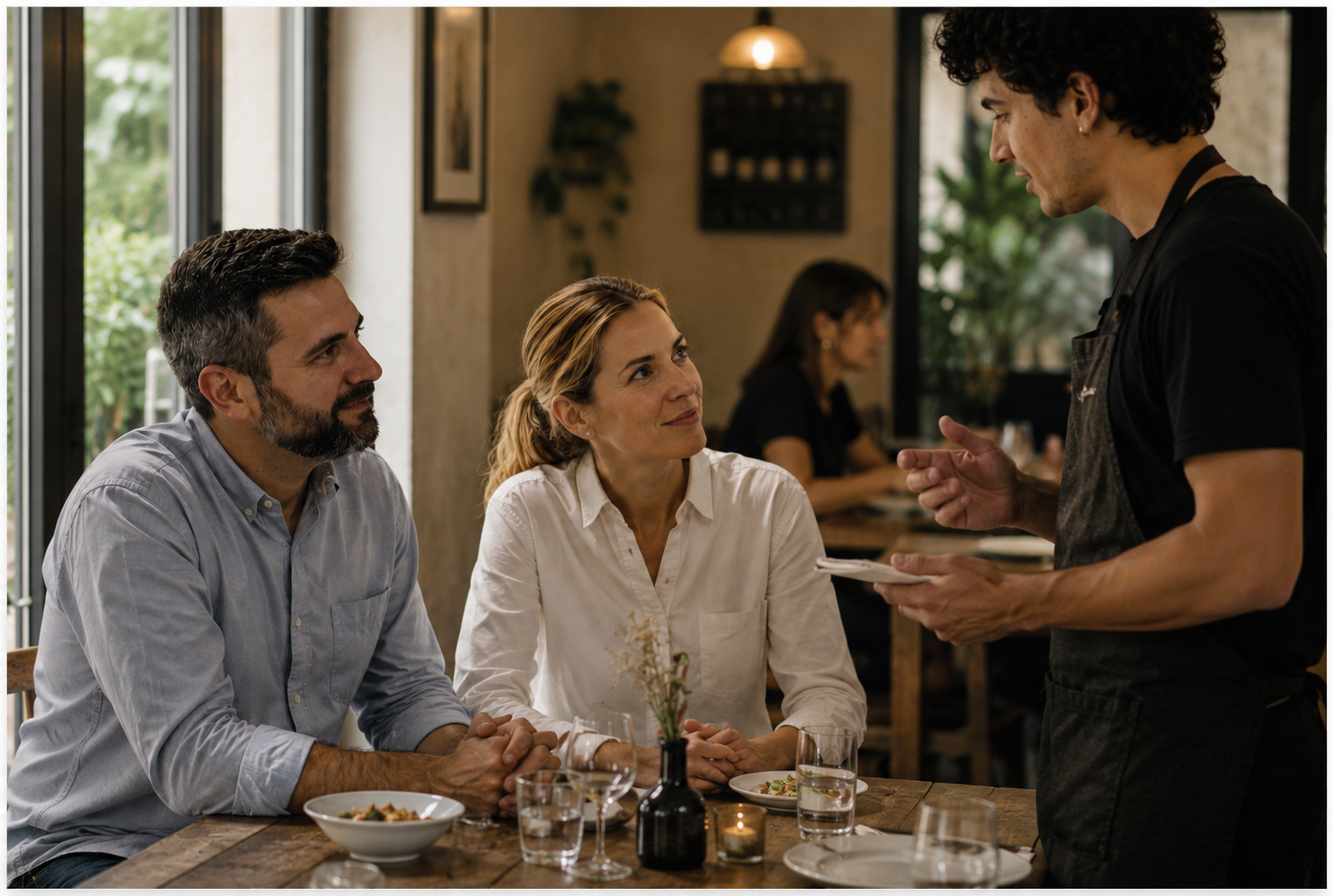
For a culinary professional, going to a restaurant is never only about eating. Even when I am there with friends or family, even when the evening is informal and I have no intention of studying anything, part of me is always observing. I see the entrance. I notice how long it takes for someone to acknowledge us as customers. I look at the menu, the table, the lighting, the distance between chairs, the movement of the servers, the condition of the bathroom, the rhythm of the kitchen, and of course, the moment when the food finally arrives.
This does not mean that I cannot enjoy the experience. It means that the experience itself is teaching me. Restaurants are one of the most direct forms of field research available to anyone who works in and around food. You can read books about service, study menus online, watch kitchen videos, and listen to chefs speak about their businesses. But when you enter a restaurant as a guest, you experience the complete system from the outside. You see whether the promise holds.
A restaurant begins before you enter it. You are across the street. You see the facade. You look for the door. Perhaps the name is clear. Perhaps the entrance is confusing. Perhaps there is a line, a host, a terrace, a menu posted outside, or nothing that tells you what to do next. Then you cross the threshold and enter the premises. What happens? Does someone see you? Do they greet you? Do they understand whether you have a reservation? Do you feel that your arrival was expected, or that you have interrupted something? This first transition matters because hospitality begins with recognition. The guest needs to feel that someone has taken responsibility for their presence.
A welcoming reception to a restaurant is not a synonym of a high-end establishment. It does not require a formal host standing behind an expensive desk. A small café, a fast-casual restaurant, a neighborhood dining room, and a high-end restaurant may all receive guests differently. Every guest arrival prompts a fundamental question: who is responsible for this person now? While often viewed simply as food providers, restaurants are actually systems of care that operate through the coordination of environment, pacing, and human attention. In this dynamic, the kitchen serves as the heart, providing the central meal, while hospitality acts as the essential structure that makes the entire experience possible.
The Table Tells You Where You Are
Once seated, the restaurant begins to explain itself more clearly. Is the table comfortable? Is it clean? Is there enough room for the number of people seated there? Can you hear the person beside you? Does the tableware belong to the place, or does it feel disconnected from the food and atmosphere? Then the menu arrives. A good menu gives the guest orientation. It should help you understand what kind of restaurant you have entered, what the kitchen cares about, how much choice is available, and how the meal might unfold. You begin to notice whether the menu feels coherent. Are there too many dishes? Do the sections make sense? Does the language clarify or confuse? Does the menu reflect the physical place? Does the price level correspond to the environment and service? A menu is never only a list of things available to eat. It is the first organized expression of the restaurant’s thinking. When the menu is clear, ordering feels easy. When it is confused, the guest begins working too hard before the food has even arrived.
Every restaurant has a model. Some are designed for speed. You enter, order at a counter, collect the food, sit down, eat, and leave. Others are designed around several courses, longer conversations, and a slower sequence of service. The model may change. The obligation to take care of the guest does not. In a fast restaurant, hospitality may mean that the ordering system is clear, the counter moves efficiently, the tables are clean, the food arrives correctly, and someone clears the space when guests leave. In a more formal restaurant, it may mean guiding the guest through the menu, pacing courses, maintaining the table, understanding when to approach, and allowing the experience to continue without unnecessary interruption.
Hospitality should be a seamless experience for the client, visible only through its impeccable organization. The guest should not have to chase every part of the meal. Where do I order? Where do I sit? Who is serving this table? Has the kitchen received the order? Where do I pay? What happens next? When the operation is well designed, these questions are answered almost invisibly. The guest moves through the restaurant without feeling the machinery underneath. That is often what good service looks like. Not a spectacle, but flowing continuity.
After ordering, I often go to the bathroom. This is not always part of a physiological need, it is partly practical and partly observational. The condition of the bathroom can tell you a surprising amount about the restaurant. A bathroom is smaller and easier to clean than a kitchen. There are fewer surfaces, fewer processes, and fewer people working inside it. If the restaurant cannot keep the bathroom reasonably clean, stocked, and attended to, it raises questions about the broader cleaning culture of the business. This is clearly not a perfect test. A bathroom may become messy quickly. A guest may have just left it in poor condition. A small restaurant may be working with an old building and limited facilities.
But you can usually distinguish between a momentary problem and long-term neglect. Is the sink clean? Is there soap? Is there paper? Is the floor maintained? Does someone appear to be checking the space? Even a modest bathroom can communicate care. A beautiful bathroom can also communicate neglect if it is dirty. The issue is not decoration. It is attention. On the other hand, the journey to the bathroom also creates a small tour of the restaurant. You pass service stations. You see where dirty dishes accumulate. You notice whether empty tables remain uncleared. You may walk near the bar, the kitchen pass, a storage area, or the corridor where servers gather. You begin to see how the restaurant operates beyond your own table. Are the service stations organized? Are waiters moving with purpose? Is glassware stacked safely? Are plates waiting too long at the pass? Do employees communicate with one another calmly, or does every exchange carry tension? Perhaps you pass an open kitchen.
You see the cooks. How many people are working? How much space do they have? Is the kitchen under pressure but controlled, or does the pressure appear to be breaking the structure? Are cooks reaching across one another? Is the chef constantly shouting? Does the pass look organized? Are the plates leaving with consistency? These observations are incomplete. A guest sees only fragments. It would be irresponsible to assume that one brief view explains the entire operation. But fragments still teach. You begin to recognize the flow. You see how a station has been positioned, how the pass communicates with the dining room, how the room has been divided, or how one small design decision helps the staff work more efficiently. Sometimes you see a solution so simple that you remember it for years.
You Do Not Need to Invent Everything, Borrow From Those Great Ideas
This is one of the most valuable lessons in visiting restaurants professionally. You do not need to invent every operational solution from the beginning. Someone else may already have solved the same problem well. Perhaps a restaurant has created an excellent place for servers to organize cutlery without blocking the dining room. Perhaps the kitchen pass has a simple system for separating dine-in, takeaway, and delivery orders. Perhaps the menus are stored in a way that keeps them clean and immediately accessible. You notice it. Later, when facing a similar problem, you remember. “That restaurant handled this well.” This is not copying a concept or stealing someone’s identity. It is a professional observation.
Kitchens, restaurants, studios, factories, and workshops have always developed through people seeing how others work and adapting useful ideas to their own conditions. The important thing is to understand the principle behind the solution. Why does it work there? Would it work in another space? What problem is it solving? What would need to change before using the same logic elsewhere? Observation becomes useful when it moves beyond admiration.
Watch the Food Arrive
Eventually, the drinks and food begin to arrive. Now the restaurant has to coordinate several systems at once. The order has to be entered correctly. The bar has to prepare the drinks. The kitchen has to sequence the dishes. The service team has to know where everything belongs. The food has to leave the kitchen in good condition and arrive before it begins to deteriorate. When you are dining with several people, timing becomes especially visible. Does everyone receive the food together? Does one person sit waiting while the others begin eating? Are appetizers clearly shared, or does the table have to reorganize them? Do the drinks arrive before the food? Are the dishes placed confidently, or does the server ask the entire table who ordered what? A smooth delivery can look effortless. It is not. It is the result of communication between the menu, ordering system, kitchen, pass, and dining room. When all of it works, the guest simply begins eating. That apparent simplicity is a form of operational achievement.
The food is, of course, part of the research. How does it taste? Is the seasoning clear? Does the temperature feel correct? Does the presentation make sense for the type of restaurant? Is the portion coherent with the price and structure of the meal? Does the food correspond to what the menu described? But I am also interested in whether the dish belongs to the restaurant. A technically impressive plate can still feel disconnected from the room, the service, the menu, or the audience. A very simple dish can feel completely correct because everything around it supports what it is trying to be.
This is another reason to experience restaurants in person. A photograph shows the plate. It does not show the distance from the kitchen to the table, the sound of the room, the pace of the service, the person who explains the dish, or how the food feels after the guest has already been sitting there for forty minutes. The restaurant gives the dish context. And context affects perception. Hospitality does not end when the plates reach the table. The guest may need another napkin, more water, a missing condiment, another drink, or clarification about something on the plate. Is anyone paying attention? This does not mean someone should constantly interrupt the table. Attention is not the same as intrusion. Good service reads the situation. The server notices that the water glasses are empty without asking every two minutes whether everything is fine. A missing item is corrected quickly. Finished plates do not remain indefinitely. The table is cleared without making the guests feel pushed.
This balance is cultural as well as operational. In some places, dishes disappear almost the moment the last bite is taken. The restaurant may be trying to turn the table quickly. In other places, guests are allowed to remain longer, speak, drink coffee, and complete the social part of the meal at their own pace. Neither rhythm is automatically correct. It has to fit the restaurant. The problem appears when the guest begins to feel that the business is more interested in recovering the table than in completing the experience. You feel it when the server repeatedly asks whether you want anything else. You feel it when the bill appears before you request it. You feel it when the table is stripped too quickly and the space around you begins suggesting that it is time to leave. Commercial pressure is real. Restaurants need to use their tables effectively. But guests also remember how they were made to feel until the end.
A restaurant can execute a beautiful meal and weaken the memory in the final ten minutes. The bill is part of the experience, the bill is not an administrative detail outside hospitality. It is the final transaction inside it. How long does it take to arrive? Is it correct? Is payment easy? Does the person disappear after placing it down? Is the farewell attentive, or does the relationship end the moment the card is processed? This is also the point when the whole experience begins to settle. You look back across the meal. The entrance. The table. The menu. The bathroom. The service. The timing.The food. The way you were treated. And a simple question appears: Would I return? That question is useful because it brings the whole restaurant together. Perhaps the food was excellent, but the service made the evening uncomfortable. Perhaps the room was beautiful, but the menu felt confused. Perhaps everything was modest, but the restaurant took care of you so well that you immediately began thinking about who else you could bring..
Sit Near the Kitchen
When possible, I like to sit where I can see part of the kitchen. Not because I want to monitor the staff or search for mistakes. I enjoy seeing kitchens work. I notice the equipment. The pass. The station arrangement. The movement of the cooks. The relationship between the chef and the team. How the grill is handled. Where plates are finished. How service communicates with the kitchen. Sometimes the view is only partial. A door opens and closes. A narrow counter reveals the final plating. A cook appears with a stack of pans. Still, the glimpse gives the restaurant another dimension. You understand that the plate did not arrive from nowhere. There is labor behind it. Heat. Timing. Repetition. Organization. Pressure. An open kitchen makes this more visible, but even a closed kitchen leaves traces. You hear the printer, the bell, the movement of plates, the tone of communication, and the moments when the rhythm changes.
For a cook, these details are naturally compelling. They also build references. You begin to understand what calm looks like in a busy kitchen. You see when a chef has created a station where everything needed is within reach. You notice when a pass supports precision rather than creating congestion. These images stay with you. But there is a fine line when you engage in professional observation. You can become unable to enjoy anything. You enter the restaurant already searching for faults. Every delay becomes evidence. Every unfamiliar decision becomes wrong. You spend the meal mentally redesigning the business instead of experiencing what it actually is. That is not useful field research.
Observation needs an open mind. You do not know every condition behind what you see. The restaurant may be short-staffed that day. A machine may have failed. A new server may be learning. A supplier may not have delivered. The building may impose limitations that are invisible from the dining room. The purpose is not to prove that you could run the place better. The purpose is to pay attention. What appears to be working? What feels intentional? Where does the experience lose continuity? What could be learned? What remains unclear? These questions create a more disciplined form of observation than simply deciding whether the restaurant is good or bad.
Make Notes, But Remain at the Table
Mostly I make mental notes during restaurant visits. Sometimes I make a photograph or a small video, and write something down later. A menu structure. A service detail. A piece of equipment. A plating decision. A small operational solution. A question that appeared during the meal. The note does not need to become a formal review. It can simply remain as a reference. But the observation should not consume the experience. If you are dining with other people, you are also responsible for being present with them. Constantly photographing, walking around, staring into the kitchen, or analyzing every plate aloud can make everyone else feel that they have entered your private research assignment.
Balance matters. You can observe candidly. Notice while remaining part of the conversation. Take one photograph rather than twenty. Write after the meal. The restaurant is a field of research, but it is also a social space. Respecting that is part of understanding hospitality. Over time, these visits can become an important professional archive. Not a ranking of restaurants. A collection of references. A menu that handled choice particularly well. A dining room that made a small space feel generous. A kitchen pass that solved a difficult transition. A server who explained the food with precision but without performance. A bathroom that revealed extraordinary attention. A restaurant that moved quickly without making guests feel rushed. A chef who remained calm while the kitchen was visibly under pressure.
These memories become useful later. When you design a menu, train a server, organize a kitchen, rethink a service sequence, or work on your own restaurant concept, you are not starting only from theory. You have seen hospitality performed. You have also seen where it breaks. The archive does not tell you to reproduce another restaurant. It gives you a wider vocabulary of possibilities. Restaurants are living references, and there are many ways to learn about the restaurant industry. Because the most important lesson a restaurant can offer is often not a technique, ingredient, or plate. It is the feeling of being considered throughout the entire visit. That is what the hospitality business is really building. A sequence of decisions that tells the guest: We saw you arrive. We prepared a place for you. We paid attention while you were here. And we would be glad to receive you again.
How to Read a Restaurant: Field Research From the Entrance to the Final Bill