The Spoon
The Cook’s Most Constant Companion
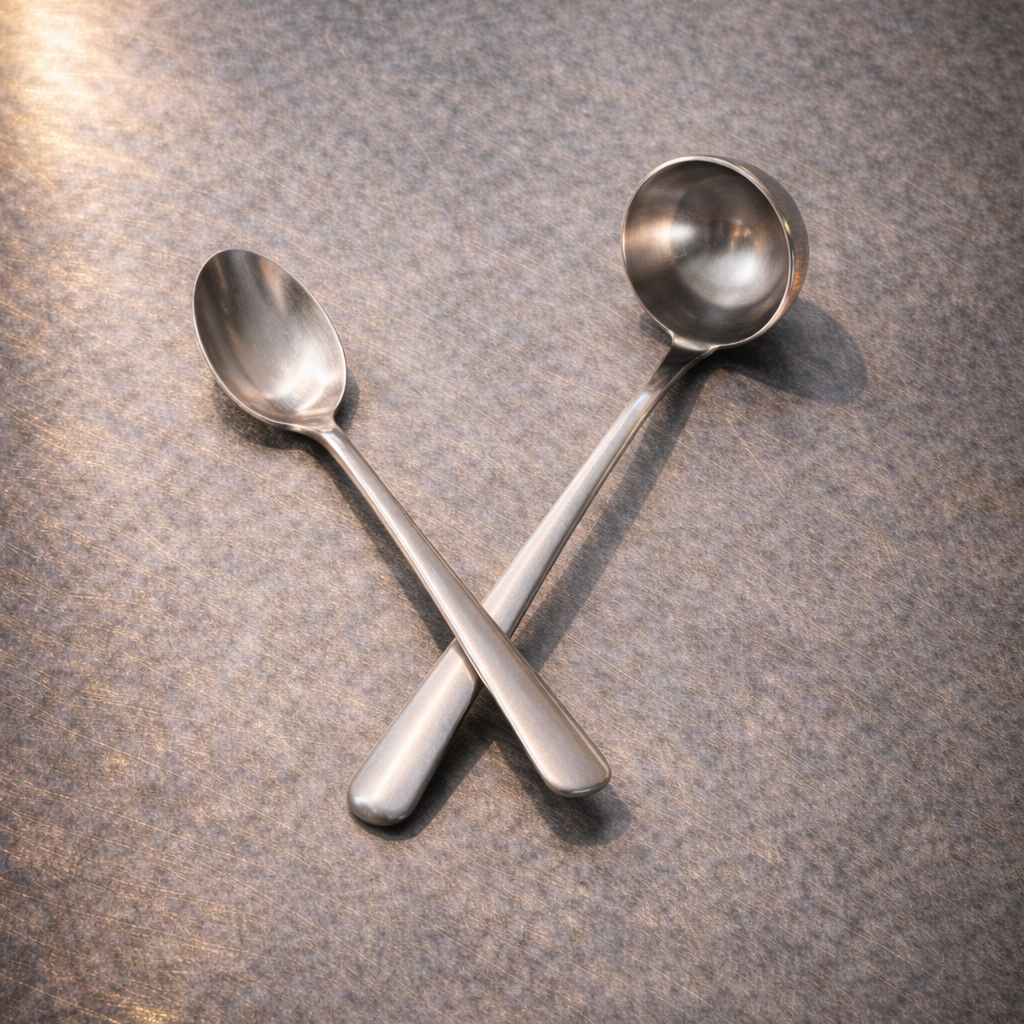
Few tools are as constantly present in the hands of a cook as the spoon. In professional kitchens, chefs often keep a spoon in their pocket or within immediate reach. During service, it becomes an extension of the cook’s senses: stirring sauces, tasting preparations, adjusting seasoning, and guiding the final composition of dishes. Where the whisk creates movement, and the tongs pick ingredients, the spoon accompanies nearly every stage of cooking. It is the instrument through which cooks observe, taste, and refine what they are preparing.
Function
The spoon performs several essential roles in the kitchen.
Stirring
Spoons move ingredients through liquids, helping maintain even cooking and preventing sticking.
Tasting
One of the most important functions of the spoon is tasting. Chefs continually taste sauces, broths, and preparations to adjust seasoning and texture. In professional kitchens, it is common to see containers of spoons placed near workstations so cooks can taste repeatedly during service.
Transferring
The spoon acts as a small shovel, moving ingredients from one vessel to another. This includes transferring sauces, plating components, or moving ingredients during cooking.
Skimming
Large spoons are often used to remove impurities from stocks or broths during simmering.
Plating and shaping
In modern kitchens, spoons are frequently used to shape and present food.
They are used to:
• drizzle sauces
• place precise amounts of puree
• create quenelles
• guide the visual arrangement of a plate
Geometry
The shape of a spoon determines how it behaves when handling ingredients.
Bowl Shape
The curved bowl of the spoon allows it to hold liquids and small quantities of ingredients. Spoons used for plating often have elongated shapes that allow precise control of sauces.
Depth
Shallower spoons are often used for tasting and plating, while deeper spoons hold larger quantities of liquid.
Ladles
Ladles are essentially large spoons designed for serving soups, broths, or sauces. Their deeper bowl allows them to carry larger volumes of liquid.
Materials
Spoons are made from several materials, each with different characteristics.
Stainless Steel
Stainless steel spoons are the most common in professional kitchens. They are durable, heat-resistant, and easy to clean. Unlike porous materials, they do not absorb flavors or odors.
Silicone
Silicone spoons are sometimes used when working with delicate cookware surfaces such as nonstick pans.
Wood
Wooden spoons are traditional tools, but are less common in professional kitchens because wood absorbs moisture, oils, and flavors over time. This makes them harder to maintain in environments where many different ingredients are prepared.
Ergonomics
The spoon’s simplicity hides its versatility.
Handle Length
Long-handled spoons are useful for stirring large pots, while shorter spoons provide more control for tasting and plating.
Weight
A balanced spoon should feel comfortable in the hand and allow precise control when transferring ingredients or plating sauces.
Availability
Because spoons are used constantly during cooking, professional kitchens typically keep many of them within reach. It is common to see containers filled with spoons placed near workstations so cooks can quickly grab one when needed.
Choosing the Tool
Selecting a spoon depends on the task. Consider:
• size appropriate to the preparation
• depth of the spoon bowl
• precision required for plating or stirring
• durability for repeated use
For many cooks, a few well-balanced stainless steel spoons become the most frequently used tools in the kitchen.
Common Misconceptions
One misconception is that spoons are primarily measuring tools. While recipes often refer to tablespoons or teaspoons, the spoons used in daily cooking vary widely in size and shape. Their capacity is rarely standardized. Instead, experienced cooks use spoons as intuitive measuring tools, relying on visual judgment and experience to estimate quantities.
Closing Reflection
The spoon may be one of the simplest tools in the kitchen, yet it accompanies the cook through almost every stage of cooking. It stirs, tastes, adjusts, transfers, and presents. More than a measuring instrument, it becomes a mediator between the cook and the preparation. Through the spoon, cooks observe how a sauce coats its surface, how a broth tastes, or how a puree holds its shape. In this way, the spoon becomes not just a tool, but a continuous point of contact between the cook and the food.