The Mandoline
Precision, Speed, and the Discipline of the Cut
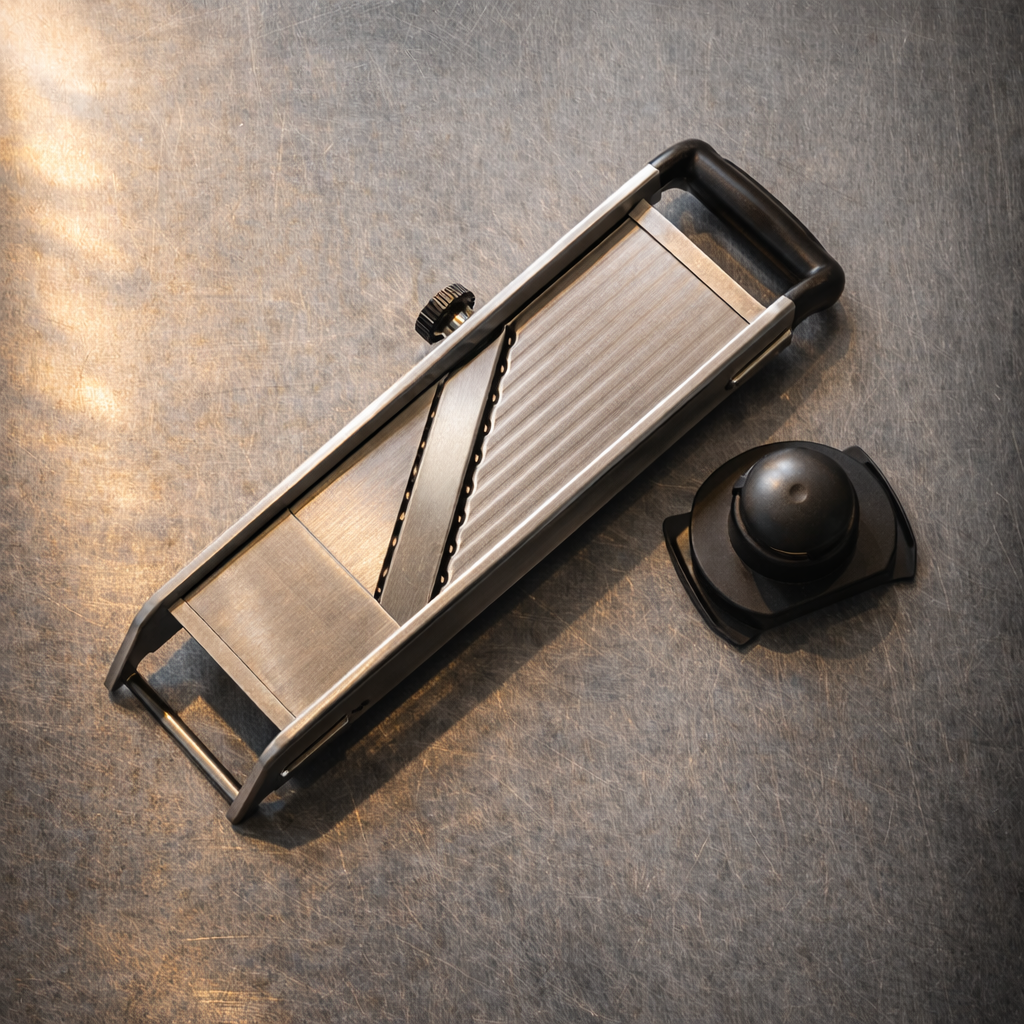
Among kitchen instruments, the mandoline occupies a unique position. Where knives rely on hand movement, the mandoline fixes the blade in place and moves the ingredient instead. This reversal of motion allows the cook to produce slices of extraordinary precision and consistency. A well-adjusted mandoline can transform a potato into perfectly even gratin slices, turn carrots into delicate julienne, or produce translucent ribbons of cucumber within seconds.
It is a tool of mechanical precision and repetition. But this precision comes with a cost. Because the blade remains exposed and extremely sharp, the mandoline demands concentration and discipline from the cook. Used well, it becomes one of the fastest and most elegant cutting instruments in the kitchen. Used carelessly, it can cause serious injury.
The Function
The mandoline exists to produce uniform cuts with speed and accuracy. Its main advantages are:
• perfectly consistent slice thickness
• rapid preparation of large quantities
• precise julienne and decorative cuts
• clean, repeatable geometry
This consistency is particularly valuable for preparations where even thickness affects cooking behavior. Examples include:
• potato gratin
• vegetable chips
• pickled vegetables
• shaved salads
The mandoline transforms irregular ingredients into precise, repeatable forms.
The Geometry
Although mandolines share the same principle, their design can vary considerably. High-end mandolines often feature heavy construction, precise adjustment systems, and extremely sharp blades. They are designed for kitchens where the instrument is used daily for large-scale preparation.
Fixed Blade Mandolines
These models contain a single fixed slicing blade with an adjustable platform that controls slice thickness. They are simple, reliable, and often preferred for everyday kitchen work.
Mandolines with Interchangeable Blades
Many mandolines include removable blade inserts that allow additional cutting styles. Common attachments include:
• julienne blades
• waffle-cut blades
• shredding blades
These attachments greatly expand the instrument's creative possibilities.
Materials
Mandolines are typically constructed from stainless steel, reinforced plastics, or combinations of both. More important than the material itself is the instrument's structural stability. A well-designed mandoline should feel rigid and secure when in use. Weak hinges, unstable frames, or poorly fitted components can create dangerous situations during slicing. Instruments intended for frequent use should prioritize durability and stability over convenience.
Ergonomics
Several factors influence how safely and comfortably a mandoline can be used.
Stability
The instrument must remain stable during cutting. Many mandolines include fold-out stands or rubber feet that help anchor the instrument on the work surface. If the mandoline shifts during slicing, the risk of injury increases significantly.
Visibility
Good lighting and clear visibility are essential. Because the blade is fixed and extremely sharp, the cook must remain aware of the distance between the fingers and the cutting surface at all times.
Blade Exposure
As the ingredient decreases in size during slicing, the distance between the hand and the blade decreases.
For this reason, many mandolines include hand guards or gripping adapters that hold the ingredient safely during the final cuts.
Choosing the Tool
Selecting a mandoline depends largely on how frequently it will be used.
Occasional use
A simple, reliable mandoline with basic slicing adjustment may be sufficient for occasional garnishes or salads.
Frequent kitchen work
Professional kitchens benefit from sturdier mandolines designed for continuous use and larger quantities.
When choosing a mandoline, several qualities are essential:
• strong structural stability
• sharp and replaceable blades
• reliable thickness adjustment
• well-designed attachments that fit securely
Reading reviews and speaking with other cooks can be valuable when selecting a dependable model.
Common Misconceptions
One misconception is that mandolines are primarily tools for making salads. In reality, they are precision cutting instruments capable of producing a wide variety of preparations. Another misunderstanding involves safety. Because mandolines appear simple, many cooks underestimate the level of attention they require. Distraction, wet ingredients, or excessive speed can easily lead to injury. Working carefully and deliberately is essential.
Closing Reflection
The mandoline changes the relationship between the cook and the cut. Instead of guiding a blade through the ingredient, the cook guides the ingredient across a fixed blade. The result is speed, precision, and remarkable consistency. Used carefully, it opens a world of visual and culinary possibilities. Vegetables can be transformed into ribbons, paper-thin slices, or delicate lattices. It is not merely a tool for slicing. It is an instrument for shaping ingredients with geometry and intention.