The Paring Knife
An Extension of the Thumb
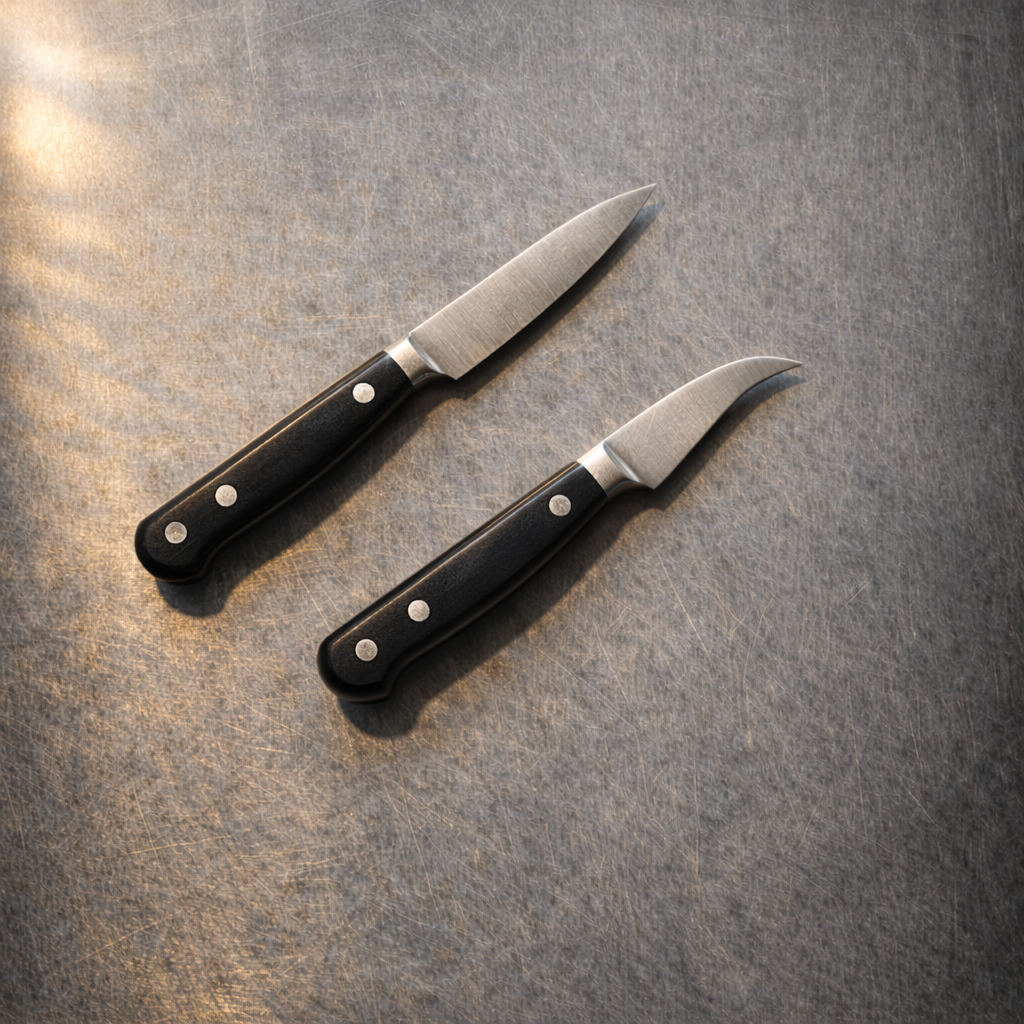
In the hierarchy of the professional kitchen, the chef’s knife is the instrument of scale. It handles production, volume, and repetition. It moves quickly across the board, reducing ingredients into usable form. The paring knife operates in a different register. Where the chef’s knife works with the arm and shoulder, the paring knife works with the fingers. It is not a knife for production but for intimacy. It is the instrument that brings the cook closest to the ingredient.
Peeling a potato, removing the eye from a strawberry, cleaning the ribs of a mushroom, and trimming the silver skin from a small piece of meat. These are not gestures of force but gestures of control. Often, the ingredient never touches the board. It is held in the hand, turned slowly, examined, and corrected. For this reason, the paring knife behaves less like a small chef’s knife and more like a scalpel. The paring knife acts as a mechanical extension of the thumb’s opposable power.
The Function
The paring knife is the instrument of precision preparation. It excels at tasks that require control rather than power. While larger knives shape ingredients in broad movements, the paring knife refines them. Typical uses include:
• peeling fruits and vegetables
• trimming small cuts of meat or fish
• removing blemishes from produce
• coring apples or tomatoes
• shaping garnishes and decorative cuts
In this sense, the paring knife is not the knife of transformation but the knife of correction and refinement.
The Geometry
The personality of a paring knife is defined largely by its blade profile. Although many variations exist, three forms dominate professional kitchens.
Spear Point — The Generalist
This is the most common profile. The blade curves gently toward a centered tip. It allows small board work but is particularly suited to in-hand tasks such as peeling or coring. For most cooks, this is the most versatile and practical paring knife.
Sheep’s Foot — The Precision Tool
The sheep’s foot profile features a straight cutting edge and a spine that curves down toward the tip. This geometry allows maximum contact with the board and offers exceptional control for delicate slicing tasks such as trimming shallots or garlic.
Bird’s Beak — The Peeler
Often called a tourné knife, this blade curves inward like a claw. The curved edge allows the knife to follow the contour of round ingredients with minimal waste, making it ideal for peeling apples, shaping vegetables, or hulling tomatos.
Materials
The steel used in a paring knife influences both maintenance and performance.
Stainless Steel — The Workhorse
Stainless steels contain chromium, which protects the blade from corrosion.
Advantages include:
• resistance to rust
• tolerance to acidic ingredients
• lower maintenance requirements
These characteristics make stainless steel ideal for busy kitchens.
High-Carbon Steel — The Purist’s Choice
Carbon steels can take extremely fine edges and often provide exceptional cutting feedback.
Advantages include:
• sharper potential edge
• excellent edge retention
• satisfying cutting feel
However, they require attentive care. Carbon steel reacts to acidic ingredients and can rust if left wet or neglected.
Ergonomics
Unlike a chef’s knife, which is typically held using a pinch grip, the paring knife is often held entirely in the hand. Because of this, comfort and balance become particularly important.
Bolster
A large bolster can prevent proper sharpening along the entire length of the blade. Ideally, the blade should taper smoothly into the handle.
Tang
A full tang, where the steel runs through the entire handle, generally improves balance and durability.
Handle Materials
Professional kitchens demand handle materials that tolerate frequent washing and temperature changes. Materials such as micarta, texturized steel, or composite polymers offer durability while maintaining good grip.
Choosing the Tool
When selecting a paring knife, three factors matter most.
Blade length
Most paring knives measure between 7 and 10 cm (3–4 inches). This size provides precision without sacrificing versatility.
Blade profile
For general use, the spear point profile offers the best balance of versatility and control.
Comfort
Because the knife is used for repetitive tasks, the handle should feel natural and balanced in the hand. A well-designed paring knife quickly disappears into the cook’s grip.
Common Misconceptions
One common misunderstanding is that the paring knife is simply a smaller version of the chef’s knife. In reality, it serves a different role entirely. Another frequent mistake is using the paring knife for tasks that belong to larger knives, such as slicing large vegetables on the board. While possible, it is inefficient and increases the risk of poor cutting technique. Finally, many cooks confuse honing with sharpening. Honing realigns the edge, while sharpening removes metal to recreate the cutting edge itself. Because the blade is small and used frequently, a paring knife benefits greatly from regular, proper sharpening.
Closing Reflection
Tools reveal the habits of the cook who uses them. The chef’s knife speaks of rhythm and production. The paring knife speaks of patience and attention. It is the knife used when the cook’s hands move closest to the ingredient. Used thoughtfully, it becomes exactly what it should be: an extension of the hand itself.