The Whisk
The Instrument of Movement
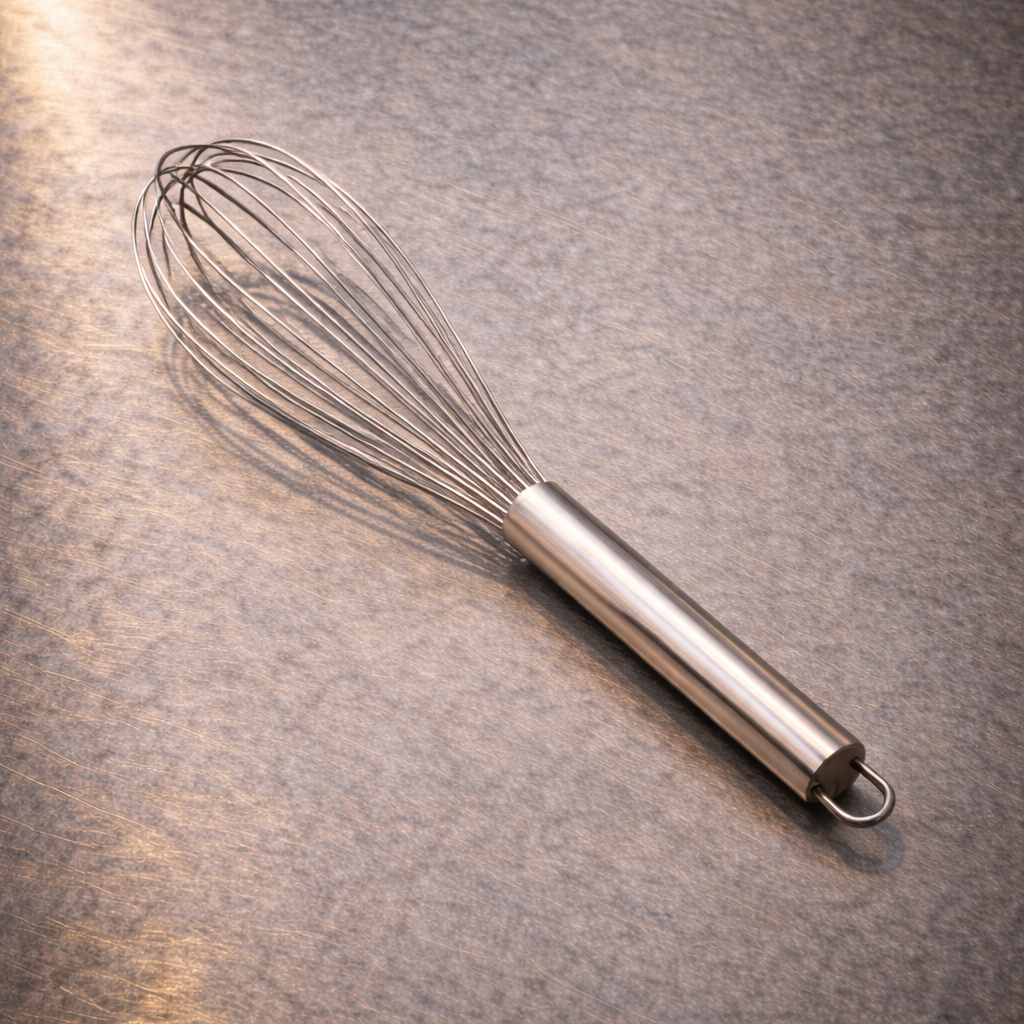
Among kitchen instruments, the whisk is unique. It does not cut, hold, or contain ingredients. Instead, it creates movement within them. Through repeated motion, liquids combine, emulsions stabilize, and air becomes incorporated into mixtures. The whisk turns still ingredients into dynamic systems. Oil disperses into vinegar, eggs capture air, and sauces thicken through constant agitation. In this way, the whisk is less about the object itself and more about the pattern of movement it generates.
Function
The primary role of the whisk is to move ingredients rapidly and evenly. By agitating a mixture, the whisk allows components to disperse into one another. Depending on the technique used, the whisk can achieve several effects.
Stirring
Gentle circular movement keeps ingredients evenly distributed during cooking, especially in sauces.
Emulsifying
Rapid motion breaks fat into tiny droplets that disperse throughout a liquid, forming stable emulsions such as vinaigrettes or mayonnaise.
Beating
More vigorous whisking incorporates air into mixtures such as eggs or creams.
Aerating
Certain preparations require the whisk to trap air inside a structure, creating lighter textures. The effectiveness of these movements depends greatly on the whisk's design.
Geometry
The shape and wire structure of a whisk determine how it moves through a mixture.
Balloon Whisk
Balloon whisks have widely spaced wires that form a rounded shape. This design maximizes air incorporation and is commonly used for whipping eggs, cream, or batters.
Compact Whisk
More compact whisks have tighter wire spacing and a narrower profile. These are often used for sauces that require controlled mixing without excessive splashing.
Wire Thickness
Wire thickness also influences performance. Thin wires move quickly and incorporate air easily, making them ideal for light mixtures. Thicker wires provide greater strength and are better suited for thicker mixtures or heavy sauces.
Mini Whisk
Small whisks are often used for quick mixing tasks, such as combining dressings or emulsifying small quantities of ingredients. Many cooks keep a mini whisk within easy reach during service.
Materials
The whisk's material affects durability and heat resistance.
Stainless Steel
Stainless steel whisks are the most versatile and durable. They tolerate high heat and are easy to clean, making them common in professional kitchens.
Silicone-Coated Whisks
Silicone-coated wires are designed to protect delicate cookware surfaces such as nonstick pans. However, they may not withstand the same level of heavy use as steel whisks.
Nylon
Some whisks incorporate nylon components for similar protective purposes, though they are generally less heat-resistant.
Ergonomics
A whisk must be comfortable to move quickly and repeatedly.
Weight
Whisks should remain light enough for rapid movement. Heavy whisks slow down aeration and increase fatigue during extended whisking.
Handle Design
Handles should allow a secure grip even when the cook’s hands are wet or greasy.
Storage
Some whisks are delicate enough to be stored hanging to preserve their shape. Others are robust enough to be kept in drawers or utensil containers. Once a whisk’s wires become bent or distorted, it loses much of its effectiveness.
Choosing the Tool
Choosing the correct whisk depends on the task. Try to consider:
• the viscosity of the mixture
• the desired level of aeration
• the heat environment in which it will be used
• the volume of the preparation
Pastry kitchens often favor lighter balloon whisks for aeration, while cooking environments may require sturdier whisks that can handle thicker sauces.
Common Misconceptions
A common misconception is that any whisk can perform all whisking tasks. In reality, the geometry of the whisk strongly influences its behavior. A whisk designed for whipping egg whites may perform poorly when stirring a thick sauce, while a compact sauce whisk may incorporate very little air. Selecting the correct whisk improves both efficiency and control.
Closing Reflection
The whisk represents one of the most subtle instruments in the kitchen. Rather than applying force, it relies on rhythm and motion. Through repeated mixing, it organizes ingredients into stable structures, such as emulsions, foams, or smooth mixtures. In the hands of the cook, the whisk becomes less an object and more a gesture: a circular motion that brings ingredients into harmony.
Related Instruments
Mixing Bowl
Spoon
Spatula
Tongs
Cutting Board