The Blender
The Mechanics of Texture and Emulsion
In many kitchens, the blender represents the moment when ingredients undergo radical transformation. Solid foods become liquids. Fibrous vegetables turn into smooth purées. Oils and liquids combine into emulsions that would otherwise separate.
Unlike a mortar and pestle or a grinder, which rely on crushing or grinding, the blender operates through high-speed shearing forces. Rotating blades move ingredients rapidly, cutting them into microscopic particles and dispersing them evenly throughout a liquid base. This process produces textures that are often impossibly smooth when compared with manual methods. For this reason, the blender has become one of the most versatile tools for transformation in modern kitchens.
Function
The primary function of the blender is liquefaction and homogenization. By rapidly rotating blades within a container, the blender breaks ingredients into extremely small particles and distributes them evenly through a mixture. This allows the blender to perform several important transformations:
• liquefying fruits and vegetables
• producing smooth purées
• emulsifying sauces
• aerating liquids
• integrating ingredients into uniform mixtures
Blenders are particularly effective when ingredients are combined with liquid, allowing particles to circulate continuously around the blades.
Liquefaction
One of the defining abilities of the blender is its capacity to turn solids into liquids. Fruits, vegetables, nuts, and cooked ingredients can be transformed into soups, smoothies, sauces, or creams. The speed of the blades reduces particle size rapidly until the mixture becomes fluid and uniform. This process is often referred to as liquefying.
Emulsification
Blenders are also powerful tools for creating emulsions. An emulsion occurs when two ingredients that normally separate, such as oil and water, become suspended together in a stable mixture. The high-speed movement of the blades breaks oil into tiny droplets that disperse evenly throughout the liquid. This allows cooks to create preparations such as:
• mayonnaise
• aioli
• vinaigrettes
• emulsified sauces
Immersion blenders are especially popular for this purpose because they can be used directly inside a container or pot.
Geometry
Blenders appear in several forms depending on the scale of the preparation.
Countertop Blenders
Countertop blenders consist of a fixed motor base with a removable blending jar. These devices can produce extremely smooth purées and liquids and are often used for soups, sauces, smoothies, and emulsions. High-speed professional models can generate extremely fine textures.
Immersion Blenders
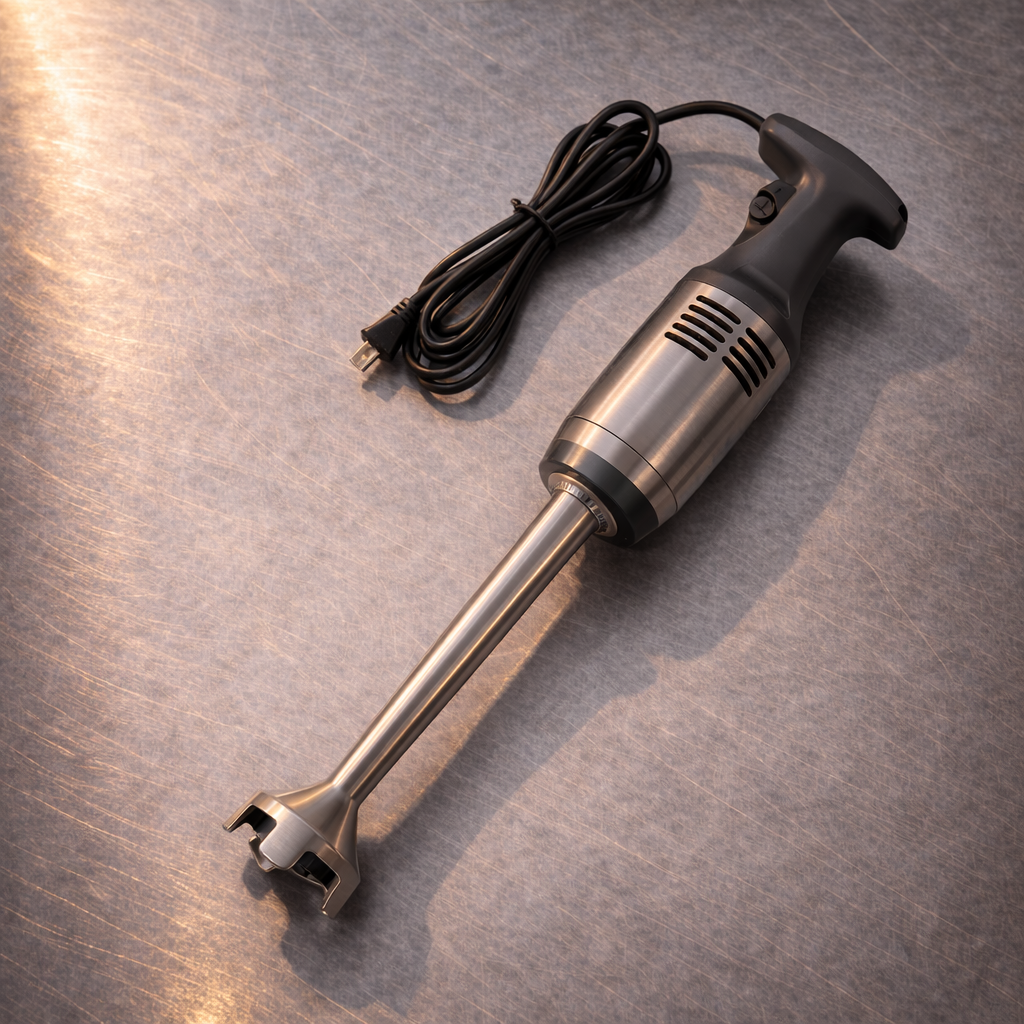
Immersion blenders, also known as hand blenders, are handheld devices with a rotating blade at the end of a shaft. They allow cooks to blend ingredients directly inside pots, bowls, or containers. This makes them particularly useful for quickly emulsifying sauces or puréeing soups without transferring ingredients to another vessel.
Commercial Immersion Blenders
Large professional immersion blenders are used in restaurant kitchens and food production environments. These powerful devices can process large volumes of soups, sauces, or purées directly in cooking vessels.
Blades and Motor Power
The performance of a blender depends largely on two factors:
• blade design
• motor strength
Different blade shapes influence how ingredients circulate and break down. Some blades are optimized for liquefying ingredients, while others are designed for thicker mixtures such as nut butters or dense purées. Motor power determines how efficiently the blender can process heavy ingredients and how long it can operate without overheating.
Heat Generation
Because blenders operate at very high speeds, friction can generate heat within the mixture. In some preparations, this heat is undesirable because it may alter delicate flavors or aromas. In other situations, heat can actually assist the blending process by softening ingredients and releasing oils. Understanding how a blender affects temperature helps cooks choose the appropriate equipment and blending time.
Choosing the Tool
Different blending tasks require different types of blenders. Immersion blenders are ideal for quick emulsifications and blending directly in cooking vessels. Countertop blenders are better suited for producing extremely smooth purées or large quantities of liquids. Professional kitchens often use several types of blenders depending on the texture and volume required. Selecting the correct machine depends on the desired texture, ingredient density, and production volume.
Common Misconceptions
One misconception is that all blenders produce identical textures. In reality, blade design, motor power, and container geometry significantly influence the final result. Another misunderstanding is that blenders can replace every other grinding or crushing tool. While they excel at liquefying and emulsifying, some textures are better produced through slower mechanical methods such as grinding or crushing.
Closing Reflection
The blender represents one of the most powerful transformation tools in modern cooking. Through rapid motion and mechanical energy, it converts solids into liquids, disperses oils into emulsions, and produces textures that would be nearly impossible to achieve manually. In doing so, the blender expands the range of textures and consistencies available to the cook. It transforms ingredients not only in form, but in possibility.
Related Instruments
Mortar & Pestle
Grinder
Sieve & Strainer
Whisk